Arty Froushan’s got another show this evening, and he’s trying not to think too hard about it.
The half-English, half-Iranian actor is speaking with The Hollywood Reporter on Zoom in early March, gearing up for the final weeks of Rupert Goold‘s American Psycho revival at the Almeida Theatre in London, where it first drew blood in 2013.
Back then, in the musical adaptation of Bret Easton Ellis‘ best-seller — with music and lyrics by Duncan Sheik and a book by Roberto Aguirre-Sacasa — Doctor Who star Matt Smith took on New York yuppie and increasingly maniacal investment banker Patrick Bateman. In the Broadway transfer, Benjamin Walker took up the post. Froushan, of Daredevil, House of the Dragon and Downton Abbey: The Grand Finale fame, is now putting his own spin on the dapper serial killer.
“Inevitably, I was inspired by the film. His voice is so iconic, and it was impossible for me to get that out of my head. I think that does bleed into my performance a bit,” he says of Mary Harron’s 2000 cult classic with Christian Bale. “[But] Rupert, the director, kept encouraging me to find my Bateman, you know? To find the common ground that I felt with the character, which is always a slightly scary thing — to find common ground with Patrick Bateman,” he laughs.
But, pulling from his own experience growing up at a well-to-do London school, Froushan tapped into that same sense of wanting to be like everyone else. “When I was a kid, I tried everything I could to squash myself into a more standardized, acceptable box,” he says. “I’m not saying I had an incredibly difficult time in doing that, but it was something that I was grappling with on some deeper level, trying to fit in and blend into the demographics of my surroundings.”
And whether it’s a compliment or not, Froushan is a perfect Bateman in the nearly three-hour, meticulously choreographed show at the Almeida. What starts as a comical galavant into the world of pretentious Wall Street workers and their respective partners — who sing about their ultra-trendy lunch orders at upscale restaurants and favorite designer brands over flutes of champagne — slowly descends into existential crisis for its protagonist. He begins dabbling in cold-blooded murder.
His mental decline is backdropped by music that transcends genres. Synth-pop and techno are whisked in with icons of the late ’80s, such as Tears for Fears’ “Everybody Wants to Rule the World,” Phil Collins’ “In the Air Tonight,” and, of course, some Huey Lewis. The end product is a frenetic yet clinical, retro show set on the precipice of ’90s New York City — deliciously camp and jarringly nostalgic, especially when Bateman dons his signature Walkman.
Analyzing the character with THR, a bespectacled, articulate Froushan is a world away from when we last saw him, coated in sweat and wielding an axe. He’s given his all to American Psycho, and is looking forward to some respite come show-closer on Mar. 21 (it’s sold out until then). “People keep asking me, ‘Is this the beginning of a great musical career?’ And I just immediately say no — not because I don’t love it, but because it requires a monkish discipline that I don’t know if I have that in me,” he says about nailing his first professional musical.
That’s not to say Froushan hasn’t adored that juiced-up flow state he and his fellow cast members reach during American Psycho‘s catchy dance numbers. But the same sentiment rings true for performers as much as their audience: It’s not for the faint-hearted. Below, one of London’s brightest theater talents cracks open the disturbing psyche of Patrick Bateman, getting paid a visit by the production’s previous yuppies (a group that includes Jonathan Bailey), and the possibility of taking this iteration of Goold’s critically-acclaimed musical back to New York: “It’s such a privilege to get to play a part as substantial and multidimensional as this. So to turn my nose up at doing it for longer would be hard, you know? But like I say, it takes something out of my soul.”
You must be loving the reaction so far. How have you found it?
It’s been great. It’s been amazing to be in a show that I think, first and foremost, is just really fun to watch. I think that’s the main takeaway that people have, that it’s sort of a theme park ride. It’s not a hard sell — even [for] people that I thought might be squeamish about it, or maybe it wouldn’t be their cup of tea. People have just been really positive and enthusiastic about it. It’s also, maybe, surprised people how slightly deeper the show is than it first seems early on. It goes somewhere that’s a bit darker and a bit more interesting than you’d expect, which is cool as well.

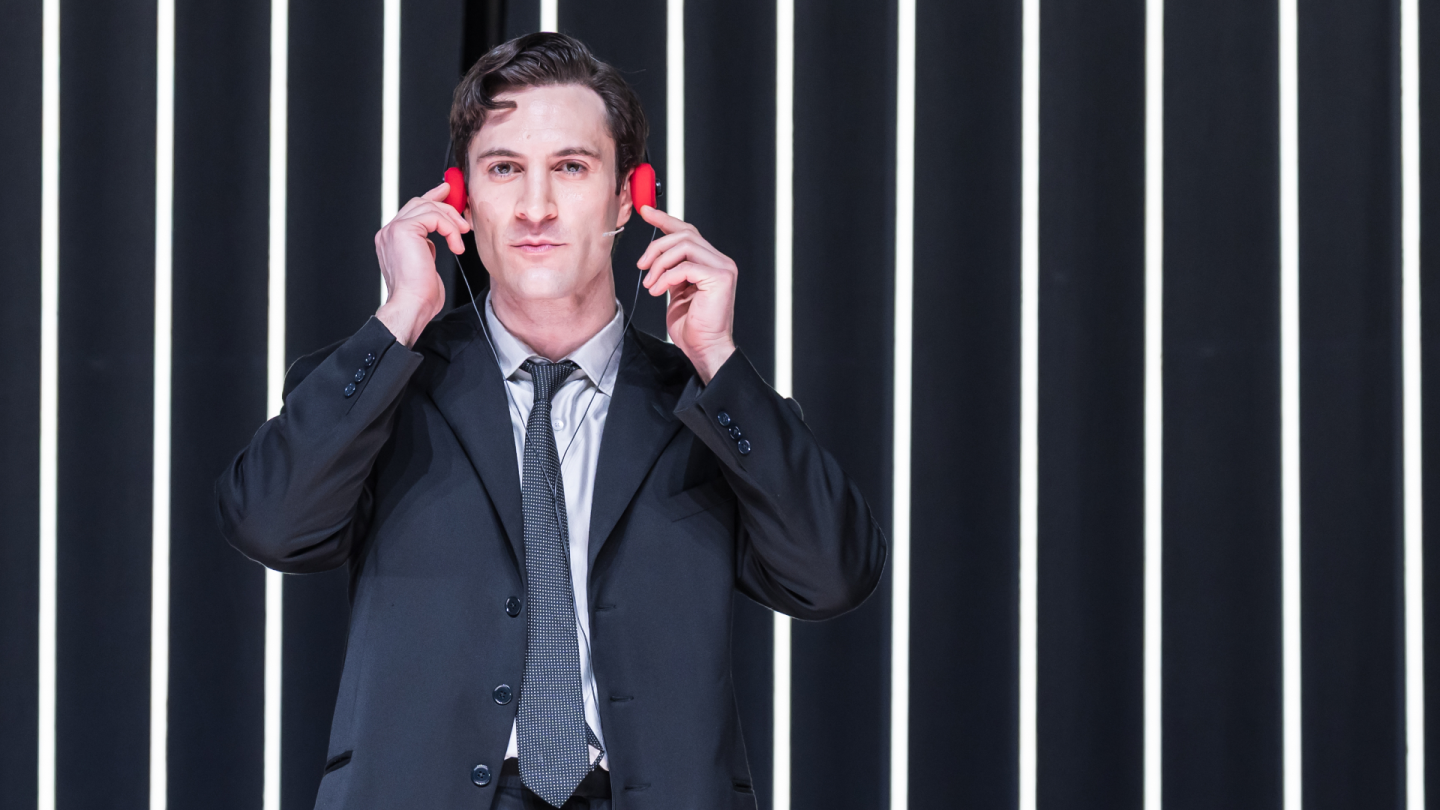
American Psycho at London’s Almeida Theatre.
Photographer: Marc Brenner
It seems pretty loyal to the book — disclaimer: not that I’ve read it. Have you? How much of a fan of American Psycho were you before this opportunity came into your life?
I was a huge fan of American Psycho. I didn’t shout about it because I feel like it’s a sort of token, slightly basic, masculine aspiration. [Laughs.] I don’t think I liked it for the right reasons to be honest with you. I dressed as Patrick Bateman for Halloween one year, and I regret that massively. But I hadn’t read the book until I got the job, and I stopped watching the movie the second I got it. I was tempted to watch it again, of course, but I thought, no, let’s put that away. Try and build something new, or at least [that] draws directly from the source material of the book, rather than the Christian Bale portrayal.
The book is the most shocking thing I’ve ever read, easily. But what I found in reading it is that he’s basically barely keeping it together for the whole thing. He starts the story [and] he’s already incredibly paranoid and on edge. There’s always a bead of sweat running down his forehead. I feel like that does come through in the film, but the way that the musical script ended up being written, it’s this Frankenstein version of the original Almeida production and the Broadway script, which they did like 10 years ago now. It’s the best of both worlds, what Rupert and Roberto and Duncan have created, but it brings out a lot more of the vulnerability and insecurity of the character [rather] than just the cold, reptilian killer that people think of when they think of Patrick Bateman. I thought that was a more interesting take than the straightforward psycho kind.
I think a lot of people will be going into this having only watched the film.
Of course, inevitably, I was inspired by the film. I couldn’t not be. I have watched it seven or eight times, probably just of my own volition. [Bale’s] voice, for example, is so iconic, and it was impossible for me to get that out of my head. And I think that does bleed into my performance a bit. Rupert, the director, kept encouraging me to find my Bateman, you know? To find the common ground that I felt with the character, which is always a slightly scary thing — to find common ground with Patrick Bateman. [Laughs.] But there was a lot when I looked into it, and I think there are universal things that he’s grappling with. But the way he grapples with them is sort of in an outlandish, insane way.
What did you find you had in common with him? Where was an entry point for you?
Well, in the musical scripts, he says, “I wish to fit in” at the birthday party. It’s a very unusual moment, because he’s full of bluster, trying to show off to Paul Owen, his nemesis, and come across as this incredibly alpha, very put-together guy. But then he makes this admission quite early on in the show that his wish is to fit in. So the desire to belong and to fit in, but also to stand apart and excel. They’re contradicting things, but I think I can relate to that. Not to be too melodramatic about it, but I grew up in southwest London. My mother is very English. I went to a very academic school where most people were called Johnny Walker and George Williams and those kinds of names. And my father’s from Iran. So I have this ridiculous name: Artemas Bolour-Froushan. When I was a kid, I tried everything I could to squash myself into a more standardized, acceptable box. I’m not saying I had an incredibly difficult time in doing that, but it was something that I was grappling with on some deeper level, trying to fit in and blend into the demographics of my surroundings.
But then, also, I’ve always wanted to go beyond that and strike out on my own path. [I’ve wanted to] increasingly celebrate and foreground certain aspects of my background and my character and my passions as an artist as opposed to shying away from them — to push them out into the open. And I think Patrick’s version of that is wanting to inflict violence and pain on the world, but it comes from a place of pain within him.
Had you seen the previous productions at the Almeida or on Broadway?
No, no. I think I was at uni in 2013 when Matt Smith did it. So my head was quite far up my ass at that point. [Laughs.] And then, [when it was] on Broadway, I was at drama school. To be honest, embarrassingly, when this audition came up last year, I was kind of like, “Oh, there’s a musical of American Psycho?” I had no idea, basically. So it was a completely novel thing to learn about. But if you know anything about the theater scene… I mean, those who know were like, “That was an iconic production.” It was crazy to be drafted into the whole buzz of the revival.
What was the audition process like? At what point did you start to feel confident?
It was a conventional self-tape. I was filming in New York at the time. It was last June or July. A long time ago. I did a tape, I saw American Psycho, and my heart jumped. Then I saw “Musical,” and I thought, ‘It’s never going to happen.’ I’ve never done a professional musical before. I did a musical at [the London Academy of Music and Dramatic Art] and at university, but I’ve never put that on my calling card as an actor. I thought, ‘If this were a straight play, I’d absolutely love to do it.’ I think my agent said, “I think you’d make a great Bateman,” which is sort of a backhanded compliment. [Laughs.] I thought, ‘You know what? I’ll just give it a go and see what happens.’ To be honest, all the jobs that I’ve got have been shots in the dark that felt really unlikely. And then, strangely, they’re the ones that stick. But I did the opening monologue, the famous morning routine…
It was so good.
Thank you. That’s so kind. And then, the scene with the detective, where the detective is cross-examining him about killing Paul Owen. Just from the movie, I thought, ‘I can do my spin on those.’ And then I sang a Duran Duran song, just to be like, “Yeah, look, I can hold a tune.” And then it wasn’t for another month or five weeks, until I came back to London, that I was able to meet with Rupert and everyone.
[At the callbacks] there were all these dancers in their leotards and jazz shoes. I was there in a corduroy suit, auditioning on my own for Patrick. And I was like, “Oh, I don’t know what they’re here for. They must be here for something else.” And they were all there for American Psycho. [Laughs.] And I suddenly was like, “Oh, shit, this isn’t a play with songs. This is a full-blown musical.” So that was quite sobering… The whole process took about four and a half months, and I only got the part about two and a half weeks before we started rehearsing. It was suddenly all hands on deck. [I had] dancing classes. They paired me with this amazing singing teacher called Mary Hammond, who has taught Chris Martin and Yungblud and all sorts of amazing people. She whipped me into shape in a couple of weeks, and then it was just pedal to the metal.
You wouldn’t be able to tell that the musicality was a pinch point for you at all — was that what you found most daunting?
Absolutely. As I was preparing in rehearsal, I thought what I can definitely do is just digest [the text]. Because there’s a lot of monologue. It’s a conventional play but it has these wonderful songs in it. [The text] was my comfort zone. But then, yeah, doing the choreography… Lynne Page, the choreographer who’s just been nominated, very deservedly, for an Olivier for the show, was devising it as we went. Which was fun, but I was also like, “Please tell me what the choreography is! I need to learn it so that it’s in my muscles by the time we open!” But it was all like, “Scrap that, let’s try this.” It was pretty late in the day that things really crystallized. So that was quite unnerving. And similarly, musically, I didn’t get around to doing that final number, “This Is Not an Exit,” until about two weeks before we opened for previews. I just had to trust that Rupert knew what he was doing. And obviously, he does. So it was fine.
American Psycho
Photographer: Marc Brenner
Has it been empowering to add that string to your bow?
It’s a great feather in my cap. People keep asking me, “Is this the beginning of a great musical career?” And I just immediately say no — not because I don’t love it, but because it requires a monkish discipline that I don’t know if I have in me. I mean, Patrick Bateman in [the] American Psycho musical is a particularly substantial role. I don’t leave the stage for nearly three hours. Not all musicals will be as demanding as that. It’s the sustained focus that is so demanding I find, but I love when a musical is good. When you’re in the groove with an amazing cast of triple threats… There is nothing better when we’re in the middle of a number and we’re all just cooking. It’s an amazing feeling. But you can’t really drink or have a social life. It’s been good and healthy for me to just be disciplined and focus on work for a bit. But I do miss my life, and it’s just on pause. I can’t really do anything other than the show at the moment, and conventional theater is a bit more forgiving on that front.
What do you to compress after a show? Straight home?
It’s usually straight home. One of the great delights, but also slight annoyances of doing a show as popular as American Psycho, [is] that family, friends, everyone wants to see it. So every single night there’s usually a minimum of five people from completely different walks of life who come to the show. I always end up being this weird, compère [or] host of [introducing them]. It’s my mum’s friend from university 30 years ago and then a guy I went to primary school with. It’s the last thing I want to do after a show. [Laughs.] But usually there’s a bit of socializing in the bar afterwards and then I cycle home. I need to eat a second dinner because I burn an ungodly amount of calories doing a show. And then I’ve been alternating between David Lynch films to chill out — which is sort of dreamlike, but also quite nightmarish, I think that’s what Patrick would watch — and Love Is Blind. I just need to put my brain in a pickle jar for an hour and watch people talking about whether they should get married. People who live in Ohio or something.
The show is sold out now until the end of its run. There’s no possibility it would go to the West End?
I don’t know. There’s certainly a possibility that’s not been formally discussed, but I know that Es Devlin, our designer, who is amazing, was talking about wanting to take it to New York in some capacity. It had a slightly ill-fated run on Broadway last time it was there. But I think that was quite a different show. It was a bit more broad, a bit more camp. This version has a bit more, maybe, gravitas, and is more in tune with current events. I feel like it’s slightly more meaningful in this moment that we’re in. She [Devlin] thinks that New York would be a good home for it. I’m open to anything, obviously, at all times, but it’s not an easy thing to accept — doing a longer run of this show. It really does take it out of me.
Is it something you’d really have to think about?
Yeah, I don’t know. I really can’t comment on that, but it’s such a privilege to get to play a part as substantial and multidimensional as this. So to turn my nose up at doing it for longer would be hard, you know? But like I say, it takes something out of my soul.
Do you have a favorite sequence in the entire show?
It’s so hard to choose, because so much of it is a delight to play. In terms of the musical numbers, “Killing Spree,” the big number at the beginning of Act Two [when] Patrick’s just on a rampage, stabbing people in the club and shooting up dance floors and having these really funny phone conversations interspersed with the number, that’s so fun. The big techno end of that number, you can feel [the audience’s] eyes widening as it climaxes. Then the other horror number where I drill someone’s head. You’re playing this game with the audience [where] they’re sort of leaning in and laughing and having fun, and then they’re reeling. They’re leaning in and out constantly during the show, which is quite an interesting experience as an actor, to feel them push and pull like that. But those numbers, you feel them caught in this half-space between loving it and being horrified by it.
It got really gruesome. Maybe because I haven’t read the book, so I don’t know how horrifying it is.
The book makes the musical look like the Disney Channel.
Have you learned anything about Patrick Bateman that’s really surprised you, or challenged any of your preconceptions about American Psycho?
Definitely. I always knew it was funny — it’s not a straight horror film, is it? There’s a black comedy element to it. And I understood that it was a satire on capitalism, but I didn’t quite understand the more philosophical dimension of it, of a man who’s grappling with existence in the modern world. And that’s not just capitalism, it’s also modernity in a slightly larger sense, and the hollowness and emptiness of that. What it means to exist, and what one’s identity is, and how you can prove your realness. Patrick’s trying to explain to people who he truly is, and people are always misconstruing him. That schism is something that I think tortures Patrick… It reminded me, and I hope it reminds other people when they see the show, that American Psycho is not a glamorization of a handsome man killing women for fun. It’s a satire of that toxic version of masculinity and the society that has created that toxicity.
Have you spotted any celebrities who’ve come to see the show?
Because it’s my job as Patrick to address the audience directly, people are always like, “Did you see me?” and I’m like, “Yeah, of course I saw. I’m literally shining a torch in your face. I can see everyone in the whole audience.” So it’s usually quite quick that I pick up on famous faces. Press night was fun. We had Gina McKee, a wonderful actor, and Matthew Needham, [who] I worked with briefly on House of the Dragon, a wonderful actor as well.
Then we had most of the boys from the original production come in. So we had [Jonathan] Bailey, Hugh Skinner and Ben Aldridge. I think that for them, that was a very surreal experience seeing this. It’s very nostalgic, and it’s a very formative show for them, because that was before all of them had their very glittering careers. And I think they all kind of fell in love with each other during that show, as our cast is doing currently. And then we had Dave Bautista, the big Marvel actor [and] wrestler, just pop up the other day. Some cool directors. The Almeida is great like that. People want to come and see theater there, because it feels… I don’t want to say exclusive, but it feels a bit special.
Arty Froushan as Noël Coward (center) in ‘Downton Abbey: The Grand Finale.’
Rory Mulvey / © Focus Features / Courtesy Everett Collection
You’re dabbling in film, TV and theater right now. Are you positioning yourself for any one format, primarily?
You know, my heart is with theater. As an actor, you want to constantly cycle between all the mediums. I love making movies. TV is obviously really fun, and theater has its own unique magic. Having just done six months of theater back-to-back, six days a week, eight shows a week… I am very ready to be on a cushy film set [being] brought ginger tea and treated like a prince. [Laughs.] Obviously, my tongue is in my cheek there. But I would love to make a movie next. I’m going to be filming some of season three of Daredevil, which is the Marvel series I’ve been doing on and off. That’ll be coming up in spring.
I’m mainly auditioning and up for film stuff at the moment. I did an independent film called The Persian Version like three years ago. But it wasn’t until Downton Abbey, only 18 months ago, that I did my first proper studio film. And it is a different experience from doing television. People are slightly more artistically invested. It’s more collaborative. You feel like you’re involved in the creation of something, rather than someone brought on at the end to just dot the I’s and cross the T’s. I think I did that the right way around… So I’ve loved making films, and that’s my main interest at the moment. But as ever, I’m open to anything, and I think this industry throws up the most bizarre and delightful surprises if you just stay open to them.
American Psycho runs at the Almeida Theatre until Mar. 21, 2026.