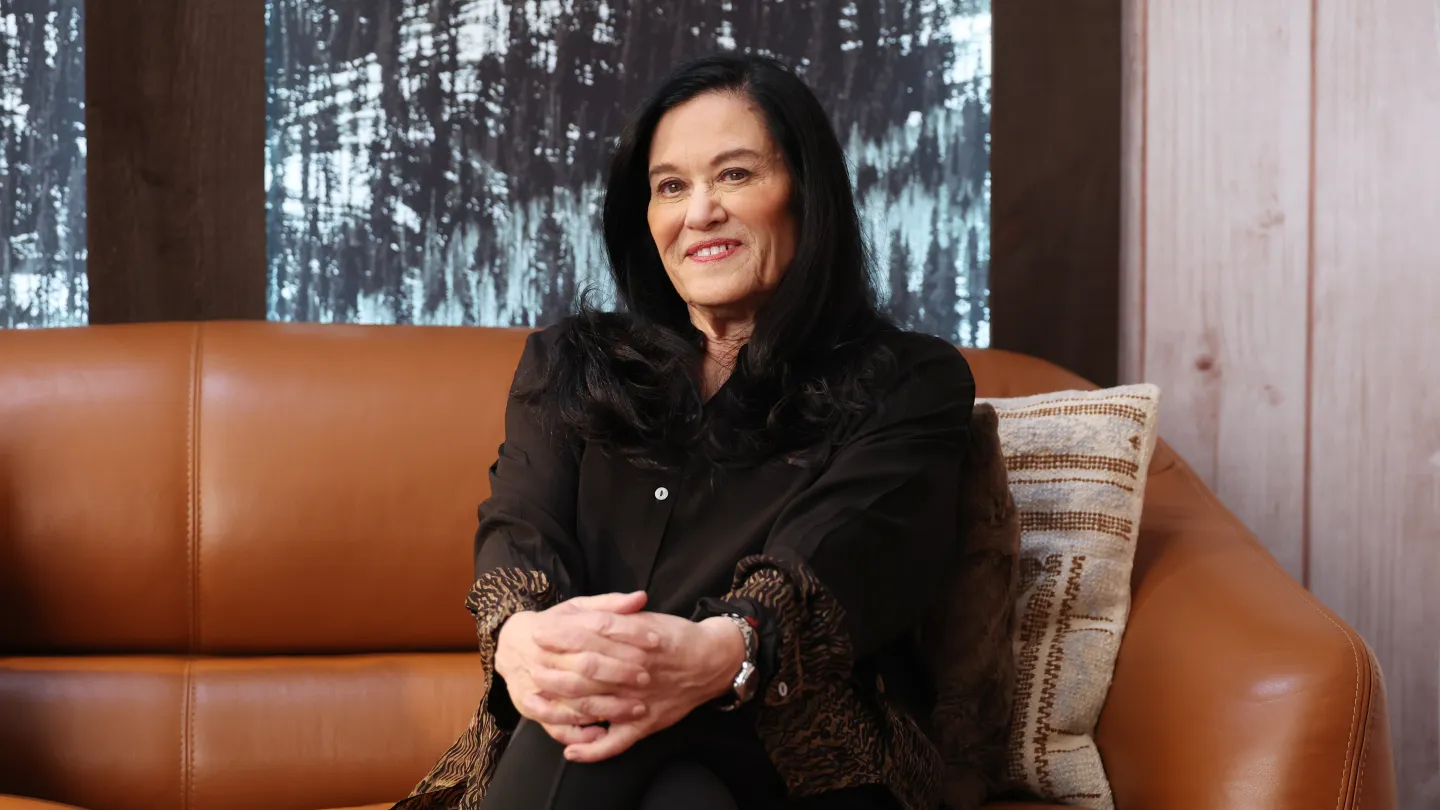
When documentarian Barbara Kopple directs a film about the labor movement, she tends to go big.
With 1976’s Harlan County, USA, she documented the dramatic 13-month strike waged by Kentucky coal miners against the Eastover Mining Company, filming armed standoffs and violent altercations between workers and management. In 1990’s American Dream Kopple tackled the failed 1985-1986 strike waged by meatpacking workers against a Minnesota Hormel Foods plant, capturing the splintering of a union in real time. Both films won the Academy Award for best documentary.
Now, Kopple is returning to the subject of worker organizing with a new film interweaving three separate but interconnected labor stories in and around New York City. Since 2023 Kopple has been documenting delivery workers, including those working for Amazon, UPS and food-delivery apps, in their fight for higher wages and improved working conditions. Some of her subjects have unions (UPS drivers and part-time loaders are represented by the Teamsters, for instance, who are also organizing Amazon workers) and others do not, such as the so-called “deliveristas” working for apps.
“These are three stories that are New York. It’s not Kentucky, it’s not Minnesota, it’s New York,” says the filmmaker, who spoke about the film ahead of receiving the Sebastopol Documentary Film Festival’s Lens of Power Tribute award on April 9. “And I just wanted to see what was happening, really, with modern-day unionism.”
What she has learned so far has struck her. Even for someone accustomed to covering tough workplaces, Kopple is disturbed by some of the stories. Working in warehouses is dangerous and physically taxing, she notes, with packages sometimes falling from on high. At Amazon, she says, it’s an ethos of “get fired [or] get hurt, keep going.” At UPS, too, she adds, “They [workers] to go faster and faster and faster and they’ll hurt their legs or somebody in their family will be very sick. [Workers will] ask, ‘Can I have to go to the hospital?’ And they’ll say, ‘Well, it’s either your job or your family. Make the decision.’”
She was gratified that the New York City Council passed a measure in late 2025 requiring apps like DoorDash and Uber Eats to give food delivery workers a justification and a chance to appeal in the event they are deactivated, or fired. That’s because “[App companies] used to be able to just fire them for anything. Like if a liquor store canceled an order, for example, they’d be fired and have no way except listening to robots on the telephone to get an appeal,” she says.
Kopple is taking her usual cinema verité approach to the film as much as possible, embedding with union organizers and workers on the ground, avoiding staged, sit-down interviews when possible. Still, she’s found embedding with workers more difficult in New York in the early 2020s than it was in Kentucky in the ‘70s or Minnesota in the ‘80s.
“People are afraid for their jobs because they live in a place where it costs a lot of money to live, so they’re not as open maybe as they were in Harlan County or American Dream,” she explains. “You just really have to be there and struggle to really understand. Even if you’ve been there two years, it’s still hard. You would never want to be a person responsible for getting somebody to lose their job.”
Kopple is now both continuing to film and editing the movie against the backdrop of President Donald Trump’s administration, which has taken a far more combative stance against labor than his predecessor, President Joe Biden. Trump’s White House has also transformed arts funding for documentary filmmakers like Kopple. In 2025 the administration canceled numerous National Endowment for the Arts and National Endowment for the Humanities grants, once a key source of support for documentary filmmakers and organizations.
The White House’s actions have spooked even independent foundations that in the past helped finance documentaries, Kopple says. “They’re scaring the foundations that could help. People are afraid to speak out, to say anything,” she says. “So we’re on our own.” Kopple said she has relied on individuals who care about her work to fund her latest project so far.
That said, having to get creative with funding isn’t new for her: On American Dream, she in part bankrolled the film by soliciting donations from Catholic groups. “There was a pastoral letter in which there was a section on the economic crisis, plant closings and wage concessions,” she explained to BOMB magazine in 1992. “What we were doing fit right in.”
Distribution will be another hurdle. A previous documentary that touched on the Staten Island warehouse union drive at Amazon, called Union, struggled to find a distributor when it was released to rave reviews in 2024; the film from Brett Story and Stephen Maing ended up self-distributing. “A couple of distributors said, really honestly, ‘We have a working relationship to Amazon Studios and we cannot risk that arrangement,’” Story told THR that year.
Kopple knows that this part of the journey may not be easy. “I’m going to do whatever I have to do for distribution,” she says.
Despite the obstacles, Kopple loves that she’s back covering worker organizing. She believes it’s important to be telling these stories. Calling it an “anti-union time,” she said, “remaining silent is worse.” She added, “You just have to be out there making films, singing songs, writing pieces that penetrate people’s hearts and souls and continue on.”