Exactly two years ago, director Kip Williams brought his Sydney Theatre Company production of The Picture of Dorian Gray to London’s West End, and with it what he calls “cine-theater,” a heightened fusion of the two media that represented a truly spectacular stage and narrative experience. The production last year transferred to Broadway and won its star, Sarah Snook, a Tony Award for lead actress.
Williams is back again, with the third part of his gothic trilogy (in between was The Strange Case of Dr Jekyll and Mr Hyde, which did not transfer from Sydney). Dracula is the most well-trod of the three novels, its diabolical villain forever refusing to lie down and die. But over-familiarity is, for the most part, swept away by a production of stunning, seductive imagination and bravura execution.
The technique, which broadly involves actors interacting with on-stage cameras and pre-recorded performance, has discernibly matured: It’s less showy (the smart phone face filters, fun but draining, have been abandoned), more elegant and more thrillingly filmed. But, like Dorian Gray, it still requires a single performer to play a plethora of characters and provide a charismatic center for its high-tech wizardry — to make the whole thing human.
Following Snook’s Tony and Olivier Award-winning turn as Dorian, Cynthia Erivo offers her own version of smashing it out of the park. She’s such a likable, multi-talented performer, and here, across 23 characters, her versatility, charm and singular physicality are irresistible.
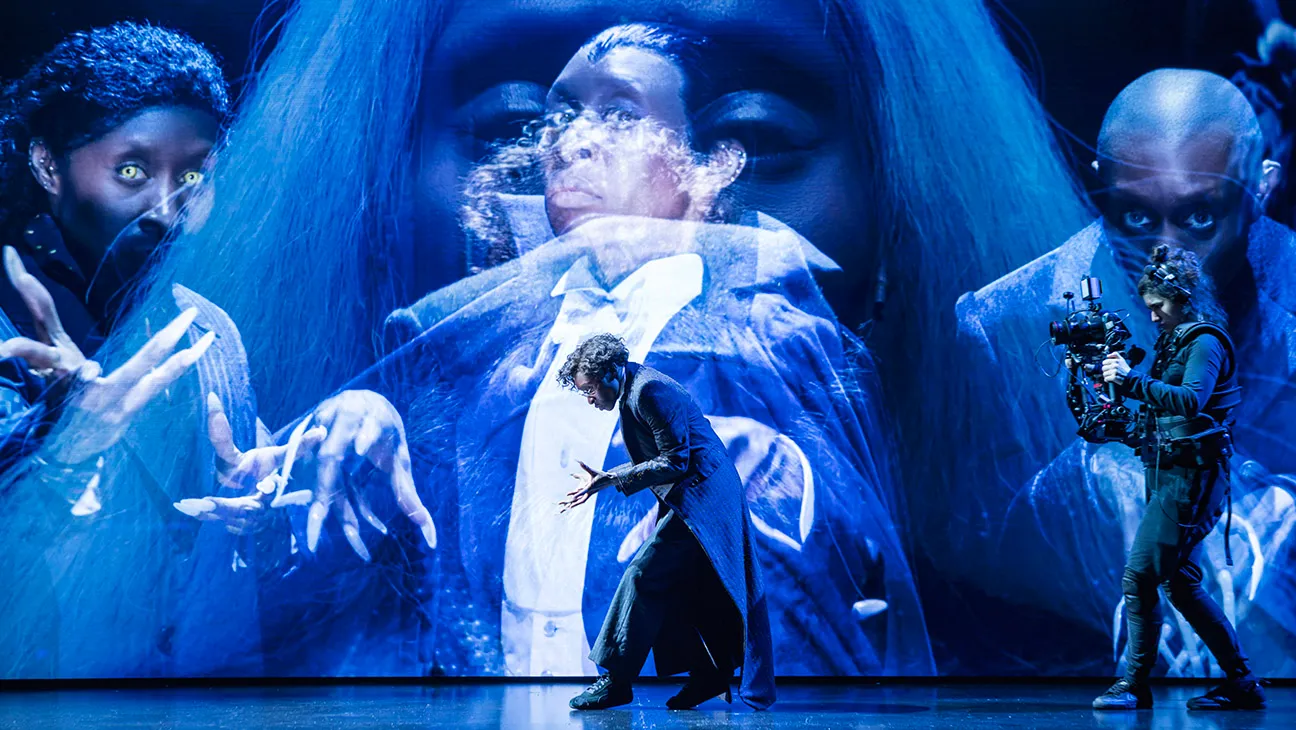
It starts with a bare stage, at the rear of which hangs a giant horizontal screen. Erivo enters in dark trousers and singlet, her body lean, sinewy, covered in tattoos, her head shorn, nose ringed, fingernails fiendishly extended, a vampire in waiting. As she lies on the ground, a camera descends from the rafters and beams her face onto the screen, where it splinters, multiplies, an intimation technically and thematically of what is to come.
As adaptor, Williams is faithful to the novel, not least its epistolary structure, the narrative moving between characters. The first is Jonathan Harker, naïve English solicitor despatched to Transylvania to do a deal with a mysterious Count whose plan is to dip his fangs into Victorian England. Erivo is a very convincing, well-spoken English gent, matter-of-fact to the point of idiocy as his journey becomes darker and darker, until finally recognizing his dire predicament.
Erivo’s Count fits none of the stereotypes; neither grotesque nor glibly sinister, Max Schrek or Bela Legosi, this Dracula is gorgeous, with lacquered red hair, a lilting African accent, lithe and beautifully dressed. Nonetheless, Harker’s observation of his host’s “wet white teeth’” as they glisten enormously on the screen above his head is a reminder of the danger — underlined when Dracula saves the young man from the hungry brides, simply because he wants Harker for himself.
The lawyer’s sojourn in the castle always feels like an over-long prologue, but Williams invests it with humor (the lip-smacking brides, all played by Erivo of course, are fabulous) and even gusto as Harker’s revelatory exploration of the castle is accompanied by Paul Dukas’ “The Sorcerer’s Apprentice,” played at full volume. This sequence also shows how much can be achieved, in the expression of space, with very little set or props, just movement, music and invention.
When the action shifts to England, the virtuosity of direction and performance, and this brand of theatrical expression, becomes more evident. Erivo effortlessly segues, in the flesh, between Harker’s demure fiancée Mina and her more confident and romantically adventurous friend Lucy, the onstage costume and wig changers now coming into play, while on screen she elicits considerable mirth as Lucy’s three very different suitors — the earnest doctor Seward, the rather dull yet successful Arthur Holmwood and the enjoyably direct Texan Quincy Morris.
Erivo will also play the mad Renfield (again, very differently from the stock figure who manically rants in between mouthfuls of birds and insects, this one a gentle-faced, almost Zen Irishman), a salty seaman, and, unrecognizable beneath flowing white locks and beard, a Moses-like Van Helsing, among others. Van Helsing is one of those never seen live (it would take an age just to fit the rings that engulf his fingers), yet it truly feels as though he is flesh and blood on stage, so palpably present is he on screen.
How these characters all play, simultaneously, remains a marvel, at times even a mystery. As with Dorian Gray, the theatrical crew are constantly working alongside Erivo or in the background — changing her hair and costume, operating cameras and lighting, moving props. But, dressed entirely in black, they are barely perceivable, to the extent that when a sofa suddenly appears in the center of the stage, or a bed, or a character mentions being given a letter and a letter appears in Erivo’s hand, it is by magic.
At any one time, Erivo will play a character live on stage, with cameras providing angles and close-ups fed onto the screen, giving the audience options on the performance; at the same time, she interacts with other characters played by her in pre-recorded footage. Often — and this feels like a development in the technique — her live character is filmed and somehow inserted into the background of the pre-recordings, alongside the other characters. It’s miraculous, convincing and seamlessly allows one actor to populate an entire story.
Rather than mere showmanship, there is a thematic sense to it. In Dorian Gray, the approach underlined Dorian’s split personalities, as well as the way in which the young man was a construct of the various conflicting influences upon him. Here, with Erivo embodying everyone from vampire to vampire hunter, doctor to madman, lover and suitor, there is a growing sense of connection between them all, particularly a well of unconscious desire that Dracula is reflecting, rather than merely exploiting.
As amusing as it is when the imprisoned yet still deadpan Harker expresses the realization that his host wants “to consume me” (before immediately launching into an account of breakfast), there is here the seed of a theme that resonates through the play.
Dracula and his brides are not the only hungrily desirous characters on display. Lucy of course has three eager suitors, and will eventually be after their throats; Mina will have a taste for blood; Victorian repression is sneered at, while desire, lust, seduction and possession in some way affect them all, to the point that Dracula himself is as much an object of desire as any of his victims.
No wonder he can’t be seen in anyone’s mirror; Williams suggests that in looking at the Count, the other characters are really looking at themselves. And when Erivo gets the chance to sing, a simple but hair-tingling mantra “come to me,” it may be the only time that an audience wills Dracula and Mina to walk off together into the sunset.
From Dorian Gray, Williams reunites with designer Marg Horwell, lighting designer Nick Schlieper and composer Clemence Williams, joined by sound designer Jessica Dunn and video designer Craig Wilkinson. All contribute brilliantly to the evocation of Victorian gothic, the drama, the echoes of the Dracula legacy — whether it’s Horwell’s luxurious costumes, her fantastically effective, Expressionistic cemetery, the synergy of revolving set, lighting and sound for a storm scene that almost elicits sea sickness, the fabulous widescreen framing and montages, or the moment when the stage is saturated in blue, as Erivo dances manically across it, while in the background she embodies three different, but familiar Dracula personas.
Near the start of proceedings, Jonathan Harker muses on Transylvania as an “imaginative whirlpool.” He could have been speaking of the play itself.
Venue: Noël Coward Theatre, London
Cast: Cynthia Erivo
Playwright: Kip Williams, adapted from the novel by Bram Stoker
Director: Kip Williams
Set and costume designer: Marg Horwell
Lighting designer: Nick Schlieper
Music: Clemence Williams
Sound designer: Jessica Dunn
Video designer: Craig Wilkinson
Presented by Sydney Theatre Company, Michael Cassel Group, Kindred Partners