When The Beatles broke up, Paul McCartney was all of 27 and had spent close to half his life in musical partnership with John Lennon. As he notes in Man on the Run, he wasn’t sure he’d ever be able to write another song. But an exceptionally prolific decade unfolded, explored with style and energy in Morgan Neville’s revelatory documentary.
With ace editing by Alan Lowe, Neville follows a general chronology, but wisely avoids the completist minutiae of an album-by-album breakdown. The film is devoid of talking heads and rich with offscreen interviews, both new and vintage, that serve as insightful voiceover commentary. There’s a lyrics-and-melody power to the interplay of sharp observations and visuals that dive deep into archival material — a fitting dynamic for a film about someone with a preternatural gift for infectious tunes. And there’s a playful, irreverent bounce to the film that’s in sync with the Liverpudlian music hall tradition that McCartney, more than any of the Beatles, has held close.
Man on the Run
The Bottom Line
A not-so-silly love song.
Release date: Friday, Feb. 27
Director: Morgan Neville
Rated R,
1 hour 55 minutes
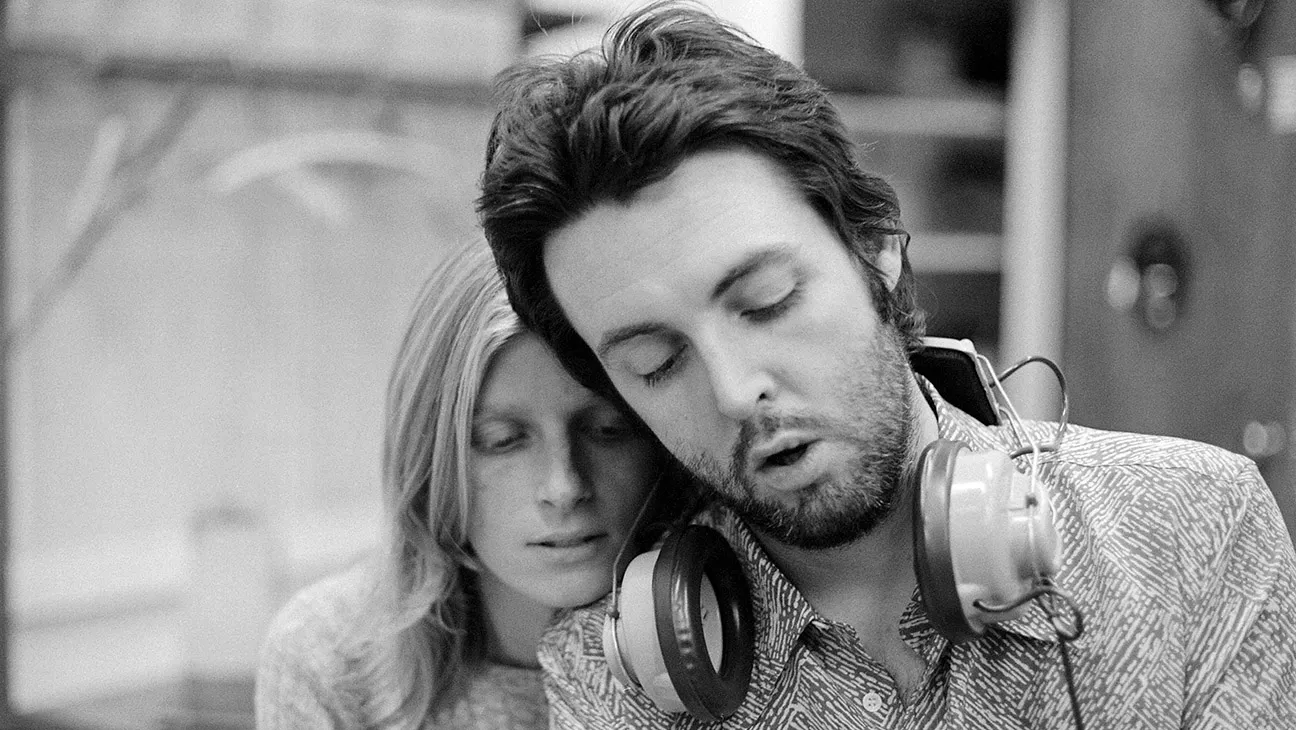
At its core, though, Man on the Run is a tribute to two life-changing love stories: McCartney’s bond with Linda Eastman, who’s heard in newly unearthed interviews, and with Lennon, an affection that proved stronger than business feuds and even withstood the mean-spirited wordplay of Lennon’s “How Do You Sleep?”
Neville, whose 20 Feet From Stardom revealed an untold chapter of pop-music history that was right under our noses, manages to do something similar here, with one of the most in-the-spotlight figures in the world of modern music. A quick and lively pre-title montage traces The Beatles’ rise from the Cavern to the Sullivan show to their final public performance. And then comes the “Paul is dead” hysteria, reaching a fever pitch not long after the March 1969 marriage of the “last bachelor Beatle” to Linda Eastman — cue the sobbing teenage girls.
As to the gap between the band’s actual dissolution, instigated by Lennon, and its official split, which arrived months later, when McCartney announced publicly that he was leaving, McCartney says he “kind of bought into” the generally accepted idea that he was the bad guy who broke up the band. Neville includes a clip from a London play about The Beatles that bore the unwieldy title John, Paul, George, Ringo…and Bert, featured some very bad wigs and makeup and, in keeping with the official story, cast McCartney as the villain. (On the band-breakup front, the doc doesn’t spend time on the merciless scapegoating of Yoko Ono and Linda McCartney by the media and some Beatles fans.)
Having liberated himself from the lie that the Fab Four were still a going enterprise, McCartney retreated to his rustic farm in a remote corner of Scotland, a central element of Man on the Run, captured in evocative footage both vintage and new. It was about as far from center stage as you could get — “way at the end of nowhere,” in Linda’s appreciative words. There they began raising a family and, after McCartney’s one-man-band solo album (a four-track lo-fi landmark, according to one observer), he and Linda released Ram. The critics used such words as “nadir,” “inconsequential” and “irrelevant”; Sean Ono Lennon, one of the documentary’s chorus of observers, more accurately calls it a masterpiece.
At a time when Ono Lennon’s parents were staging antiwar bed-ins, and George Harrison was reaping critical acclaim for his triple-disc All Things Must Pass, McCartney’s songs weren’t “about” things in the same way as theirs — or the things he wrote about, the domestic joys and comical characters, weren’t considered as important. Neville doesn’t ignore evidence of creative instincts that could lean toward kitsch, if not outright schlock or, as Wings drummer Denny Seiwell puts it, “soppy shit.” With a wry chuckle, McCartney chalks up these cornball elements of his TV specials and other outings to the perils of being surrounded by yes people.
Once a Beatle, always a Beatle — in more ways than one. Especially fascinating is the film’s conflicting commentary, from McCartney and members of the various iterations of Wings, about his attempts to create an egalitarian experience rather than a star-plus-backup-band situation. (The group’s one steady element over the years, besides Paul and Linda, was guitarist Denny Laine, who died in 2023.) Building a band, he was re-creating the setup that had defined his life to that point. He was also professing to be starting from scratch.
However humbling it may have been to take the group out for a series of surprise lunchtime shows on college campuses, rather than heading straight to stadiums, the venture was naturally complicated by his enormous celebrity. And however sincere his view that he was building something from the ground up, it’s hard not to hear something disingenuous when he tells an interviewer, “I’m just some fella who used to be in a group called The Beatles.” The disconnect is clear in the remarks by several former band members on the futility of his equality concept. Later, McCartney goes to the heart of the matter with an astute assessment of a value bred into him in Liverpool, a working-class aversion to being the boss.
Tracking Wings’ ups and downs and reconfigurations, the triumph of Band on the Run, life on the pastoral homefront, and the sign-of-the-times pot busts, Neville stirs up a fine mix of visual and audio material. Besides 8mm home movies and videos, there are glimpses of professional photographer Linda’s extraordinary portraits of famous musicians, and Paul’s diaries and handwritten lyric sheets. Graphic elements and animation lend a kinetic collage effect, and demo recordings, outtakes and recording-studio discussions enrich the aural experience.
In addition to Paul, members of Wings, and Ono Lennon, the terrific offscreen chorus includes the McCartneys’ daughters Mary and Stella, Mick Jagger, Nick Lowe and album-cover designer Aubrey Powell. Chrissie Hynde offers especially perceptive observations regarding the timelessness of McCartney’s music.
But the most welcome voice in the film is that of Linda, straightforward and down-to-earth. As her daughters and others observe with fierce love and admiration, she raised four kids without an entourage of assistants while touring the world as a rock musician. Linda, who died in 1998, was her husband’s first recruit for his post-Beatles band, even though she didn’t play an instrument. “Here’s middle C,” she recalls him telling her. “You can play keyboard.” To say she took a lot of heat for it is putting it mildly. It didn’t make her defensive; “I’m here because we love each other,” she says of her role in Wings.
Man on the Run doesn’t look ahead to her untimely death or frame her story through that lens; it’s rooted in the events of a momentous decade for her and Paul McCartney, a period that crucially includes his rapprochement with his “brother,” John Lennon, and ends with Lennon’s murder. “My only plan is to grow up,” McCartney announced to the world when he left The Beatles. Neville’s film is alive with growing pains.