On August 13, 1982, Universal released teen comedy Fast Times at Ridgemont High in theaters, marking the directorial debut of Amy Heckerling from a screenplay by Cameron Crowe. The film, featuring a breakout performance from Sean Penn, would go on to become a cult classic. The Hollywood Reporter’s original review is below:
Fast Times at Ridgemont High has it all Pac-Man, pizza, cruising, cursing, rockin’, rollin’ enough to keep even the most “totally awesome” teen tuned in all the way. And, given the recent success of almost every zany adolescent film, Fast Times should easily pull in its share of youngsters. What separates this Universal release from the pack, however, is its warmth. It may be a film about kids, but it’s for adults who have not forgotten what it’s like to be a kid.
Fast Times follows six teenagers through one year at Ridgemont High, clocking every escapade, from ordering a pizza for arrival during U.S. History to boyfriends and unwanted pregnancies. Screenwriter Cameron Crowe has adapted his bestselling book quite well, keeping a very personal perspective (Crowe actually went back to high school before writing the book, posing as a student for a year as research). Amy Heckerling, in her feature debut, has proven herself to be a truly gifted director, able to tickle the ribs with one hand while the other tugs at the heartstrings.
Although the high school setting might at first brand Fast Times as another Porky’s spin-off, the film stands on its own. If comparisons are to be made, they might better link Fast Times with the intimate portrayal of ’50s teens in American Graffiti. Both Graffiti and Times delve beneath the surface of their characters, showing in the process that teenagers haven’t changed all that much. They just quit cruising the main drag with Elvis. Now they “check out” the mall to the beat of the Go Go’s.
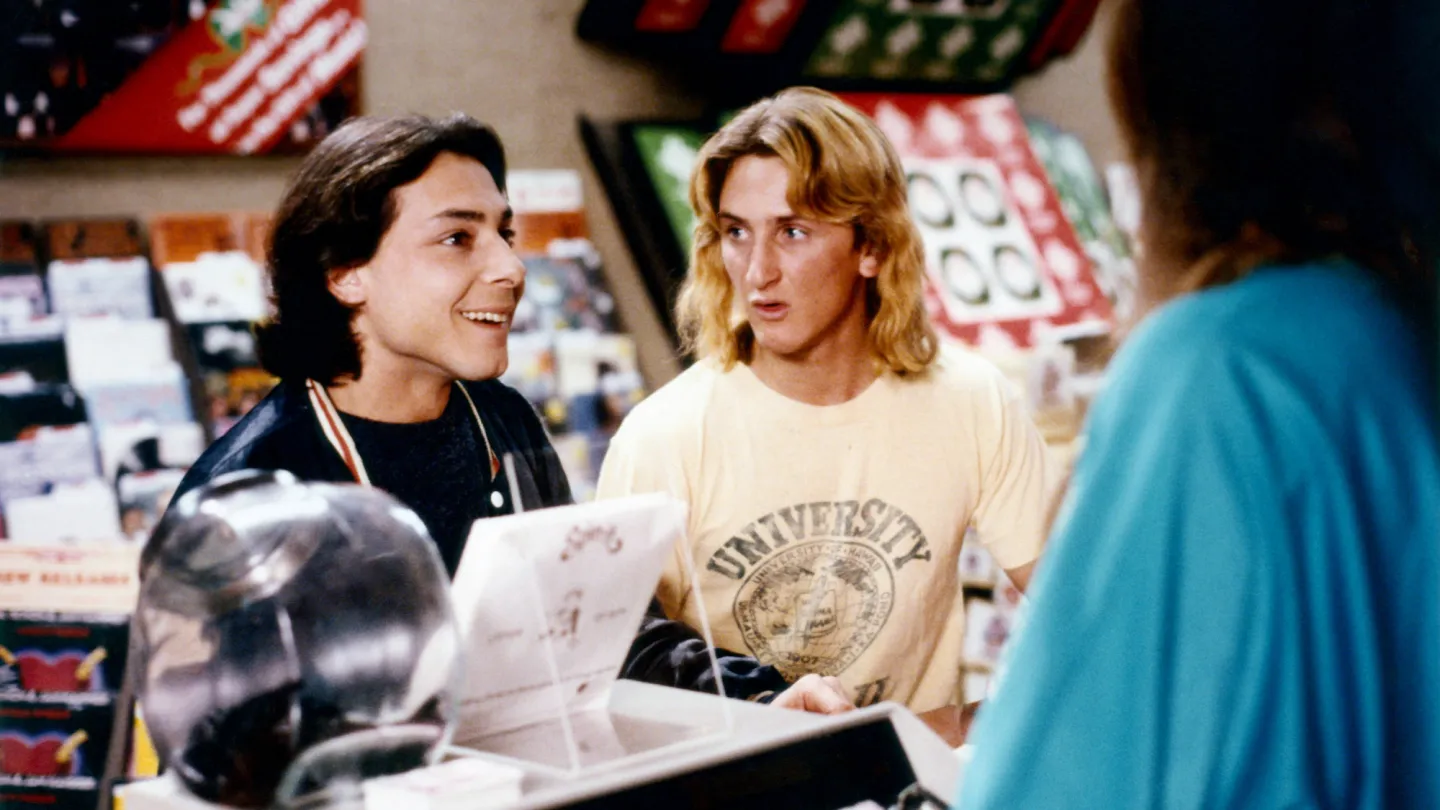
The cast approaches the picture with a delightfully devil-may-care sincerity, playing off of one another with a simple ease. It is these characterizations, as written by Crowe and under the skillful eye of Heckerling, that give the film its charm. The most flamboyant in his characterization is Sean Penn as Spicoli, the bleached-out surfer with the permanently blood-shot eyes and a half-smile pinned to his cheeks. Penn provides the wilder moments at Ridgemont High, and to his credit, never dropped the reality of his character in going for a madcap laugh.
Judge Reinhold’s Brad also adds consistent comic edge to the picture with his sad eyes and fast food attitude. Robert Romanus, as Damone, would scalp Ozzy Osbourne tickets to his grandmother, and yet deftly treads the tightrope between cockiness and desperation. Phoebe Cates play the nymphette Linda to the hilt, showing only now and again the lost little girl inside. Jennifer Jason Leigh, as the freshman with a lot to learn, proaches her Stacy with the most even of keels. Her performance, although quite natural, tends toward the monochromatic. Brian Hecker, as the would-be beau, has little to do other than proffer an embarrassed smile. Veteran actor Ray Walston, as the history teacher, plays a sour-pussed straight man to the constant shenanigans of Spicoli.
Music plays an important role in Fast Times, offering an ambience that varies from “Oingo Boingo” to Jackson Browne. Although the likes of the Go Go’s and the Cars are present at times, the soundtrack as a whole seems too staid to provide a backdrop for ’80s kids kicking around in the heyday of punk. Other technical credits include the fine work of Dan Lomin whose art direction gives the Sherman Oaks Galleria an intimacy it has never known. — Gina Friedlande, originally published on Aug. 11, 1982.