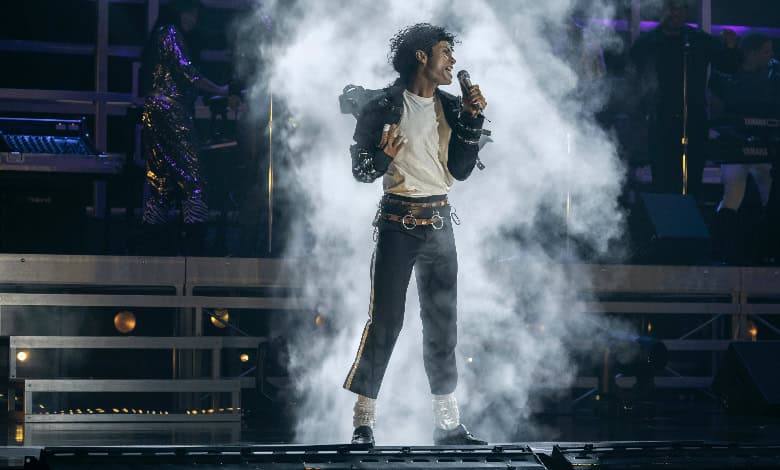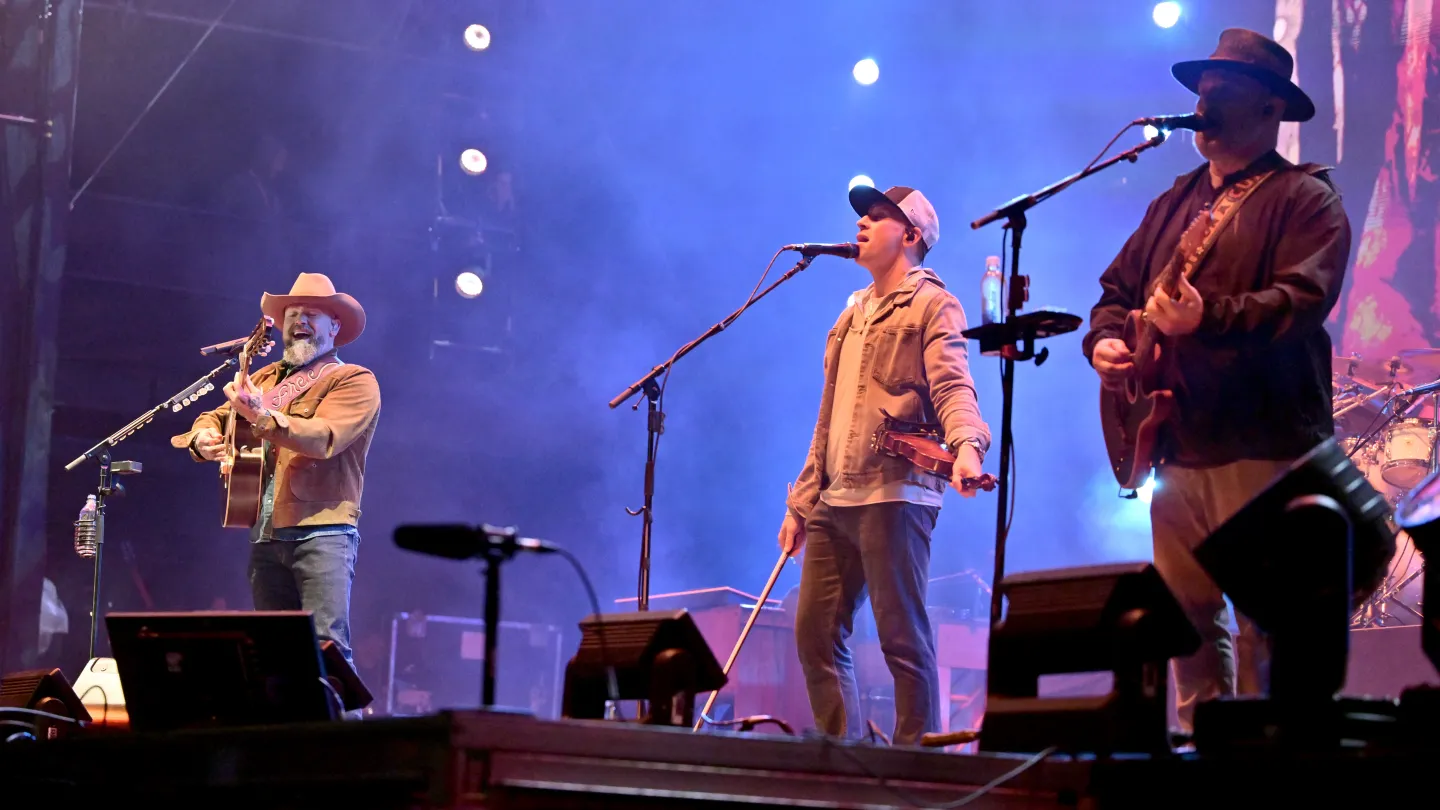
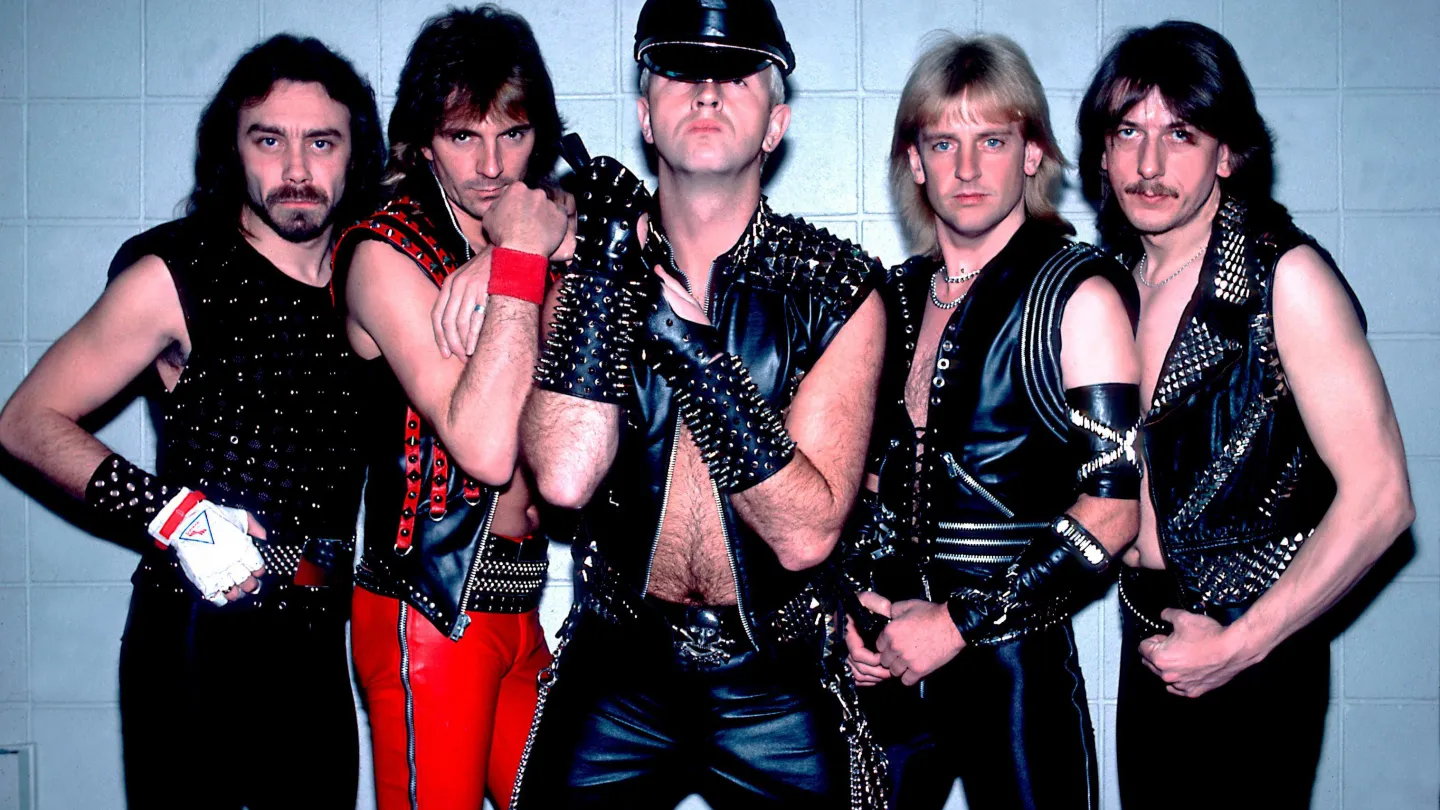
The studded leather stage garb, the ear-splitting falsetto and thrashing guitars of a bunch of heavy metal gods suggest a stereotype bordering on satanic. Even the name given to the industrial birthplace of this lovingly assembled rock doc’s subjects, “The Black Country,” sounds like a demonic spawning ground. But one of the chief takeaways from fanboy co-directors Sam Dunn and Tom Morello’s entertaining legacy salute, The Ballad of Judas Priest, is how endearingly this canonical band comes across.
Sure, they helped define heavy metal culture by dressing like a biker gang, sparked a culture war trial over accusations of subliminal death messaging and superfan Jack Black describes their sound as “the song you want to fuckin’ play on the electric chair; it’s the song you want to play before you fuckin’ head off into oblivion.” But these guys seem approachable, unpretentious and refreshingly uninclined toward bad-ass macho-aggressive posturing. They are the kind of nice, self-deprecating working-class English lads you could take home to meet Mum and Dad. Maybe it’s the delightful Birmingham accents.
The Ballad of Judas Priest
The Bottom Line
The sweeter side of hardcore headbangers.
Venue: Berlin Film Festival (Berlinale Special Midnight)
With: Rob Halford, K.K. Downing, Glenn Tipton, Ian Hill, Scott Travis, Richie Faulkner, Tom Morello, Jack Black, Darryl McDaniels, Dave Grohl, Lzzy Hale, Billy Corgan, Scott Ian, Kirk Hammett, Ozzy Osbourne, Andy Sneap
Directors: Sam Dunn, Tom Morello
1 hour 38 minutes
That’s not to imply that Dunn and Morello’s film makes the pioneering metallurgists seem in any way inauthentic or soft. But when you partly frame a Judas Priest doc with longtime frontman Rob Halford, now a cheerful septuagenarian, strolling down to his local to order fish and chips with mushy peas and a pickled egg, you inevitably demystify your Metal Lords.
Then again, Judas Priest appear never to have cared much about cultivating an offstage mystique to match their hard-edged, high-energy performance style. Any band in their genre that would craft a metal power anthem out of Joan Baez’s introspective folk ballad “Diamonds and Rust” clearly isn’t just playing to expectations.
The movie has surprising warmth and heart, notably so in its handling of Halford’s sexuality. The singer was never in the closet with his bandmates or management, but he was encouraged to hide that side of himself as their popularity grew in the 1970s. Halford acknowledges that metal was an alpha male-dominated sphere in which he himself believed there was no place for an openly gay man.
That created a struggle between success and fame on one side and loneliness and angst on the other, leading to a period of alcoholism, which he kicked with a 30-day rehab stint. But when Halford casually came out during a 1998 MTV interview, and the news traveled round the world in 24 hours, he was astonished at the outpouring of love and acceptance from the metal community.
The doc makes wry points about going back and looking for hidden queer meaning in the band’s lyrics, yielding not exactly subtle clues like Halford strutting around the stage singing “Grinder! Looking for meat!”
Earlier, they switched from sequins and satin into their defining leatherwear look, finding the initial pieces in a gay sex shop in London’s Soho. There’s humor in Metallica lead guitarist Kirk Hammett, a San Francisco native, recognizing the look from late 1970s Castro leather boys: “I was thinking, huh, maybe it’s different in Britain.” But Halford drolly specifies: “There was never any equation to S&M, because I’m the most vanilla guy in the gay world.”
The doc mixes present-day interviews with the band, archive material and input from contemporaries like Ozzy Osbourne and next-gen rockers Dave Grohl and Hammett. Black’s contributions are both reverential and light-hearted.
But some of the most insightful and witty commentary comes from co-director and Rage Against the Machine guitarist Morello. He talks about starting a heavy metal appreciation club while he was at Harvard, which would meet every week to discuss Harvardian topics like “The social impact of the twin axe attack on ‘80s metal post Defenders of the Faith.”
In subsequent years, Morello started organizing similar gatherings of like-minded friends to discuss metal at the Rainbow Bar & Grill in Los Angeles. One such meeting, extensively excerpted here, is a “Judas Priest Round Table,” at which Morello is joined by Run-DMC vocalist Darryl McDaniels, Smashing Pumpkins frontman Billy Corgan, Scott Ian from Anthrax and Halestorm’s Lzzy Hale.
The group’s Priest love is contagious, and there’s a nice note of inclusivity in the fact that two Black musicians, Morello and McDaniels, were instrumental in getting Judas Priest into the Rock & Roll Hall of Fame after the band had been passed over on two previous ballots.
Perhaps the most interesting chapter looks back on the “Satanic Panic” period, when mainstream America’s fear of the heavy metal subculture peaked. Concerned mothers formed the PMRC (Parents Music Resource Center) to scapegoat hard rock as a pollutant of their children’s minds, while Senate subcommittee hearings pushed for censorship.
The most significant offshoot of all this came in 1990, when a Nevada civil action funded by Christian conservatives went after Judas Priest for $6 million, alleging that subliminal messages in the band’s music prompted the suicide pact of two young males. This would seem ludicrous today if not for the far right’s habitual moral hysteria. But watching a courtroom full of people straining to hear vague signals like “Do it” in a Priest song raises eyebrows, especially when it’s determined that the subliminal words were never there. “The common-sense thing is, why would you tell your fans to fucking kill themselves?” observes Halford.
While the band was cleared of any suspicion, the experience of their music being put on trial left behind a heavy cloud. They argue that, rather than feeding loneliness and despair, metal allowed misfits to find their communities. Hammett gets emotional talking about it, calling the music “medicine.”
This is more of a celebration than a warts-and-all study, with relatively little on the personal side. Conflicts are glossed over, line-up changes happen without drama and any life or relationships outside the band are mentioned only in passing. LGBTQ audiences might wish to know if Halford ever managed a clandestine relationship over the 25 years of fame during which he remained closeted, or indeed since. But Dunn and Morello make no apologies for sticking to the music and the rapport among the band members.
As with any group that’s been recording and performing in various configurations for more than half a century (Morello calls them “the Willie Nelson of heavy metal”), time takes its toll.
Longtime guitarist K.K. Downing’s departure in 2011 was a blow, though he’s vague about the reasons, beyond saying it started to feel more like hard work than joy. Even more saddening was the Parkinson’s disease diagnosis that struck Glenn Tipton, Downing’s other half in the twin axe “guitarmony” component so essential to the band’s dynamic. (The late Osbourne makes touching comments about the sense of solidarity he felt as a fellow Parkinson’s sufferer.)
The biggest change to the band came in 1992 when Halford decided to step away for a while to pursue solo projects. That lasted 11 years, but despite any rancor the break might have caused, when the time came for him to return, Tipton says, “He didn’t need to ask.” Nevertheless, that negotiation took place, in quintessentially British style, over a cup of tea.
I confess that aside from a handful of Led Zeppelin bangers, I’ve never been much of a metal fan and before The Ballad of Judas Priest, I couldn’t have named even one of the band’s hits. But watching them perform at the 2022 Hall of Fame ceremony, with all four core members — Halford, Downing, Tipton and bassist Ian Hill — together again on stage, I found myself thinking “Priest! Fuck, yeah!” as my index and pinky fingers involuntarily formed devil horns.