Industry watchers fearing the encroachment of generative AI may be expecting Tilly Norwood to show up in the next Fast and Furious movie or an AI-generated screenplay to end up on the Black List. But the realities of that kind of AI takeover of Hollywood are hindered by multiple barriers to entry, including labor contracts, ongoing copyright questions and actual consumer interest.
The reality of how AI is currently being integrated into the largest swaths of the entertainment industry is much more mundane. And, as with previous introductions of new technology into Hollywood, from digital film to email, AI is percolating from the bottom up, starting with the assistant class — on track to become industry standard as today’s underlings (those that survive the continual layoffs that is) rise to positions of power.
Confronted with larger workloads and a shrinking headcount, AI — both the kind officially approved by companies and more surreptitious uses — has made its way via support staff into essential Hollywood workflows, including the creative development process.
The Hollywood Reporter spoke to a dozen assistants and support staff working across studios, networks and agencies — all of whom requested anonymity citing job security and a difficult Hollywood labor market — who outlined how AI is in daily and consistent use, for matters small (getting that fawning thank you note to fit into the Beverly Hills florists’ 250 character limit) and larger (using an AI notetaker during a studio meeting with the creatives behind a streaming series).
One partner at a major Hollywood management company says they do not allow AI to be used by support staff or representatives, telling me, “I prefer independent thought.” Still other entertainment outfits are more bullish about incorporating AI into day-to-day operations, some even asking staff to track their AI use, a practice more common at tech companies like Meta and Google. In January, Disney held an internal AI summit with representatives from all departments to promote the integration of AI use across the entire company’s business, from Imagineering to business affairs and beyond. (This all happened months before the studio’s $1 billion AI investment with OpenAI ended following the termination of the company’s Sora video app.)
Hollywood support staff, like office workers around the world, are using AI for pedestrian, unglamorous tasks like composing emails, setting meetings and figuring out how to dole out the constant stream of requisite congratulations and holiday gifts. “I do not need to be spending two hours of my day figuring out how to get a bottle of wine to somebody in the middle of nowhere,” says one assistant.
And then there are the applications to more Hollywood-specific support staff tasks, including the handling of sensitive information and creative workflow.
“These are not tools built on the nuances of our industry,” says Warner Bailey, the onetime Hollywood assistant who is behind the popular social media meme page turned media company Assistants vs. Agents. Bailey has long been surveying the thousands-strong support staff ranks on how they do their jobs, including how they use (or misuse) AI. “Right now, a lot of assistants are just going and pasting sensitive information in the public AI tools, including things like client schedules and deal terms, internal notes, and data,” he says
The concern, Bailey says, is with “shadow AI” use — i.e. the use of free or otherwise publicly available AI tools, as opposed to enterprise or business accounts, without company approval or security oversight. Bailey, who is currently building an admin automation platform meant to be used by the current and next generation of entertainment professionals, points out that there is little to no training offered to assistants on AI use. And Hollywood’s young assistant workforce, the majority of which is currently Gen Z, has been using GenAI and LLMs in school and their personal lives for several years, and is importing some of those habits into the workplace.
Bailey says, “The education piece should fall on the company, but has to, unfortunately, fall outside of it because of various factors like shrinking budgets and also knowledge base. The [administrative] systems internally are so obsolete that senior-level, or even those who were assistants two or three years ago, don’t necessarily have the knowledge to train other people on it.”
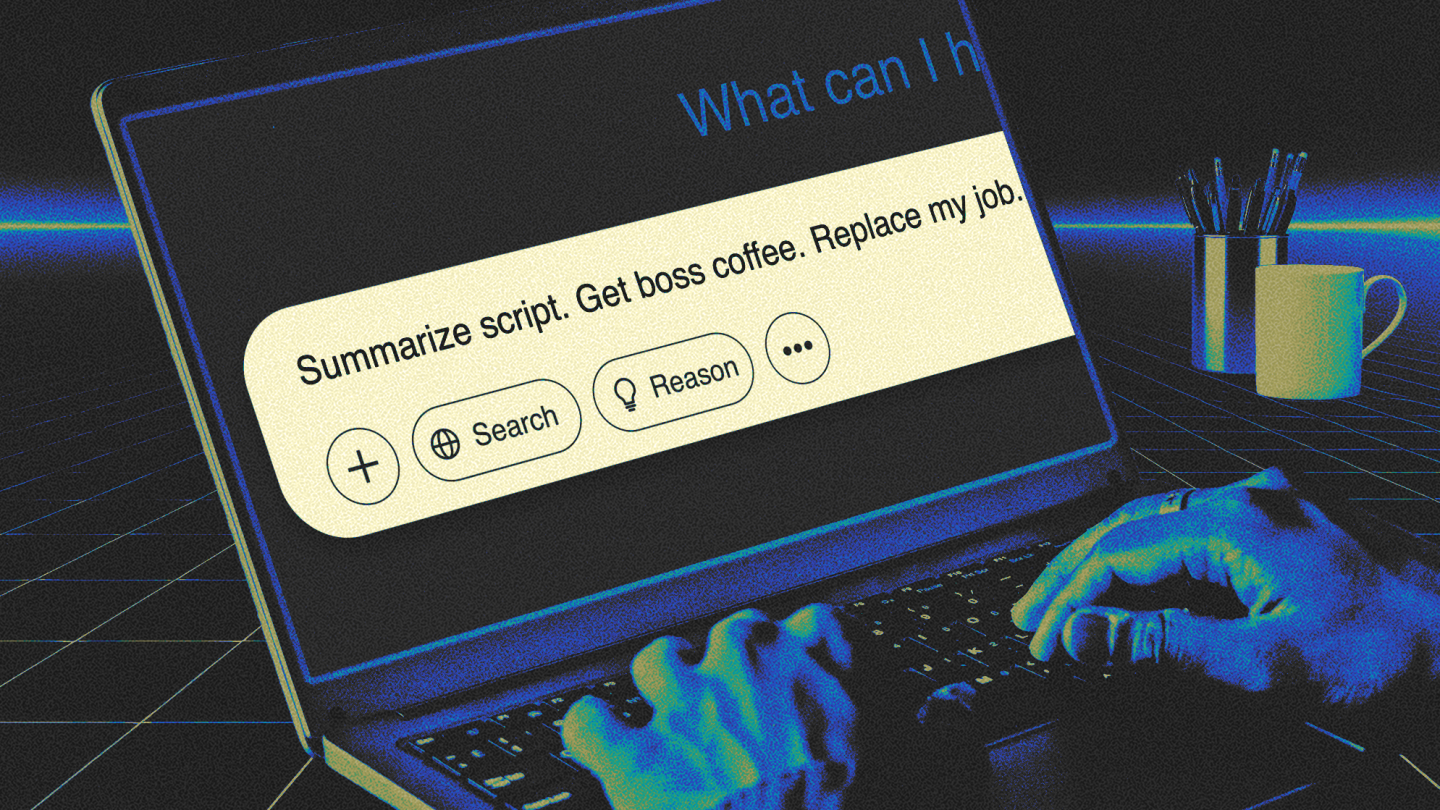
Some support staff are using AI to keep up with the biggest perennial of Hollywood assistant-dom: Coverage. Coverage is the bedrock of the Hollywood development process, the first step in a story making its way from page to screen. In order to get the industry standard development report about the content and quality of a script, book, short story, etc, readers have uploaded PDFs of various written materials, including unpublished work, to ChatGPT, Claude and others in order to generate summaries.
But LLMs are built to ingest and synthesize text, often omitting subtleties like nuance, irony and other important (read: human) aspects of storytelling. They’re also prone to introducing narrative inaccuracies. This, says industry veterans, leaves AI-assisted coverage lacking.
“AI can’t summarize emotion. It can’t define if a character is original,” says Stephen Galloway, dean of Chapman University’s Dodge College of Film and Media Arts (and a former THR editor), who himself spent five years as a script reader doing coverage.
Chapman’s film school has five AI-related classes for students, and Galloway points out that AI is a useful tool but, he says, “There’s a dual obligation: one is to master the tool, but know what you can do that is separate from the tool.”
Many who spoke to THR consider AI use less of a preference and more of a necessity. As budgets and headcounts continue to get slashed, the culling is coming from the bottom, leaving assistants to support not just one, but sometimes two or three bosses. (In a 2025 survey of over 100 representatives and executives from THR’s annual Next Gen list, half said they either shared an assistant or didn’t have one at all.)
When employing GenAI tools, one of the biggest concerns voiced to THR by assistants is about the environmental impacts of the energy-draining tech. The biggest concern is about job security.
“When they say, ‘You should be using AI,’ the first thought in your head is: ‘Are you asking me to teach you how to replace me with technology?’” says one studio assistant.
The use of AI by the Hollywood underclass dovetails into the larger existential anxieties that are plaguing up-and-comers. As assistants see AI as increasingly necessary to keep up with workloads, that same tech may be keeping them from robustly building the skillsets they will need as they move up the industry ladder.
“I can’t help but think that, yeah, we’re going to quote-unquote streamline, but then you’re just goanna give me two more bosses, and we will be back to where we started. Instead of hiring two assistants, you’re goanna hire one, and I’m still swamped with admin work,” adds the assistant, “And I’m not being pushed any closer to a promotion.”
For now, Galloway says, AI represents less of a threat to the assistant workforce than the general retrenchment and consolidation affecting the industry. He points out that because of cost-cutting, there are fewer entry-level jobs, and assistant pay has largely remained the same over the past decade as the cost of living has significantly increased in Los Angeles.
Hollywood is an industry built on an apprenticeship model, beginning with time spent as an assistant (or, in previous generations, in the mailroom). But, says Galloway, “the industry is really shrinking. When it shrinks, when things change, there is an atmosphere of panic, and people then don’t really have the bandwidth to be nurturing and caring. It’s survival first. That is damaging what was a continuous ladder of relationships.”
This story appears in The Hollywood Reporter’s upcoming AI Issue, out in April.