In 1986, The New York Times ran a screed against a film-restoration trend gaining steam.
Published in the thick of the “colorization” craze of the 1980s, the late critic Vincent Canby argued that the process of altering black-and-white movies with modern visual flourishes “desecrated” those classics, writing that “nobody connected with the original[s]…had anything to do with this artistic revisionism” and “of the half-dozen [colorized] films I’ve seen to date, all but one were virtually unwatchable.” The problems in Canby’s view were both ethical and aesthetic, ultimately betraying that key quality of any artwork — that it belongs to the time in which it was made.
Forty years later, Canby’s impassioned argument fits rather neatly into a raging debate around a new technological movement: The use of Generative Artificial Intelligence to expand upon, alter or simply “complete” movies that were made decades before. The Sphere in Las Vegas thrust the practice into the mainstream with its AI-ified take on 1939’s The Wizard of Oz, which employed various techniques to fill the space’s 160,000-square-foot interior display plane. Echoing that 40-year-old Canby editorial, today’s Times’ critic Alissa Wilkinson wrote, “It suggests that in the future, every artist’s choices could be reversed, altered or ripped to shreds, then presented by their corporate owners as if they’re essentially the original, just zhuzhed up a bit for a new century.”
Colorization died a relatively quick death, at least as a formally accepted practice; its short lifespan serves as a reminder that backlash to innovations can be both warranted and effective. AI, though, might yield a more complex story.
“In moving-image history, these debates about technological change and its impact on creativity or labor or our understanding of the past have resurfaced at various times,” says Dr. Charles Acland, a distinguished professor of cultural theory and film studies at Concordia University. “But we also live in an economy where there is such extraordinary hype around what gets called AI…that it puts a different kind of pressure on these discussions and debates. Colorization is a good comparison, but it didn’t have the same sweeping social and economic impact of something like generative AI — so there’s more at stake in how we sort through what we’re going to accept and valorize.”
Since its August 2025 opening, The Sphere’s Oz has sold more than 2.2 million tickets, a staggering number for what remains, even for all its enhancements, a live and edited presentation of a widely available film first released nearly 90 years ago. If critics and cinephiles were split on, even largely repelled by, The Sphere’s digital addition of new Oz performances and visuals, the general public embraced an immersive, eventized version of the classic movie.
And with that, more is on the way. The AI-restoration wave may only be starting to crest.
Edward Saatchi, founder of Fable Studios, is currently spearheading an elaborate project on The Magnificent Ambersons. The only existing version of the 1942 Orson Welles family drama was famously cut down and re-shot by RKO against the director’s wishes, with more than an hour of unseen footage eventually destroyed. Welles himself spoke decades later of his desire to reshoot the original ending — RKO’s version was decidedly sunnier — and revive the dismantled final act. Admirers have since brainstormed doing that on his behalf. Welles’s Ambersons cut is considered among the great lost films, though its existing form is still itself revered.
The trail of evidence that Welles left behind has kept the notion of restoration alive. From the set photos and the “cutting continuity,” a document describing how each shot leads into the next, to the director’s own comments over the years, one could at least imagine the Ambersons that never saw the light of day. With this evidence, filmmaker Brian Rose spent years meticulously creating those lost scenes through animation.
“The thought was always in the back of my mind that, ‘Yeah, this will be my thing, and then somebody else will come along and do something else, or maybe technology — AI — could do a seamless recreation,’” Rose says. “The only thing that I completely missed the ball on was how quickly the technology would come around.”
Saatchi, who’s been obsessed with Ambersons since childhood and now runs a Gen AI company, reached out to Rose to combine forces — because, indeed, the technology came around. So far, they have been operating without the participation of Warner Bros., owner of the property and much of RKO’s back catalogue, and are in the thick of a process that will take years. One “shoot” with real actors has already been completed, with the missing shots recreated; there will be two additional filming sessions with performers, drawing from lessons of the previous shoots, and whose work will be superimposed onto the original actors’ likeness in the film with the help of AI. The hope is for the final filming portion to be completed within a year or so.
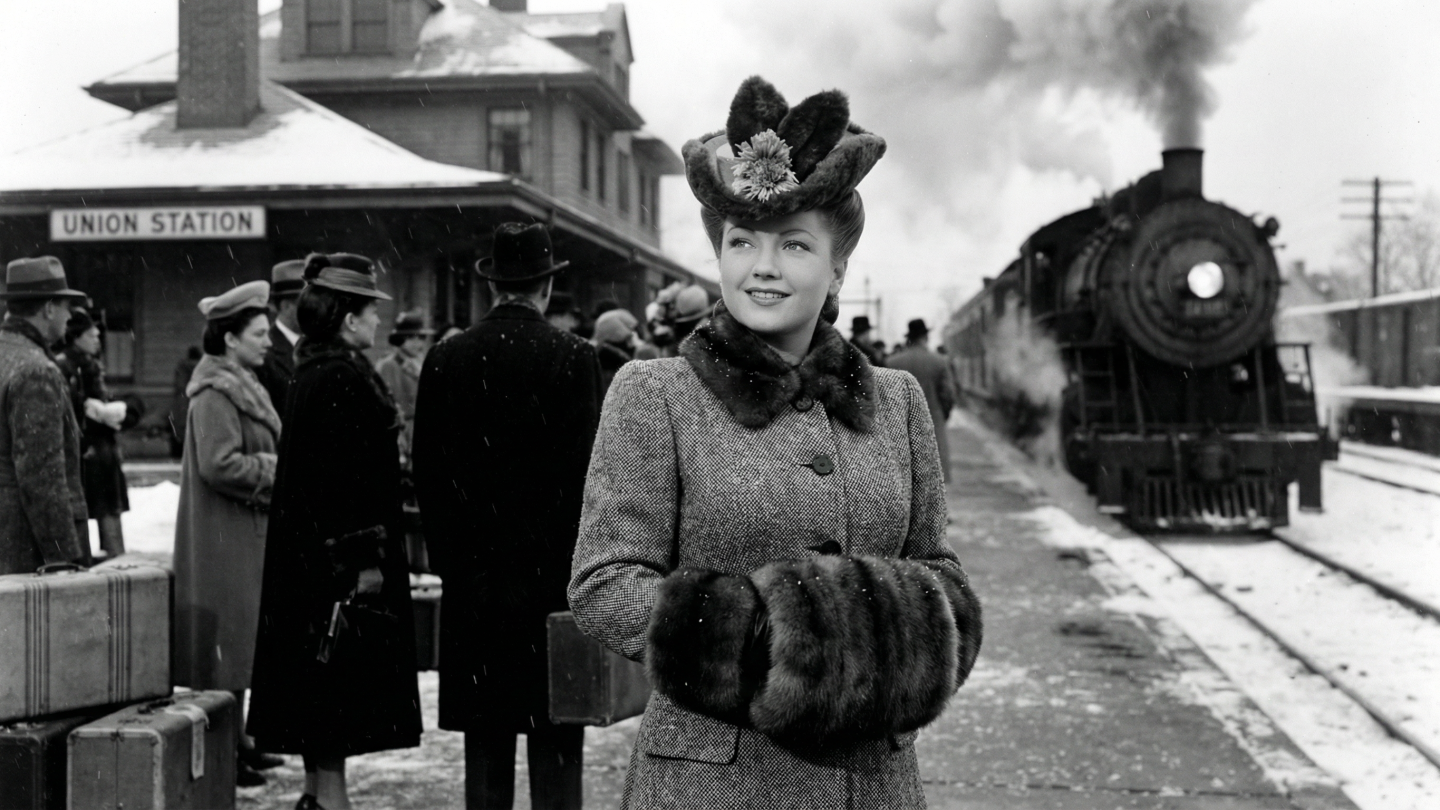
“Some people are going to be like, ‘Oh no, this is terrible,’ and some people are going to be like, ‘Okay, so wait, I’m going to be defending the butchering of this person’s vision and not even think about how to actually show what he was intending?’” Saatchi tells THR. “If I was to guess, the majority of the people that I’ve talked to across many different areas within Hollywood are of the view that…if it’s genuinely seamless and you can completely justify what you’ve done in terms of the decisions, maybe it is a service to cinema to see what the greatest filmmaker of all time at the height of his powers made.” (You can see one of the new shots above.)
Saatchi adds, “We’ve had a lot of outreach from established directors who are like, ‘This is pretty cool, this is a great idea’” — though at this stage, he says he cannot name any of them. (He has not heard from Martin Scorsese, at least, who once expressed interest in reconstructing Ambersons, according to film historian Robert Harris.) Saatchi hopes to attract further filmmaker interest in joining the project as he progresses, granting it more legitimacy within the cinephile community.
The Welles estate was not approached about this project before it was announced last year, a communication lapse which Saatchi regrets. Orson’s daughter Beatrice Welles runs the estate and says now in a statement to The Hollywood Reporter, “Like most people I’m quite terrified of AI and in many ways wish it had never been invented.” She had no further comment, pointing back to what she told The New Yorker last month: “As far as Ambersons is concerned, I’m a purist and wish that originally it had never been tampered with. Nobody and nothing can think like my father. In regards to what Fable Studios is doing, while I am skeptical I know they are going into this project with enormous respect towards my father and this beautiful movie and only for that I am grateful.”
Saatchi says that he has spoken with the estate recently, and “they’ve been really open-minded about it. I think, for them, it’s about the intention and how it works structurally.” He believes his Ambersons “is going to be a disaster if it’s distracting, and so it’ll be very obvious if we’ve succeeded.” He describes the project as an academic exercise as opposed to a commercial one like The Sphere’s Oz. “It’s kind of a terrible turning point in cinematic history that we’re trying to undo to some extent,” Saatchi says of his effort.
If the pair pull it off, the implications could be massive, revealing AI’s potential to convincingly resurrect and reinvent our cinematic history — a potential that before the tech had remained firmly theoretical. That, Rose believes, would bring great benefit. “When I think about the first milestone use of AI in this medium, it could be really without redeeming value — propaganda to foment disunity and confusion, something that exploits a person’s likeness, something pornographic,” Rose says. “Edward and I are trying to use AI to give something back. That’s also a motivating factor: This could be a really beautiful, redeeming way to employ this technology, which is still being worked out and can be scary and leave a lot of people with uncertainty.”
***
For all the backlash AI has generated in Hollywood, those practicing restorations are holding firm. Representatives for The Sphere were not available to speak for this story, but a source familiar with its Oz says that “using AI was the only way to maintain the integrity of the original film.” The endeavor began with solving the problem of altering a movie shot for a 4:3 screen to fit The Sphere’s unique — and enormous — dimensions, and AI models were trained on that original source material. Critics maintain that director Victor Fleming and the original film’s other late artists had no say in their work essentially feeding a machine for the generation of new performances and images. The source familiar with the Sphere says that “respecting the original was a priority.”
Some film veterans are less convinced. Daniel Rorer, the Oscar-winning filmmaker who directed the new AI survey film The AI Doc: Or How I Became an Apocaloptimist, says he has problems with restorations not made with a late filmmaker’s consent, like an Oz or an Ambersons. “To be like, ‘I know that the artist doesn’t have any agency over this, but I’m just going to do it, I want to do it,’ is just a dystopic, selfish, postmodern dumpster fire of a use case for the technology, in my opinion,” he says. “Do we have to be fucking with everything that was made in the past? Can we just let things exist?… It is kind of inconceivable that you’d go to the Sistine Chapel and they’d be like, ‘Hey, yeah, we decided we wanted to change some elements to the ceiling — we zhuzhed it up a little bit.’”
Acland adds that the RKO cut, flawed as it might be, actually contributes to our appreciation of Welles’ artistry. “The fact that the studio back in 1942 insisted on re-edits and a happy ending and taking the film away from Orson — well, that’s part of Orson Welles’s story, and makes the film interesting to watch for all of its flawed components.” he says. “The idea we’re going to go back and fix that is a historical absurdity…. What you’re going to get is a shell of that technological component on top of it.”
Saatchi, at least, welcomes pushback — and at times doesn’t even refute it. “Even this, which I feel is clearly done with the best of intentions, has things that are kind of ethically indefensible,” he says, pointing to his project’s generation of new performances with deceased actors’ likeness without their consent. “There is no argument for why that’s defensible — other than that’s the only way to do it.” He believes that anyone taking up the mantle of AI-driven restoration should acknowledge at the outset that “This is not a wholly good thing.”
This raises an obvious question: Why do it at all?
For better or worse, The Sphere’s Oz has introduced a new generation — indeed, a whole new demographic — to Golden-Age cinema as few in the modern era have been able to. The huge commercial potential is another obvious matter. The case for Ambersons, meanwhile,is very specific to Saatchi and Rose, who both harbor a lifelong obsession with completing this work. The situation is also unique in that, over Rose’s many years of compiling and constructing, they have an exact blueprint to follow. The goal is precision in capturing Welles’s vision, not making stuff up.
Rose sees many other opportunities in this vein: “The only limit is the will and obviously the resources necessary to dedicate to a project… this may put me in the minority, but I’m someone who doesn’t feel so protective of a certain film like, ‘Oh, how dare you, you can’t do this.’” But like many noted filmmakers currently speaking out against AI, Rorer argues the opposite: “What is art? To me, art is a human expression of creative activity that expresses some truth about being human that says, ‘I was here, I existed, this was my experience, this is how I felt.’”
In his 1986 New York Times essay, Canby noted that a colorized, or “tinted,” version of the 1937 film Topper had made $1 million, mostly in TV syndication dollars, by publication time. “If income like that can be earned by even a nonclassic screwball comedy,” he wrote, “we may soon be seeing a young Charles Foster Kane with orange hair.” For today’s Welles purists, that would be the least of their concerns.
This story appears in The Hollywood Reporter’s upcoming AI Issue, out in April.