Following in the esoteric footsteps of the folk singing espionage of Amazon’s Patriot, the noir musical puppetry of AMC+’s Ultra City Smiths and whatever mysterious cult-y thing was happening in MGM+’s (then-Epix’s) Perpetual Grace, LTD, HBO’s DTF St. Louis is probably creator Steven Conrad‘s most accessible and easily describable television project to date.
The tricky part, though, is that the series I’m about to describe for you isn’t the series that DTF St. Louis actually is — which will probably tick off the viewers who’ve watched the trailer and tuned in for something tawdry and outrageous, and leave out the viewers who would respond well to the truly odd, but also emotionally raw suburban melodrama it seems to be by midseason.
DTF St. Louis
The Bottom Line
Coarse and semi-funny, then sentimental and semi-moving.
Airdate: 9 p.m. Sunday, March 1 (HBO)
Cast: Jason Bateman, David Harbour, Linda Cardellini, Richard Jenkins, Joy Sunday, Arlan Ruf, Peter Sarsgaard, Chris Perfetti
Creator: Steven Conrad
And the problem with that is that critics have been sent only four out of seven episodes and, as much as I hate the hoary cliché, there are absolutely two wolves inside of DTF St. Louis. One is cynical and snarky, with a sour-to-the-point-of-curdled view of humanity, and the other has a heart full of sentiment, drunk to the point of passing out on the milk of human kindness.
These are the two wolves inside Conrad’s other TV and film projects as well, and he’s at his best when neither wolf triumphs entirely. Which presents the challenge of reviewing DTF St. Louis. I was interested that it wasn’t the show it initially presents itself as, and I found something satisfying about the fourth episode, which almost could have functioned as a finale. But there aren’t three additional episodes’ worth of puzzles left to be solved, and almost all of the paths I can imagine filling out the time are frustrating in different ways — leaving me positive-ish about what I’ve seen, but politely skeptical about the prognosis from here.
The sniggering and somewhat puerile tone suggested by the title is a, if not the, predominant tone of the first episode or two of the series, which is wholly written and directed by Conrad.
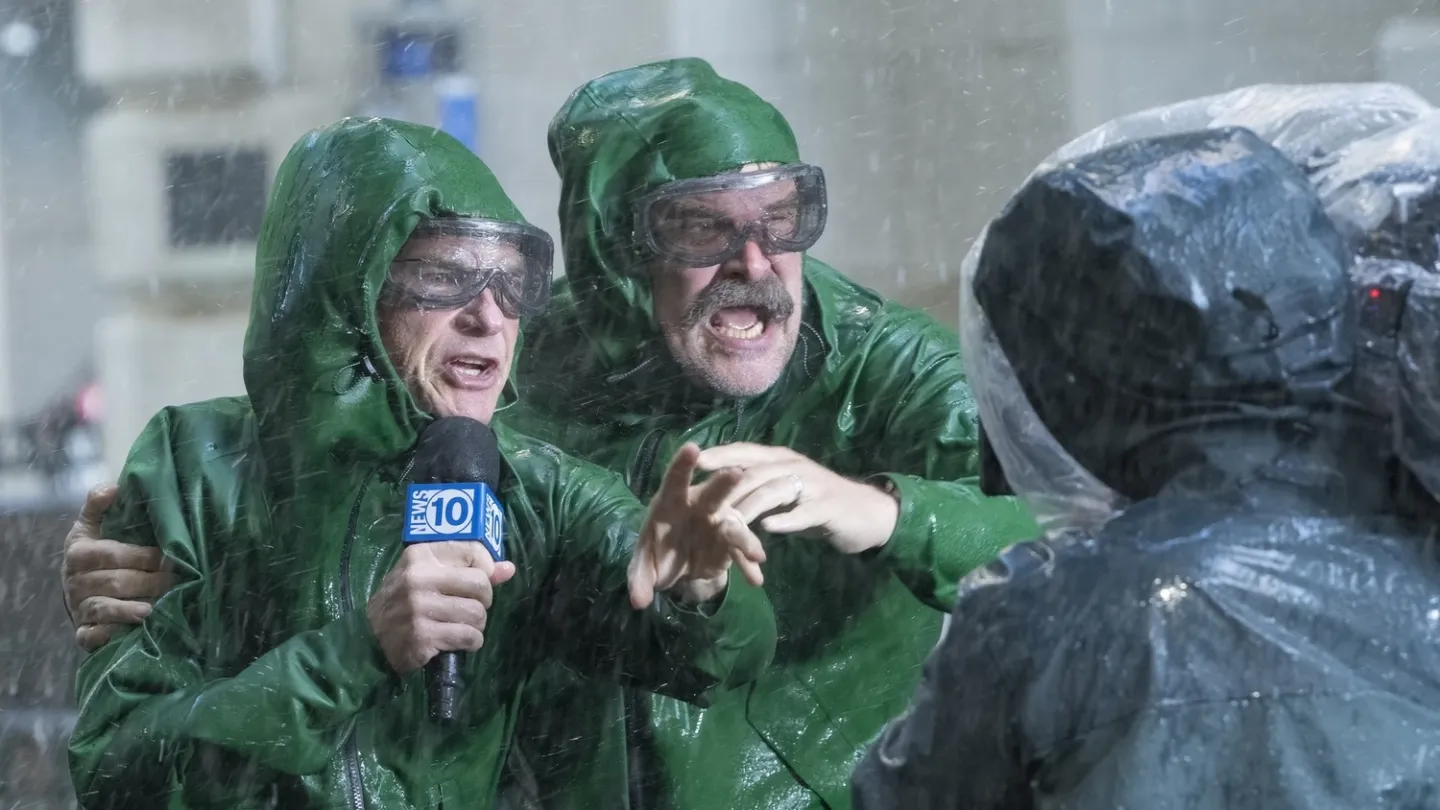
Jason Bateman plays Clark Forrest, star weatherman for a big St. Louis station. Most of our sense of Clark as a character is determined by our assumptions about weathermen, a profession that Conrad finds fascinating mostly in symbolic, rather than practical, terms. In a chaotic and unpredictable world, somebody with artificially TV-friendly looks stands in front of a map that isn’t there and attempts to prognosticate the unknowable future. And unlike carnival fortune teller, this is a celebrated profession, to be placed on billboards that tower over the city.
One day, Clark, who rides his recumbent bike into the city, is reporting on a cyclone when he nearly gets decapitated by a flying stop sign. He’s saved by Floyd (David Harbour), the station’s new ASL translator.
Floyd, who only started learning ASL a year earlier and isn’t deaf or hard of hearing but does have an abnormally curved penis thanks to Peyronie’s disease, is an affectionate teddy bear of a man, struggling to relate to his stepson Richard (Arlan Ruf) and looking to rekindle the spark with his wife, Carol (Linda Cardellini) amid financial instability.
Clark and his wife Eimy (Wynn Everett, in a role whose underwriting has me perplexed thus far) come over to Floyd’s house for BBQ and cornhole, and there are clear sparks between Clark and Carol.
Some time later, Clark is telling Floyd about a new app called DTF St. Louis, for married people looking for a little extramarital sex. Clark is having an affair with Carol. And soon, Floyd is dead.
That, incidentally, is not a spoiler. It happens in the first 10 or 15 minutes of the pilot. The investigation into the death is conducted by Donoghue Homer (Richard Jenkins), a detective of the St. Louis County Sheriff’s Office, in awkward jurisdictional consort with Jodie Plumb (Joy Sunday), an officer with the special crimes unit in their St. Louis suburb.
It also is not an indication on how much Harbour appears in the series. He’s here plenty. Conrad likes telling stories that are temporally fragmented, introducing a narrative in the present tense and then jumping back to many different points in the past without obvious hand-holding on when in the timeline we are or which pieces of the established story are about to get fleshed out or, as is the case here, which parts of the narrative have been presented to us through the eyes of an unreliable character.
DTF St. Louis is a story about male friendship, marriage, sex and presumably murder, but it’s less about those things themselves and more about the politics of relationships: Who gets what out of doing what to whom? The often bleak opening episodes suggest that relationships in this show are rarely about pleasure or kindness. At best, they’re transactional, in which each participant is getting something from the exchange. But what if, the series ponders, a sardonic approach to humanity, one typified by Bateman’s vaunted and inherent insincerity, was only how it all appeared on first glance?
“No one’s normal, it just looks that way from across the street,” explains the character played by Peter Sarsgaard, another of the actors whose snake-y essence Conrad utilizes well here.
Oh, and people lie. All the time. Big and small, benign and nefarious, calculated and spontaneous.
Every piece of information we’re given in the first few minutes of the show has to be reexamined, from the evidence at the crime scene to characters’ go-to orders at Jamba Juice.
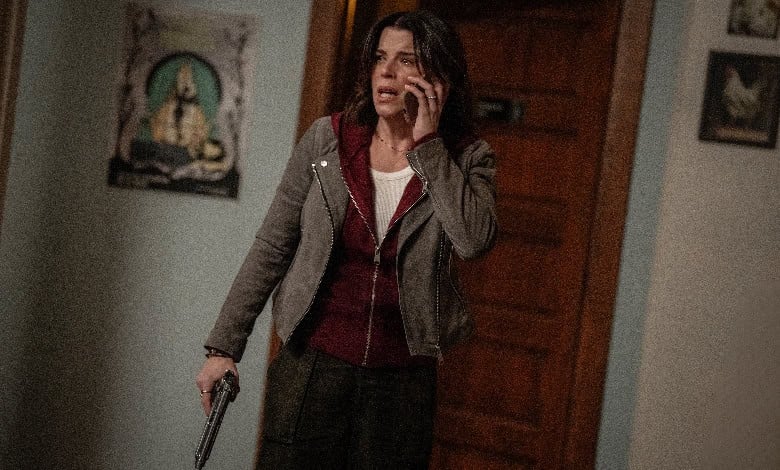
Both Bateman and Cardellini are effectively playing two versions of their respective characters — the most and least generous interpretations — which makes it hard for me to exactly parse either performance. The show’s perspective that sometimes what separates a bad guy from a good guy is the empathy of the observer, is intriguing, but somewhat an exercise. I spent four episodes, of between 47 and 57 minutes apiece, constantly aware of their acting choices, which are more as gears within Conrad’s storytelling machinations than as people. So far. Eventually it’s possible, or even likely, that the show must reconcile its character extremes (Cardellini comes closer at this point). That’s something I can speculate on, but not review.
Harbour has the tougher, but more immediately fruitful, part. From the beginning, it’s tempting to try to diagnose Floyd. Is he a lovable man-child or a pitiable case of arrested development? Does he have PTSD from something unmentioned? Is he on the autism spectrum? Both Harbour’s actual performance and the evolution of the character in the script are designed to keep viewers adjusting. Even Harbour’s physicality — the actor has put on weight and spends much of the show in ill-fitting attire or partially disrobed — is meant to elicit more than one response.
Anybody who has seen an earlier Conrad show will recognize his particular cadences and oddball choices. The dialogue boasts his familiar repetitions, conversational digressions (a debate about pornography spurred by a themed Playgirl spread is especially good) and overall awkwardness. The non sequiturs, or seeming non sequiturs (like Carol moonlighting as a baseball umpire despite having little knowledge of baseball) abound. Sardonic uncertainties about the solvency of the American Dream permeate every scene.
This may be the first time that Conrad has brought his mushy streak — seen in The Pursuit of Happyness, The Secret Life of Walter Mitty and Wonder — to the small screen to this degree, and having been uncomfortable with the emotional manipulation of several of his feature scripts, I’m wary about where these next three episodes have to go. The possibilities for either an overload of unearned feelings or a frustrating reversal back to darkness loom threateningly.
I’d be less worried about where the tone of DTF St. Louis is headed if there were more pieces of the mysterious puzzle still awaiting revelation. The thing I enjoyed the most about Patriot, other than Conrad’s love of meaningless jargon and impenetrable wordplay, was the little miracles that occurred when two divergent storylines meshed in the least expected way. Those happened several times per episode, covering for the myriad ways I found the show to be off-putting.
So far in DTF St. Louis, those “Eureka!” connections have been less plentiful and less revelatory, in part because of how frequently characters remind us that we’ve been looking at things the wrong way. Conrad is the puppeteer and his characters the puppets, and the strings have been painted in neon orange so you never forget that just because Conrad’s visual depiction of Midwestern suburbia has a sterile, grimy authenticity, nothing here should be treated as realistic.
It’s all potential as of yet. The opening hours, presented in more comedic terms, are a little funny, but not in a way that left me demonstrably laughing. The next two hours, presented in more dramatic terms, are humane, but not in a way that quite reaches poignancy. You could tell me that the last three episodes take DTF St. Louis some place revelatory and excellent or that they end up contrived and insufferable, and neither outcome would shock me.
The challenge, as Detective Homer, the sort of stick-in-the-mud balding authority figure Conrad loves messing with in his shows, puts it: “[Y]ou never know the whole thing and you have to trust the evidence that you have.”
The evidence I have is intriguingly inconclusive.