Growing up in Toronto, Maggie Kang felt she needed to conceal her obsession with H.O.T., the mid-1990s idol group whose tightly synchronized choreography, chantable hooks and lurid crimson hair — sometimes topped with ski goggles — helped define the template for modern K-pop.
“I had to hide that I liked K-pop,” says Kang, co-writer and co-director of KPop Demon Hunters. “Even my Asian friends thought it was lame. But it was just part of me — it wasn’t escapism, it was identity.”
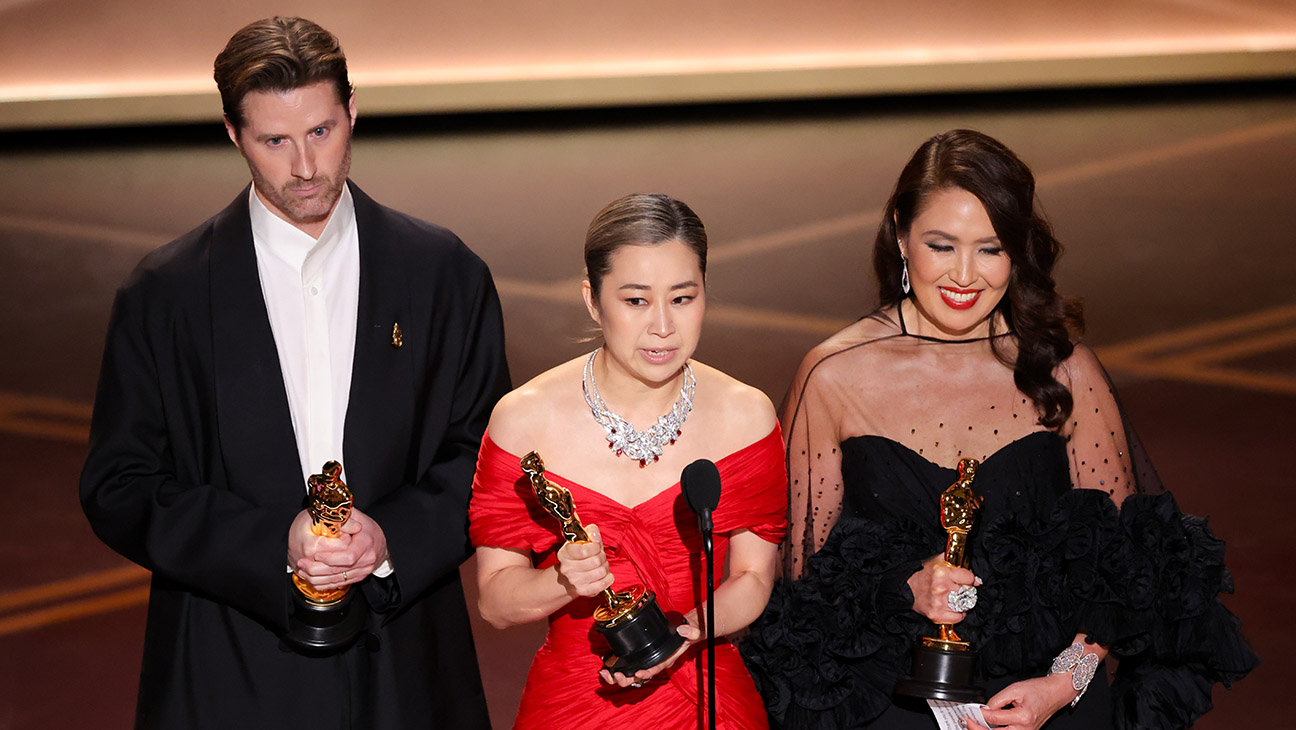
These days, Kang no longer is hiding. On March 15, her hyperkinetic animated Netflix hit — in which a K-pop girl group, Huntrix, juggles global superstardom while slaying soul-eating demons disguised as a rival boy band — made history by winning best animated feature at the Academy Awards. Its self-affirmation anthem, “Golden,” currently being belted by 10-year-olds and their parents from Los Angeles to Osaka, became the first tune by a K-pop act ever to win best original song.
Accepting the award, Kang tearfully apologized that it took so long “for those of you who look like me” to see themselves represented in such a film.
It wasn’t the Academy’s first encounter with K-culture — Parasite won best picture six years ago — but Sunday’s wins felt different, as if a wave that had been building for years had finally crested. Korean culture has been filling stadiums, with BTS and Blackpink drawing crowds once reserved for Beyoncé and Taylor Swift. Industry analysts put K-pop net export revenue — including album sales, touring receipts, streaming royalties — at an estimated $1.8 billion in 2025.
It has invaded the living room, as well, with Squid Game among the most watched series in Netflix history, and the dining room, too, with Korean restaurants expanding rapidly — a 10 percent growth in their numbers in just 2024 alone — amid surging demand for Korean fried chicken. It’s even reached the freezer aisle at Costco — where shoppers have repeatedly exhausted supplies of frozen kimbap — and now features prominently at beauty store counters, where an army of Gen Z consumers slather on Korean creams and serums infused with snail mucin, rice water and bee venom.

Tae Ju Kang and Minha Kim in Pachinko.
Apple TV+
All of which raises a glaring question: How did South Korea — a middle power of some 52 million people, a nation still emerging from a century of colonization, war and military dictatorship as recently as the 1980s — manage to pull it off? How did this modest peninsula nation end up with such a colossal cultural footprint in America?
The answer, it turns out, is complicated, involving almost as many moving parts as an intricately choreographed Seventeen dance number.
Korea Had a Long Game
The Korean Wave didn’t just happen. It was engineered over decades.
In the 1990s, a South Korean presidential advisory report helped shape the course of Korean industrial history: included in its pages was the note that Jurassic Park had generated revenue roughly equivalent to the export value of 1.5 million Hyundai cars. The statistic galvanized South Korea’s industrial planners. Their country had already conquered global markets with electronics and automobiles. Why not stories?
What followed was a deliberate government-backed push to build a cultural export industry. State subsidies for filmmakers and reinforced screen quotas shielded local cinema from Hollywood dominance while constructing the infrastructure for an industry capable of projecting Korean stories internationally.
Into this ecosystem stepped Miky Lee, the granddaughter of Samsung founder Lee Byung-chul and now the vice chairwoman of CJ Group, South Korea’s largest entertainment conglomerate. With a Harvard master’s degree and the poise of an old-school Hollywood star, Lee moved easily between Seoul boardrooms and Cannes red carpets, earning the nickname “The Godmother.” Others called her the chief architect of K-culture’s American ascent.
In 1994, Lee was working as director at Samsung Electronics America when a lawyer called with a proposition: Steven Spielberg, David Geffen and Jeffrey Katzenberg were looking for backers for a new studio. She brought the proposal to her uncle, Samsung Group chair Lee Kun-hee — but Samsung walked away from a dinner at Spielberg’s house, unwilling to back a venture it couldn’t control. According to accounts of the meeting, Spielberg reportedly noted that Lee had been the only one in the room interested in art rather than semiconductors.
DreamWorks, impressed, came back to her directly. By then, CJ, which had gained operational independence from Samsung in 1993, was charting a new course as a “lifestyle and culture” group. Lee took the deal to her brother Jay Lee, who ran the company, and the two flew to Los Angeles. Over pizza at Spielberg’s studio, clad in jeans, T-shirts and sneakers, they committed $300 million for a 10.8 percent stake and Asian distribution rights. Katzenberg would later say there were two people without whom DreamWorks would not exist: Paul Allen and Miky Lee.
The investment proved pivotal — and not just financially. Back in Seoul, Lee used the DreamWorks partnership as a master class, helping to build Korea’s modern film infrastructure from the ground up: multiplexes, studios, distribution networks. Directors like Bong Joon Ho and Park Chan-wook had a platform at home to hone their craft before finding global audiences. Korea’s contemporary film industry, in other words, was built on a pizza deal.
“When Parasite went to Cannes, it was like, ‘Wait, Koreans make movies the world wants to see?’ ” says Soo Hugh, showrunner of Pachinko, the Apple TV+ epic about a Korean family’s journey across three generations. “Miky Lee opened Hollywood’s eyes to the fact that Korean culture was worth money.”
Lee, an executive producer of Parasite, has described the 2020 Oscars — when the film became the first non-English-language picture ever to win best picture — as an “impossible dream.” The film grossed $53 million at the U.S. box office and in June topped The New York Times’ ranking of the century’s best films. Weeks before the Oscars, Bong accepted the Golden Globe for best foreign language film and delivered a line that became its own cultural touchstone: “Once you overcome the 1-inch-tall barrier of subtitles, you will be introduced to so many more amazing films.”
2019’s Parasite
The Right Content. The Right Pipeline.
K-culture’s global breakout required two things happening at once: a production culture disciplined enough to make stories that could travel and a distribution platform with the scale to send them everywhere simultaneously.
Netflix provided the latter. Over the course of the past decade, the streamer shifted from licensing third-party shows to producing local-language originals — and its simultaneous global releases gave hits like Squid Game and Demon Hunters, which has surpassed 540 million views, audiences far beyond Korea’s borders. A 2024 CivicScience survey found that 56 percent of Gen Z and younger millennials prefer to watch content in its original language — a generation saturated by algorithmically engineered sameness hungers for something that feels genuinely different, even if that means braving subtitles.
But Netflix could only work with the narratives Korean creators gave it. And what they gave it stood out partly, argues Daniel Armand Lee — better known as Tablo, the Korean Canadian leader of Epik High and a pioneer of Korean hip-hop — because they had no choice. Working without Hollywood’s franchise infrastructure or Marvel-scale production budgets, Korean artists couldn’t paper over a weak story with expensive spectacle. “We didn’t have the luxury of throwing money at a problem,” he says. What they had instead was craft — and they got very good at it.
James Shin, president of film and TV at HYBE America, the U.S. arm of the entertainment company behind K-pop sensations BTS, Seventeen and Le Sserafim — and a producer on an upcoming, still-untitled Paramount K-pop film — sees that discipline baked into the Korean production system itself. “These lightning-in-a-bottle moments keep happening,” he says. “Unlike Hollywood’s endless ‘development hell,’ Korean projects are built for completion, with room for last-minute creative shifts.”
The Fans Became the Strategy
In America, the entertainment industry has always worked one way: Make the thing, then find the audience. K-pop inverted that model entirely. With BTS, the seven-member group trained under Korea’s hyper-structured idol system, the fans weren’t a byproduct — they were part of the product, actively shaping it through voting, streaming campaigns and social media mobilization that fed directly back into creative and commercial decisions.
Shin notes that BTS, which fused hip-hop, R&B and EDM with distinctly Korean storytelling, created the template for K-culture’s rise by pioneering a fan-engagement model that extended Korea’s cultural footprint across music, fashion and social media. Fans became zealous cultural foot soldiers, streaming, voting and building global communities on Instagram, TikTok and Twitter. During BTS’ 2019 Love Yourself World Tour — at the time, the highest-grossing North American tour ever by an Asian act— U.S. stans flooded social media with coordinated campaigns, line-danced outside arenas and transformed hotel suites into pop-up shrines.
Artists across the industry credit BTS with a canny international strategy that expanded K-culture’s global sway. The group‘s strategic release of English-language singles starting in 2020 was key to its international success, dissolving the language barrier before American audiences even noticed it. Eric Nam, who stars in the upcoming Paramount K-pop drama alongside Ji-young Yoo, suggests that K-pop’s intricately synchronized choreography has been equally decisive. “One Direction didn’t dance. Justin Bieber didn’t dance. Korea, by contrast, doubled down: ‘We know this works. We’re going to make it incredible.’ ” And Kevin Woo, the K-pop veteran who provided the singing voice for Demon Hunters’ Mystery, notes that the softer, more emotionally expressive masculinity often associated with K-pop boy bands — “really elaborate costumes and hair and makeup,” he describes it — also resonates with female fans on both sides of the Pacific.
BTS
Hybe
The BTS template now extends beyond music. Demon Hunters was launched more like an idol debut than a conventional animated film. Netflix staged sing-along screenings in more than 1,700 theaters throughout the U.S., Canada, the U.K., Australia and New Zealand, where audiences sang tracks like “Golden,” waved light sticks and arrived dressed as characters.
Meanwhile, members of Blackpink have helped expand K-pop’s scope, projecting Korea’s already glittering brand onto Paris runways, acting as brand ambassadors for Chanel and Dior and helping K-pop evolve in the American imagination from a niche boy-band phenomenon into a broader cultural engine.
Han: Korea’s Secret Weapon
There’s a word Koreans use that has no real English equivalent: han. Roughly translated, it’s a profound, marrow-deep sorrow — a collective wound rooted in a century of colonization, war and division that never quite heals. It permeates Korean storytelling: the unresolved endings, the flawed heroes, the villains you can’t quite hate, the sense that the system will probably win. It is, in other words, the opposite of a Hollywood ending.
And right now, American audiences can’t get enough of that fallibility. After decades of algorithmically optimized uplift, superhero franchises and stories where good reliably triumphs over evil, something has shifted. In a polarized country grappling with inequality, institutional failure and collective anxiety, the emotional honesty of Korean narratives — messy, painful, darkly funny, unresolved — feels less like foreign cinema than like recognition. You can see it in the class warfare of Parasite, the dystopian dread of Squid Game, the simmering immigrant rage of Beef, Lee Sung Jin’s Emmy-winning Netflix thriller. Han, it turns out, travels.
Soo Hugh knows han from the inside. Her grandmother, who lived through the Korean War and its aftermath, recounted that her family was so poor that they boiled rocks to make stone soup. “All Koreans carry these dark stories,” Hugh says. “But my grandmother told them laughing.” That combination — genuine suffering refracted through dark humor, hardship worn lightly — is exactly what American audiences are finding so alluring in Korean stories right now.
“I don’t think people realize how newly modern Korea is,” Hugh says. “K-dramas began as escapism — necessary escapism.”
Kang felt it too, shaping Demon Hunters from her own inherited han. Her father fled North Korea, and she grew up in Toronto carrying the divided inheritance that marks so many Korean families. “I think han is just something you inherit as a Korean person,” she says. “My dad’s side of the family is North Korean, so I feel very much part of this sorrow of a country that is divided. That’s something I thought about when writing the story — somebody who is split, with two sides that want to exist together, but it’s really hard.”
Arden Cho, who voices Rumi, the purple-haired half-demon, half-demon hunter grappling with her divided identities in Demon Hunters, observes that Korean storytelling resonates because it embraces a messy world that gleefully defies the binary moral codes of traditional Hollywood. The animated pop stars of the film are not idealized “Disney princesses” but flawed idols who slurp ramen, burp, cry, doubt themselves and have bad hair days.
The Jump Rope game in season three of Squid Game.
Netflix
For Many Korean Creators, Hollywood Was Already Home
Part of what has made K-culture’s American breakthrough so seamless is that so much of it is now made by Americans — Korean Americans who grew up with a foot in both worlds and the instincts to navigate between them. Demon Hunters was co-written and directed by a Canadian Korean woman raised on H.O.T. Pachinko’s showrunner grew up in suburban Maryland rewinding K-drama cassettes in her mother’s video shop.
“The gap between Seoul and L.A. is gone,” says Shin. “Now it’s ‘made with Korea,’ not ‘made for Korea.’ ”
Their projects do not overexplain Korea to Americans but trust audiences to inhabit both cultural spaces at once. Kang noted that Demon Hunters’ visual style was consciously shaped by her lifelong love of anime and manhwa — Korean comics and graphic novels — and executed with careful attention to Korean linguistic and cultural nuances, even though the film’s lingua franca is American English.
“We worked really hard on the details,” she says. “Even the way the mouth shapes move — I wanted it to feel like Korean was coming out of their mouths even though they’re speaking English.”
The opening credits of Pachinko embody this cultural synthesis: characters dance in a pachinko parlor to the 1960s American pop anthem “Let’s Live for Today” — immigrant striving projected through an unmistakably American pop tableau. Beef does something similar, translating immigrant frustration into the visual vocabulary of an American thriller, animated by distinctly Korean notions of family honor, shame, resentment and parental pressure.
But Will It Last?
The ultimate measure of K-culture’s conquest may be this: Hollywood has stopped trying to compete and started trying to join. CJ, later known as CJ Group, helped build the infrastructure for Korean cinema three decades ago and is now a fixture at the Hollywood deal table. Korean directors, writers and producers no longer are supplicants at the gate — they’re partners.
The question now isn’t whether K-culture has arrived. It’s whether the machinery that made it so effective — the scrappy production discipline, the emotional authenticity, the genuine creative hunger — can survive its own success. As K-pop spurs franchises, copycat spinoffs and big studio blockbusters, the system that propelled K-culture’s rise could stumble if its authenticity starts to waver. And even if it doesn’t, K-culture fatigue and oversaturation could prove to be a challenge.
Arden Cho, for one, isn’t worried. Her upcoming psychological thriller Perfect Girl features nine Asian and Asian American female leads spanning three generations — flesh-and-blood actors this time, not animated heroines. “I hope that we continue to create more dynamic stories that are bold and don’t shy away from who we are,” she says.
As for Maggie Kang — she accepted an Oscar on Sunday night. It’s a long way from hiding H.O.T. albums in Toronto.