When stage star Richard Bean (Kevin Kline) needs a loan to finance his latest project, he makes his pitch the only way he knows how: by launching, unprompted, into a speech from Hamlet. At first, the banker is startled. By the end, he’s applauding furiously, along with every other employee and customer who happens to be in the bank that day.
Call me a cynic or a philistine if you must; I, for one, cannot imagine reacting so enthusiastically to being confronted with nonconsensual Shakespeare. But so it goes in the new MGM+ comedy American Classic, a theater-kid fantasy in which the play’s the only thing that really matters. If there’s something sweet about its earnest love for the dramatic arts, it comes at the expense of the groundedness that would have given this paean some heft.
American Classic
The Bottom Line
Blandly sunny and dully old-fashioned.
Airdate: Sunday, March 1 (MGM+)
Cast: Kevin Kline, Laura Linney, Jon Tenney, Len Cariou, Nell Verlaque, Billy Carter, Elise Kibler, Ajay Friese, Jessica Hecht, Stephen Spinella, Aaron Tveit, Tony Shalhoub
Creators: Michael Hoffman, Bob Martin
The series, from creators Michael Hoffman and Bob Martin, opens with two deaths, one literal and one metaphorical. Let’s start with the latter, since it’s the one that matters more. Richard is a Tony-winning actor whose latest Broadway turn as King Lear is playing to rave reviews … mostly. Shortly after opening night, a martini-drunk Richard corners a New York Times critic (Stephen Spinella) who had panned him, snatching his cane and aggressively monologuing Shakespeare at him.
Richard’s meltdown goes viral, putting his role — and maybe his career — on ice while his long-suffering agent, Alvy (Tony Shalhoub), scrambles to clean up the mess.
Then, just as he’s complaining to Alvy about the unfairness of it all, Richard receives a call from his brother, Jon (Jon Tenney), informing him of the literal death of their mother. That Richard’s first question is, “Did she read the review?” says everything about this man’s mostly benign narcissism.
No surprise that once he finally arrives in his hometown of Millsburg, Pennsylvania for the funeral, he decides to pull focus once more — this time by announcing a splashy production of Our Town, which he imagines will save his family’s struggling local theater and thus the town itself.
As befits the title, everything about American Classic feels old-fashioned, if not downright hokey. The plot tropes are familiar, from the vain actor to the quaint village to the show that’s going to save the day, and the predictable ways they play out. The cultural references are rarely less than 40 years old; aside from the aforementioned viral video, pretty much the entire story could have been set in the late 20th century with few changes. If its good-naturedness makes it impossible to hate, its blandness makes it equally difficult to love.
It doesn’t help that the series looks claustrophobically cheap, largely unfolding in a group of interiors that all seem lit in the same bright, flattening glow. A show needn’t necessarily be expensive to work — as we’re reminded many times throughout the season’s eight half-hours, Our Town is sparsely staged by tradition, and that hasn’t stopped it from enduring so long that it’s still inspiring new works like this one nearly a century later. But the lack of budget, in this case, is paired with a more disappointing lack of imagination.
For all the main characters of American Classic like to talk about the soul of the town and how to save it, the series displays little curiosity about the culture or citizens of Millburg. Granted, what glimpses we do see of them can be fun.
Len Cariou is endearing if woefully underused as Richard’s father Linus, an amiable puppeteer whose dementia has him coming out of the closet once a day to his friends and family, and Elise Kibler is amusing if very broad as Nadia, a Russian émigré whose passion for acting is outmatched only by her lack of talent for it.
But significant characters like Jon and Laura Linney’s Kristen — who in addition to being Jon’s wife is also Richard’s ex and the town’s mayor — are too underdeveloped to earn our investment. Neither their marriage nor their relationships with Richard are drawn with any nuance or specificity.
The next generation, represented primarily by their teenage daughter Miranda (Nell Verlaque), fares even worse. “Democracy is dying. People hate each other. The world is just falling apart. It’s different than when you guys were young,” she sighs to her uncle, sounding less like a real young person than a Boomer trying to paraphrase what his Gen Z grandkid was ranting about last Thanksgiving. He responds with a deep-cut reference to Viet Rock, because the show gets where he’s coming from in a way it can’t be bothered to try with her.
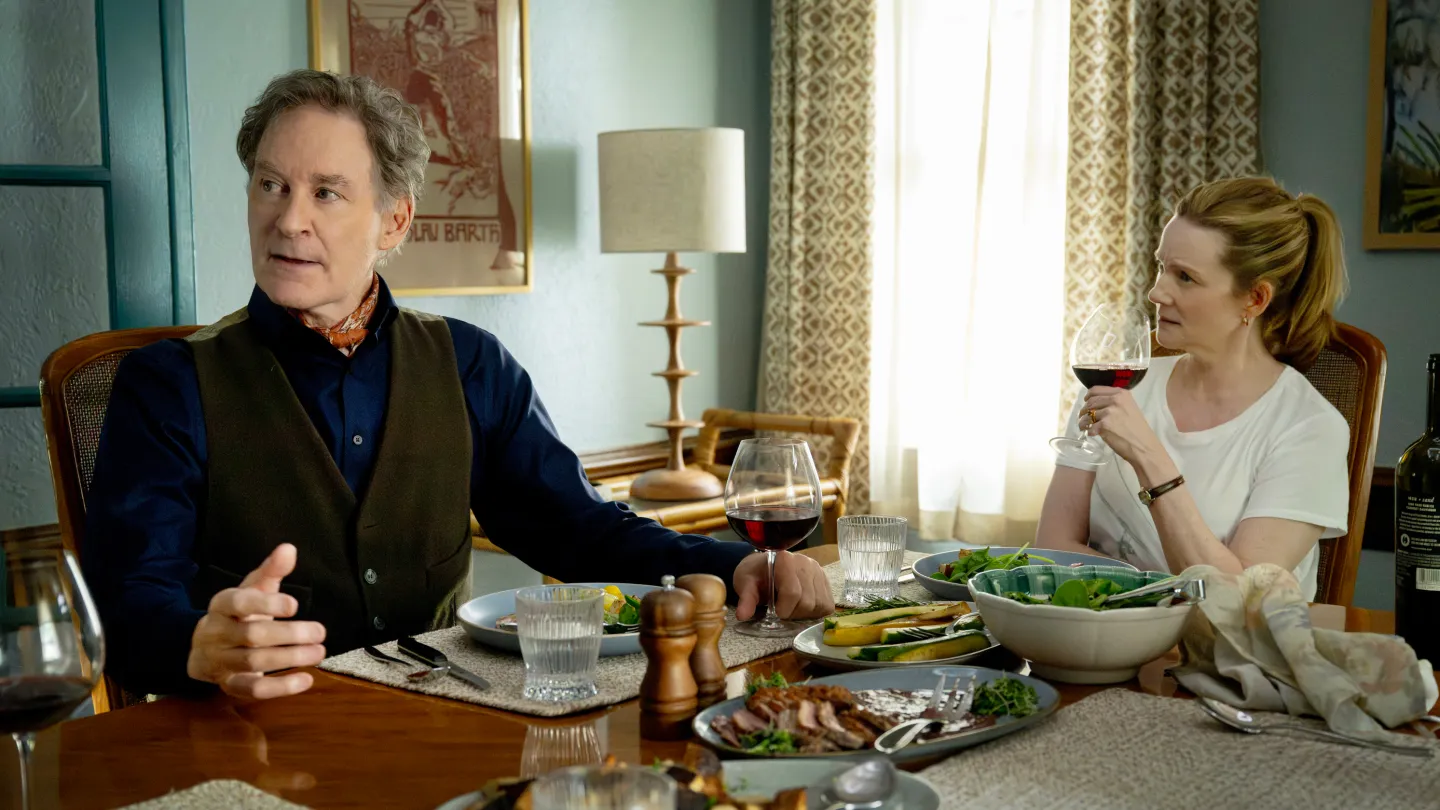
Richard is the only character the series cares about enough to grant any interiority, and though Kline plays him with a softness that stops him crossing the line from oblivious to off-putting, even he’s not written with enough complexity to keep from feeling like a well-worn cliché of a self-important thespian.
It’s telling that nearly all of the show’s most striking moments are characters performing lines written by other, greater playwrights (mainly Shakespeare and Thornton Wilder), often in moments where the predicaments they’re facing and the roles they’re playing blur together: Plays are the only lens through which Richard or his series are able to see the world at all. That American Classic knows and loves theater in its bones is not in doubt. That this passion for art has given it any greater understanding of actual human nature might be.