After I’m away on a long shoot, I always try to do trips with our boys or as a family. One of our sons was in his third year of studying Japanese at school, so we decided to go to Japan. We didn’t realize his eighth-grade spring break fell right in the middle of cherry blossom season. We kind of fell in the butter that way: We were lucky to hit it right at the peak, and it was sakura fever everywhere. I’ve never seen anything like it!
Japan takes a good amount of planning, and I owe a lot to the travel agent, Diane Sherer at Beyond, and the folks at Wondertrunk & co. in Japan. I think guides are instrumental. There’s customary behavior at certain temples, blessings and prayers you can ask for, and you don’t want to go into that blindly. It’s another culture and you want to be respectful.
We flew into Tokyo and stayed at the Lost in Translation hotel, the Park Hyatt Tokyo. Obviously, it’s iconic for me being a fan of cinema, and it’s great, very centrally located and with a huge breakfast buffet in the morning.
Japan’s is probably the most civilized culture I’ve ever seen. I’ll never forget watching Shibuya Crossing and being part of it. Having spent a good portion of my life in New York City, I was shocked that in Japan when it says, “Don’t walk,” no one walks. Shibuya Crossing makes Times Square look like a one-stoplight town in Indiana.
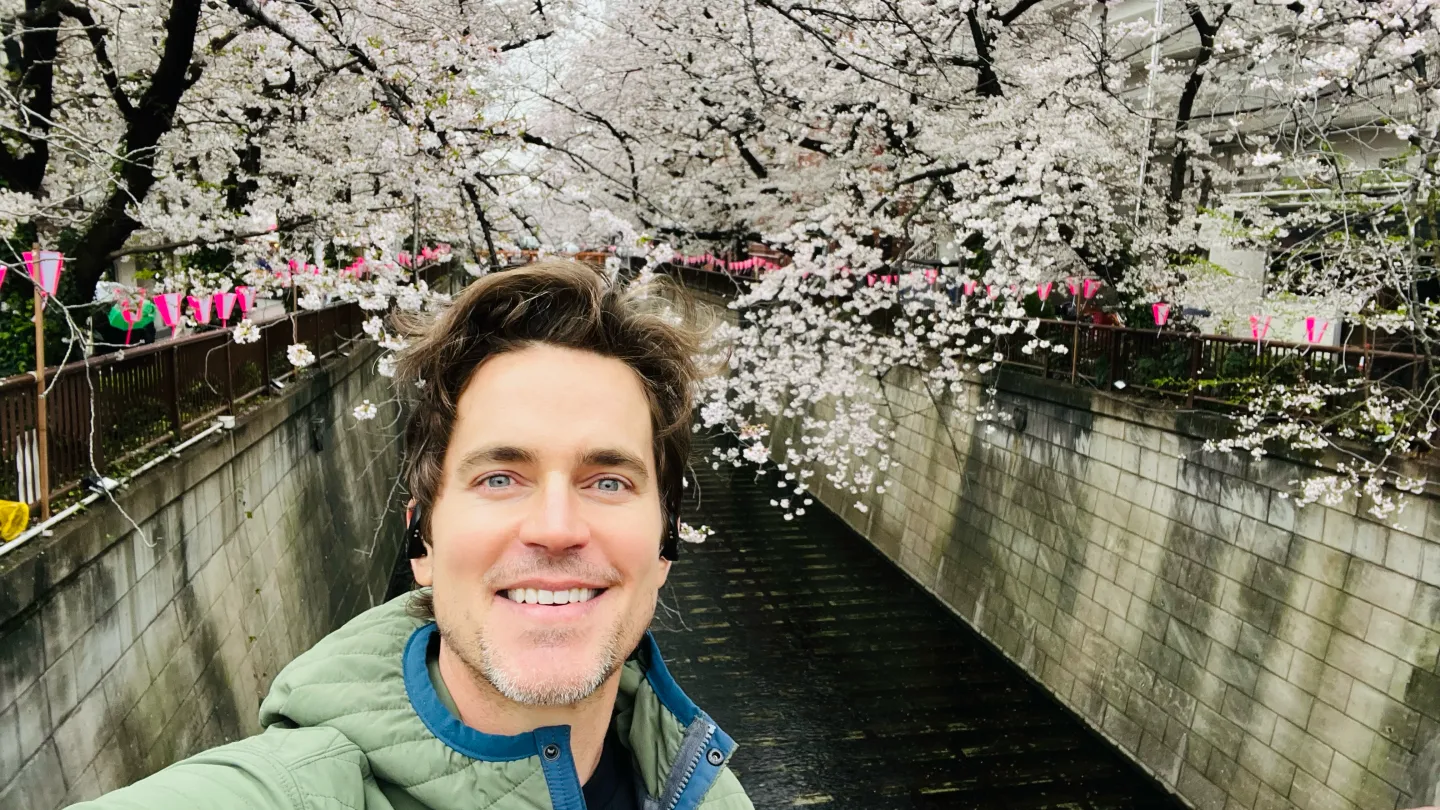
My son wanted to try Kobe steak, so we went to Hakushu Teppanyaki in Shibuya; it’s not terribly fancy, but the beef was so high quality. It’s right next to Sakuragaokacho, a street designed to elevate the cherry blossoms with all these beautiful LED light displays, which we enjoyed a walk through after eating. But Nakameguro is my favorite neighborhood: It’s an incredible, vibrant area with shops, cafes and food stalls, live musicians, young people and great thrift stores along a canal. During sakura season, the trees lean over both sides of the canal in full blossom.

Matt Bomer checked out Sakuragaokacho, a street in Tokyo with LED cherry blossom trees.
Courtesy of Matt Bomer
We did a sword fighting choreography class wearing traditional garb with the fight choreographer from Kill Bill, Tetsuro Shimaguchi. On a rainy day, we went to teamLab Planets, which is one of the coolest interactive experiences I’ve ever had in a museum. It’s sensory; at times you’re walking through water with projected koi swimming around you. We ended up doing a cruise on the Tokyo canals that was probably more for newlyweds, with plush pink cushions and a bottle of champagne on the boat. But the cherry blossoms were weeping over the edge of the canals, so the whole thing was spectacular.
teamLab Planets, a digital art experience, in Tokyo.
Courtesy of Matt Bomer
I recommend having a guide in Tokyo Station, because it’s really Byzantine and labyrinthine, and you can get lost. We took the bullet train to Kyoto, and it was incredible. But I was super jet-lagged and my passport dropped between our seats and I didn’t know it, so when we reached our hotel I obviously completely freaked out. Like an angel sent from heaven, there was an American diplomat behind me, and he said, “Don’t even worry about it. I promise you, in Japan it’ll be turned in in the next couple of hours.” He was right. Wondertrunk located it at Osaka station. The people in Japan are so honorable.
I loved Kyoto. When I go back to Japan, I will never miss Kyoto. Our hotel, The Mitsui Kyoto, was my favorite, the service was incredible; it had the most incredible onsen [hot spring] in the basement. It was so great that my son told me he wanted to get married there. It was like the bat cave, blacked out, with mist falling down on you — it looked like a 14-year-old kid’s dream hangout spot, with a hot tub and pool.
The lounge at Hotel The Mitsui Kyoto.
Hotel The Mitsui Kyoto
We visited Arashiyama’s monkey park and bamboo grove in one day, and the golden Kinkaku-ji Temple, which is stunning. Fushimi Inari-taisha shrine is really fun, but I’m really glad I went there early in the morning, before the crowds. And we did a Zen tea ceremony with a Zen Buddhist monk. He lived so simply, yet was so happy and joyful; it was really cool for our son to witness. Throughout Japan, the craftsmanship is incredible, and people take pride in the work they do, which is a refreshing, beautiful thing to see, for our son, too.
Kinkaku-ji Zen Buddhist temple in Kyoto.
Courtesy of Matt Bomer
Matt Bomer toured Fushimi Inari-taisha shrine in Kyoto and its Senbon Torii (“Thousand Torii Gates”)
Courtesy of Matt Bomer
We got to meet a young geisha in training in Gion who was [my son’s] age, 15, and that was a fascinating experience for him. He was very respectful and I thought his questions were really insightful. It was nice for both of them to see how similar certain aspects of their lives were — and different. Gion is fun, too, because you’ll be walking down the street and some geishas walk by and you’re like, “What?” It’s just so surreal. My favorite place of the whole trip was the Philosopher’s Path, a couple-miles-long walking path along a stream. With the sakura falling into the water and wild goldfish-colored carp swimming, it was such a peaceful experience.
Visiting Arashiyama Bamboo Grove.
Courtesy of Matt Bomer
We did a day trip to Osaka, and I would have stayed an extra day because I am obsessed with the food there and the people — I found them to be really, really fun. There’s a word in Osaka, kuidaore, which means “eat until you drop” culture. Even amid fancy restaurants, my favorite meal was the okonomiyaki [savory pancake] we had from a small restaurant our guide knew. I still am trying to find Osaka-style okonomiyaki here in L.A.! We went to the Osaka Castle, which overlooks the whole city and is not to be missed. It’s so grand it’s kind of mind-boggling, and there are beautiful, stepped walls you can climb up and overlook the city. The Dotonbori district is so alive and vibrant at night, with all kinds of street vendors, people laughing in the street, and these fun, glowing party boats going by in the canals. It’s really dreamy; I loved it there.
We finished our trip at a beautiful traditional ryokan in Hakone that overlooked Mount Fuji far in the distance, so you could just get an impression of the grandeur of it. The moment you get there you put on your yukata and the sandals and split-toe socks. There was an onsen, and the food was the most adventurous yet. Yet our pickiest eater broadened his horizons on the trip. Our son was down for everything, even the fish dishes I’ve never seen before.
Matt Bomer snapped a photo from the terrace of his room at a traditional ryokan in Hakone, Japan.
Courtesy of Matt Bomer
We’re going back for my 50th birthday — I want to spend it at this pizza restaurant Monk on the Philosopher’s Path, one of the best restaurants in the world apparently. I want my husband [Simon Halls] to see how magical Japan is. It’s a place I feel like everyone should visit at some point in their life. And it’s one of my favorite countries in the world, hands down.
The THR Hotel Edit
A trio of debut and recently renovated hotels in Tokyo, Kyoto and Osaka.
The Peak Lounge & Bar at Park Hyatt Tokyo.
Park Hyatt Tokyo, by Jouin Manku (c) Yongjoon Choi
Fresh off a sumptuous, elegant top-to-bottom renovation by Paris’ Jouin Manku, the so-called Lost in Translation hotel — known for its panoramic city views — is more arresting than ever, with additional suites, newly commissioned Japanese artworks, and a novel Alain Ducasse French brasserie concept, Girandole by Alain Ducasse. Yet the property’s alluring soul remains intact and it’s easy to imagine Bill Murray and Scarlett Johansson around every corner. The famed (and newly refreshed) New York Bar & Grill is as iconic and mouthwatering as ever, with live jazz nightly, and the Club on the Park spa is a divine place for downtime. Rooms from $1,026 a night.
A Capella Suite at Capella Kyoto.
Capella Hotels
In the geisha district of Miyagawa-cho, this newly opened bolthole with 89 rooms and suites represents a luxurious Japan take on quiet luxury. Designed by Kengo Kuma & Associates with Brewin Design Office, it draws inspiration from machiyas, traditional Japanese wooden townhouses. Intimate experiences are at the core of property. Guests can gain rare front-row access to private performances and encounters at the restored Miyagawacho Kaburenjo Theatre, located next door. The hotel also boasts a 12-seat counter and traditional teahouse-styled lounge bar called SoNoMa, created alongside Sonoma’s three-Michelin-starred SingleThread. There, seasonal bounty from Northern California’s Dry Creek Valley melds with Kyoto’s exquisite Kansai agricultural offerings. Rooms from $1,315.
The wellness pool at Patina Osaka hotel in Japan.
Patina Hotels & Resorts
Facing Osaka Castle and taking cues from its material and color palette, this hotel (the city sister property to Patina Maldives) opened its 20 floors last May, elevating Osaka’s hospitality scene. In addition to its 221 rooms, there is an entire 15,000-square-foot floor dedicated to high-tech meets holistic spa and wellness treatments and swimming. There’s a lot to love and experience, from bijou teppanyaki and plant-focused ultra-seasonal restaurants to the listening lounge bar and rooms themselves, with washi paper headboards evoking the castle’s walls, deep stone tubs and tatami mats. Rooms from $525. — Kathryn Romeyn
This story appears in The Hollywood Reporter’s 2026 Travel Issue. Click here to read more.