
Earlier this week, I woke up my phone and opened the YouTube app, watching some sports highlights, before switching to Netflix and finishing an old episode of Arrested Development. It was wholly unremarkable, save for the fact that we were cruising at 32,000 feet.
United Airlines is in the midst of installing Starlink internet across its fleet, and this was a demo flight, meant to demonstrate how the SpaceX-powered satellite internet service can deliver broadband as fast as you can get at home, even when cruising at 580 miles per hour six miles above the earth.
But United’s push to bring free high-speed internet to its aircraft also underscores what will become a new reality as other airlines follow: The streaming wars will soon take to the skies.
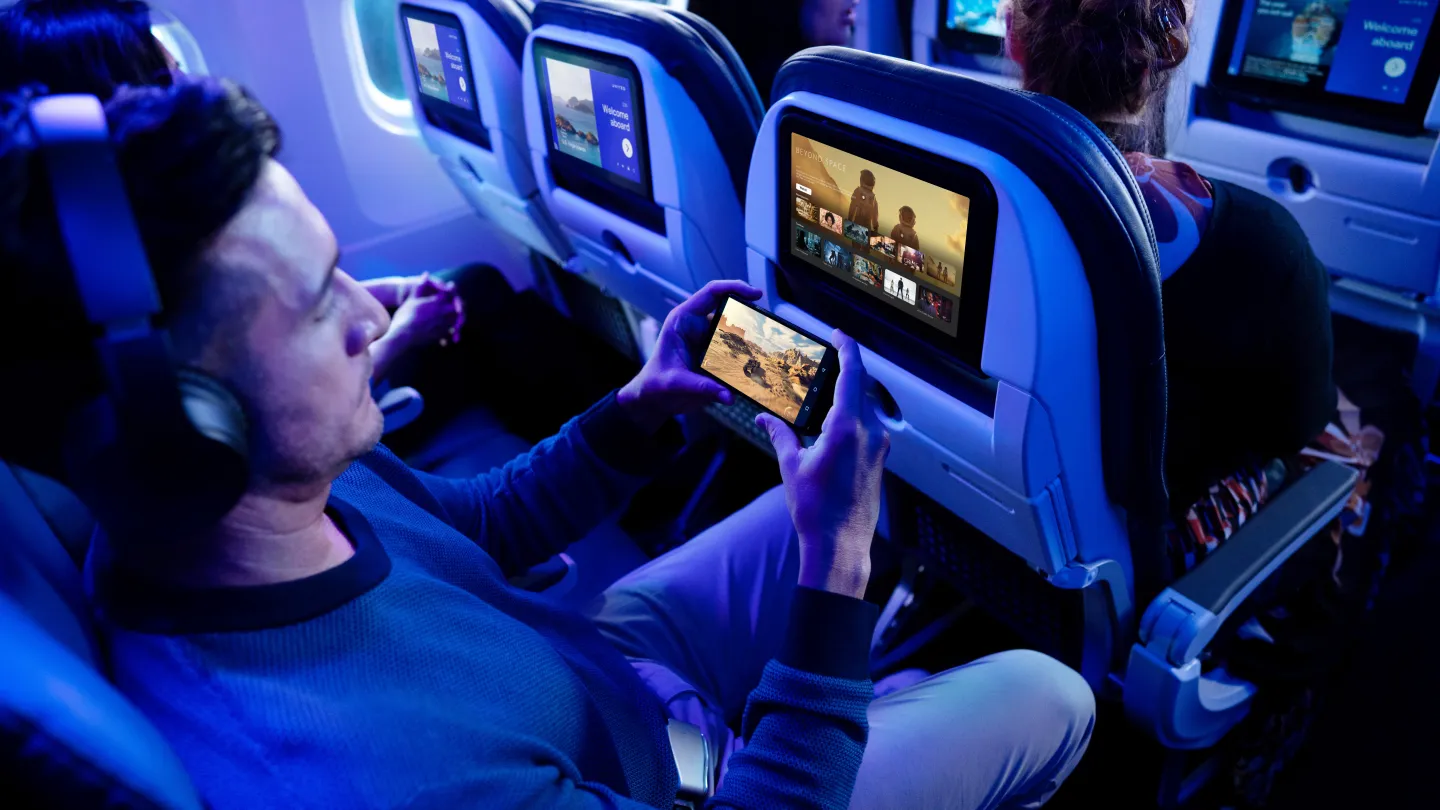
Flyers, once limited to what was licensed on the seatback screens (assuming they were even on a plane that had them), will soon be able to bring their own entertainment, be it TikTok, YouTube, Netflix, or Fortnite.
And airlines are going to adapt accordingly.
“It’s about optionality,” says Andrew Nocella, United’s executive VP and chief commercial officer, speaking to The Hollywood Reporter while standing under the tail of one of the airline’s new 787-9 aircraft. “What we have found is that Starlink just means there’s another way to connect. So there’s people that want to watch the seatback as they connect with their cell phone to text, as they connect with their iPad to do some work.”
United, he adds, is developing new approaches to entertainment that will combine the high-speed internet access to its seatback screens, which are being upgraded on its newer planes with larger screens and 4K video.
“There’s going to be a lot more that we can do with Starlink and our seat back systems in the future, we have a lot of really creative ideas,” he says. “When you combine seatback entertainment with Starlink technology, it opens up a world of possibilities that only airlines that have those two combinations can unlock.”
In fact, United demoed a taste of what that could look earlier this week, with a new partnership with Spotify. Subscribers to the streaming music platform can scan a QR code on their seatback and have all their playlists, podcasts and content available through the screen. United executives were tight-lipped when asked if they have discussed similar integrations with the likes of Netflix or YouTube, but the capacity is clearly there.

Spotify on United Airlines.
United Airlines
In-flight entertainment has become a surprising new front in the streaming wars, and a sizable $300 million per year business, too, as studios and streamers seek to sell their shows and films to captive flyers.
Airlines have been partnering with streaming services in recent years in a mutually beneficial relationship: Airlines get content, and smaller offerings like Apple TV (United, American, Air France), Peacock (JetBlue) and Paramount+ (Delta) get to give flyers a taste of their programming. YouTube also inked a deal with Delta last year, bringing a selection of some creator shows to seatback screens.
For streamers, seatback screens have become a significant marketing tool, exposing their programming to captive new audiences. But also a revenue source, albeit a modest one in the grand scheme of things. In-flight entertainment has also long been one of the core windows of the film industry, giving flyers early access to movies shortly after they leave theaters, but well before they arrive in homes.
But will those flyers be as captive is they have full access to their streaming apps?
The emergence of high-speed internet may change that. Other airlines that are partnering with Starlink, like Alaska Airlines and WestJet, are encouraging flyers to use their own devices to stream entertainment (especially on shorter flights, with planes that lack seatback screens).
But the truth is, it will change what people do in the skies.
David Kinzelman, United’s chief customer officer, says that in the first few months of Starlink rollout, a family got their home offer accepted, and one flyer reached out to say that he “vibe-coded” a new business idea (vibe-coding is using AI coding tools to create new software).
“When we announced our partnership with Starlink, we weren’t just looking to do the playbook of ‘let’s make Wi Fi better,’” he says. “We were looking to redefine what is possible with the online experience.”
But could it come at the expense of Hollywood, which has been relying on the marketing exposure of in-flight entertainment, as well as the licensing revenue that goes along with it.
Kinzelman framed it as a positive for movie fans. Before Starlink, he said, it could take 45 days to add new movies to its entire fleet of aircraft. Once it has the new internet service on every plane, he says they will be “able to take the newest movies the moment we buy them, update over-the-air from the cloud through Starlink, and have it across our entire fleet on the same day.”
Whether flyers want to watch on those screens or on their own devices once the internet is fast enough and free enough is another story, and you can bet studios will be watching, lest that classic film and TV licensing window becomes the latest one to lapse.