While Jeff Probst may be the face of Survivor, one of the people most responsible for what viewers see onscreen has spent 50 seasons behind the scenes. John Kirhoffer has been with the show since inception as a co-executive producer, overseeing the iconic challenges that have become one of the series’ most defining and enduring elements.
He also created one of Survivor’s most lasting traditions: the Dream Team.
For the uninitiated, the Dream Team is a rotating group of 20somethings who test challenges before the castaways. If you’ve ever spotted mysterious knees or rogue calves in a challenge preview, those legs likely belonged to a Dream Teamer. Kirhoffer originally created the group so he, Probst, Mark Burnett and other producers wouldn’t have to run the obstacles themselves. What began as a practical workaround has since evolved into a training ground for young creatives hoping to break into television production.
On the day Survivor 50 kicked off, The Hollywood Reporter caught up with Kirhoffer who shares below the origins of the Dream Team, why Burnett might be the most competitive person alive and why — like Whitney Houston — he believes “the children are our future.”
***
How the idea of the Dream Team came about
“Season one, we had all these ideas [for challenges]. We would go to a park in L.A., any park we could find, and put together makeshift versions of these games we were going to do and test them. It was pretty rudimentary, to say the least. Then we get out on location and would start setting them up and we realized, Holy crap, we don’t have 16 designated people. I’m doing it. Mark Burnett’s doing it. Jeff Probst is doing it. And so right away I was like, We need designated people. It was us testing all these games, and nobody’s watching it. That’s part of the problem, we need to watch it to learn.
So we said, If we ever do this again, we need designated people. So the next season (season two in Australia), we went out, scouted, came back — and I’m talking to the money people saying, “Hey, I need a designated team of people to test, young people. They just have to be PAs (production assistants), and then they can also help other people and cameramen and stuff.” We never thought it would turn into the mentoring apprenticeship that it turned into. We just needed bodies. So those first dozen seasons or so, we’d go to wherever we were locally and get kids on holiday from all over the world.
We weren’t flying anybody in. We were going to get anybody we could. I would go to youth hostels and post up signs like: Needed for X amount of weeks, $200 a week, plus all your meals. That’s how it started, and then we decided we needed to give them a name. My friend Kevin McManus goes, What about the Olympic basketball team, the Dream Team? Let’s call them the Dream Team. So he named them the Dream Team — and it’s been the Dream Team ever since.”

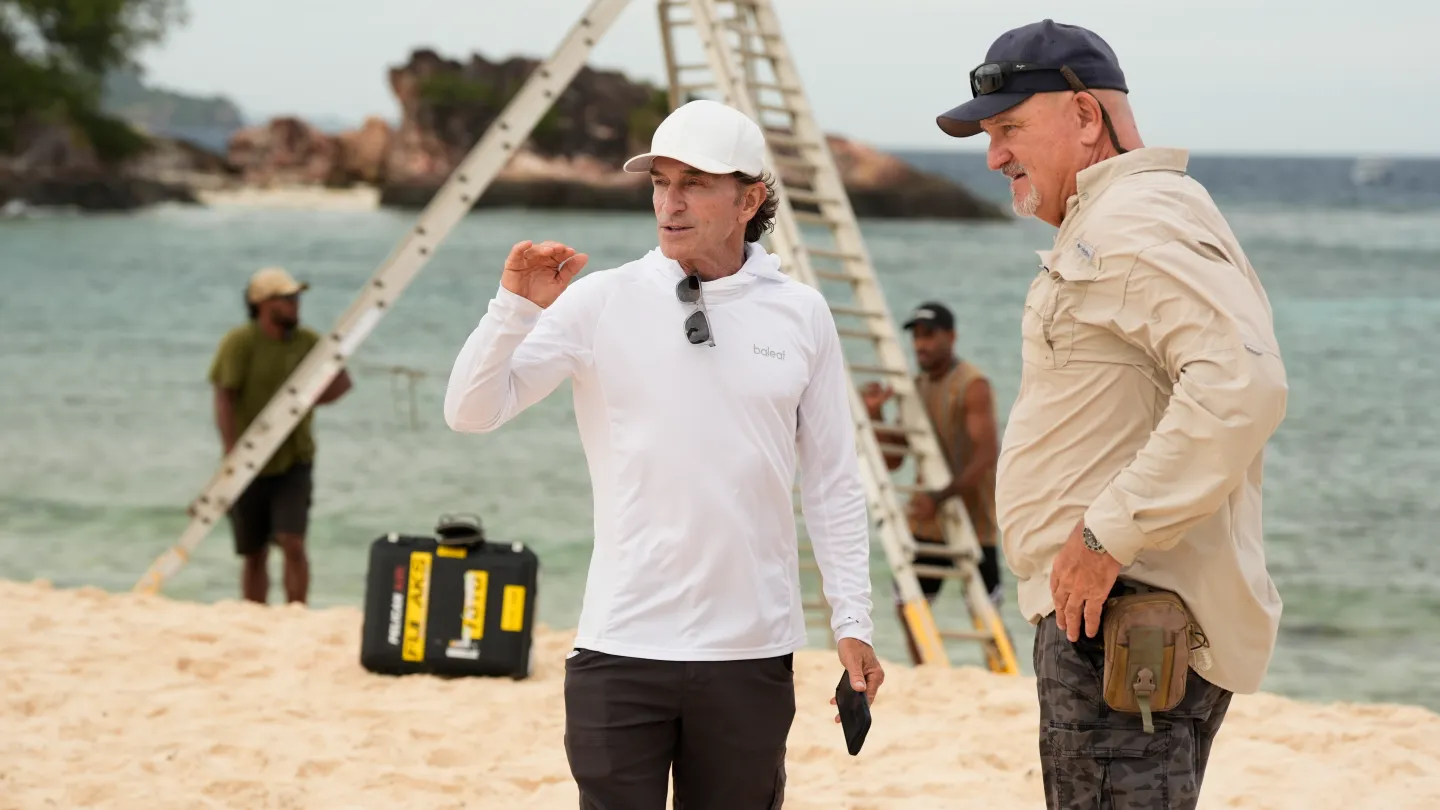
Jeff Probst, John Kirhoffer, and Chris Marchand on the set of Survivor 50.
Getting on the Dream Team isn’t easy
“Hudson Smith, who’s a co-EP on our show, and Matt Van Wagenen, our EP, saw the mentoring potential in the Dream Team and wanted to focus on film school and get the best of the best — bring them in, let them work with professionals and watch them rise through the ranks. Supervising producer Chris Marchand [nicknamed ‘Milhouse’ by the crew] and I do most of the vetting. Matt and Hudson will then go out to colleges and talk to students, give them our information, and they write to us. I’ve spoken at schools, and anybody who’s interested to hear somebody from Survivor talk will come in. But we go through the film and TV departments.
We only have about 25 positions, usually the same number as the cast. We get a couple hundred applications. I have 175 people a year I turn down. We don’t advertise but people hear about it through word of mouth. Also, everyone [on the crew] has a niece, daughter, son, nephew, cousin — a buddy who they want that are of age and would be perfect. So you take everything into account. But every year, there’s a handful of people I’ve never met who have no association with anybody else. They just came in because they heard about the opportunity and got on.”
Being a Dream Teamer is just the first step
“Art Department and Challenges are like brother and sister. The majority of the time when the Dream Team, especially newer Dream Team, aren’t out testing things, they’re painting, helping load and unload trucks. They’re out in the field getting things together, helping out the prop and construction guys. Then we also have shadowing. Every season at the beginning of the season, we bring everybody in one by one to ask, What are you interested in? I always tell them right up front, First of all, just be a good Dream Teamer. But as you go, if you see something in television production, say, ‘Hey, I’m really interested in camera, I’m interested in audio, I’m interested in art. I want to be a producer.’ Let us know.
Brittany [Crapper] is a perfect case example. She’s a co-executive producer. She was a Dream Teamer. Now she’s at my level, we’re absolute contemporaries. And she worked for me many, many years ago. Her husband, Riley, was a Dream Teamer. Then he became our prop master, and we became friends and I was at their wedding. I’ve been to six different Dream Team weddings. Brittany and Riley have three of the 80-something Survivor babies that are out there from people who met on the show and had a family.”
A “marooning” rehearsal with Dream Teamers from season 50.
The legacy of the Dream Team
“The legacy of the Dream Team, I think, is finding talent where you weren’t initially looking. We were just looking for bodies to do something, and then you realize nobody aspires to be a production assistant all their lives. We get these young kids and they all have desires and passions and talents. We don’t look at them as a herd of labor, but as a bunch of individual potential superstars. I don’t want anybody being a PA for too many years. Move up, move up, move up.
I think it’s the responsibility of everybody who’s a boss or a manager to the people that are below them, not to just keep the good ones where they are, but to nurture them. As soon as possible, promote them up. I see people who don’t want to get rid of their production assistants because they’re such good assistants. It’s like, No, move them on, move them on, move on. Another crop of good ones will come through. I think the legacy of the Dream Team is, to quote Whitney Houston, I believe the children are the future. Treat them well and let them lead the way.”
Competing on a challenge with Mark Burnett
“One of my favorite stories from season one — it’s been a long time since I talked about this — but we had a challenge where you had to swim out, dive down and get a heavy chest. We called it In From the Deep, and we were on a sandbar out in the ocean. Back then it was probably 12 feet deep or so. We had to swim out and dive down to a really heavy chest filled with lead. There were two teams side by side and six handles. You go down, pick it up, then you walk as far as you can underwater, drop it. When you run out of breath, get some air, go back down and keep going.
Back then, 26 years ago, I was a 35-year-old surfer. I was a scuba diver. I was in pretty darn good shape. I consider myself a water guy. And Mark Burnett is the most competitive person I’ve ever met in my life. Mark and I are on one team, and some of our other friends are on another team.
We went down, we pick it up, and we’re heading towards the beach and get halfway. And I gotta go up and let go. We pop up and Mark goes, What happened? I go, What? He goes, What’s wrong? Are you okay? Yeah. Well, why’d you stop? I ran out of breath. He goes, You’re freaking kidding me. We have to win this thing.
And we’re going down and I was just dying. Finally, I could feel my head hit the surface of the water, three more steps and I could breathe. We went up and we won. And I realized, Oh my gosh, when you’re competing with Mark Burnett, you don’t stop. You just don’t stop at all. That was super fun.”
***
Survivor 50 airs new episodes Wednesday at 8 p.m. on CBS, streaming on Paramount+.