James Cameron was certainly helping out David Ellison when penning a Feb. 10 letter to Sen. Mike Lee (R-Utah) opining as to why it would be disastrous for the movie business if Netflix were to close its $82.7 billion deal to buy Warner Bros.
The merger battle has intensified on all fronts in recent days, capped by Paramount — which began plotting a hostile takeover when the Warner Bros. Discovery board went with Netflix’s bid in December — submitting a sweetened offer that puts it back in the race to buy all of Warners if the board decides it is a “company superior offer.”
Meanwhile, Netflix co-CEO Ted Sarandos is off to Washington, D.C., for a meeting Thursday at the White House, sources confirm. Trump’s schedule lists a 3 p.m. ET private meeting in the Oval Office that is closed to the press.
The most revealing spat in terms of Hollywood circles was when Cameron’s letter came to light on Jan. 19, days after he’d sent it to Lee. In the letter, Cameron positions Netflix’s acquisition of Warner Bros. as a bad deal that will reduce the number of theatrical releases at a perilous time for ailing exhibitors, take away consumer choice and reduce the number of buyers who can invest in projects.
“I am but a humble movie farmer,” Cameron wrote. “And I see my future creativity and productivity directly threatened by this proposed sale. Mr. Sarandos is a good person and a clever business leader and innovator, but the goals of his company are directly opposed to the health of the cinema marketplace.”
Sarandos addressed Cameron immediately, telling Fox Business Network on Feb. 20: “I’m particularly surprised and disappointed that James chose to be part of the Paramount disinformation campaign that’s been going on for months about this deal.” He also revealed that he spoke with Cameron around Christmas and discussed his pledge to a 45-day exclusive window. He said Cameron didn’t raise any concerns or objections, but instead discussed headphones he was developing for the home.
During the hearing, Sarandos also said he is committed to giving Warner Bros. titles a 45-day exclusive run in theaters, which is now the industry norm, excluding Disney. “This is not a tentative goal or a flexible guideline; it’s a hard number and a firm commitment,” he reiterated in a follow-up note sent to Lee’s office after he learned of Cameron’s letter.
Cameron deftly recalled some of the Sarandos’ more memorable remarks when talking about why the theatrical experience doesn’t matter to the Netflix exec. But in Sarandos’ defense, theatrical isn’t part of the streamer’s business model, outside of qualifying a movie for awards purposes and keeping filmmakers happy. Operating Warner Bros. Pictures as a separate studio with a worldwide distribution and marketing operation would be additive for Netflix, and a new source of cash. It would also have access to premium video on-demand (aka buying and renting movies online), which can be worth tens of millions of dollars.
Before the pandemic, the theatrical window was anywhere from 72 days to 90 days, since PVOD didn’t exist. It has narrowed dramatically since then. Many studio movies go to PVOD even earlier, depending on their size and scape. The official makers are 17 days, 24 days, 29 says and 38 days — or after the third, fourth, fifth and sixth weekends, respectively — depending on their size and scope. And it’s all thanks to Jeff Shell, who was at NBCUniversal at the time only to be hired by David Ellison to serve as president of Paramount.
Sources on Capitol Hill, where the Judiciary Committee has oversight of Lee’s subcommittee, said the subcommittee has received a robust number of letters in support of both bidders from all quarters of the business, including stars, directors and producers. The source wouldn’t divulge any names, but one star who is likely to have sent correspondence to Lee or other lawmakers is Mark Ruffalo. While known for being an avid activist, he surprised many when taking Cameron to task in a social media post.
“So… the next question to Mr Cameron should be this… ‘Are you also against the monopolization that a Paramount acquisition would create? Or is it just that of Netflix?’” the Oscar-nominated actor wrote on Threads Feb. 21. “I think the answer would be very interesting for the film community to hear and one that should be asked immediately. Is Mike Lee against the Paramount sale as well? Is he as concerned about that as he is the Netflix sale?” (Lee is a self-proclaimed MAGA.)
Others who may oppose a Paramount sale — a category that could include agents — are those who were left stunned when the new regime put out a lengthy list of names of talent it won’t work with because they are seen as being Gaza sympathizers.
Another issue of concern: opting for Paramount could result in widespread layoffs to lower the debt load incurred to make the acquisition, leaving many at Warners favoring Netflix.
And since the movie studio is additive, it would allow Netflix to be a true player in the theatrical space. Insiders with knowledge of the deal say Netflix would still do its own movies, while Warners would make its own separate slate. Also, Netflix’s robust profit margins and balance sheet put it in a better position to invest in more content, which theaters need desperately.
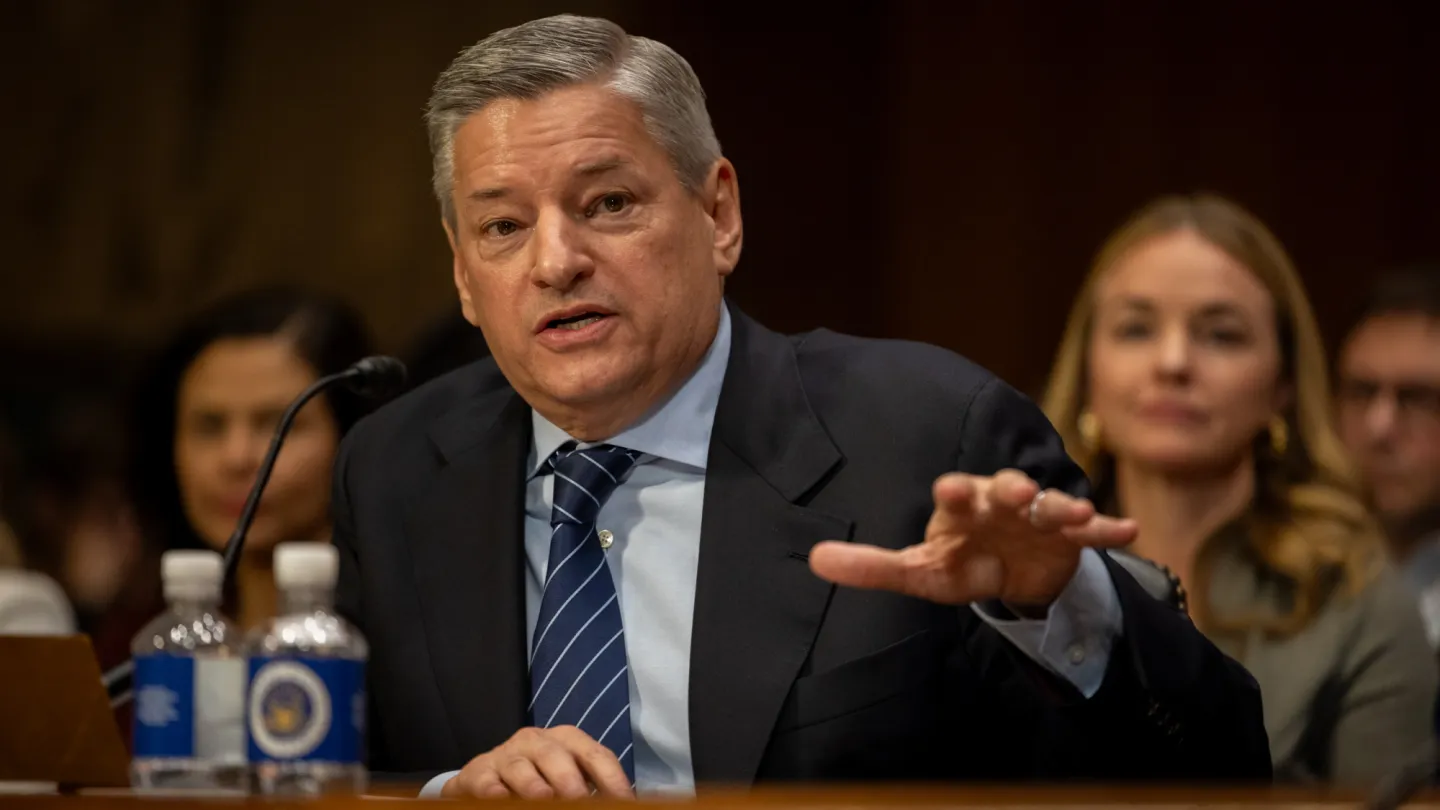
Sen. Peter Welch (D-VT) pressed Sarandos on the 45-day theatrical window during the hearing. Sarandos said Netflix has multiple purchasing arms within the company, including for family, comedy and drama content, and that these entities within Warner Bros. and Netflix will remain independent. “You can pitch to all three teams,” he explained. “One may pass and one may take it.”
Cameron is of a different mindset, and he isn’t alone in being suspicious of Sarandos’ 45-day pledge, considering Sarandos is famous for quickly retracting any positive comments he makes about a trip to the multiplex, or for contradicting his own execs. “The business model of Netflix is directly at odds with the theatrical film production and exhibition business, which employs hundreds of thousands of Americans,” Cameron wrote. “It is therefore directly at odds with the business model of the Warner Brothers movie division, one of the few remaining major movie studios.”
Yet Cameron did not address the danger of consolidating two of the last five remaining studios. And if he seemed as if he were speaking on behalf of theater owners, he wasn’t. Most exhibitors don’t care for either deal. And earlier this week, AMC Theatres chief Adam Aron suggested that people give Netflix a chance (he was in no way endorsing a merger, but AMC is doing business with the streamer, including carrying the singalong version of the Oscar-nominated K:Pop: Demon Hunters).
“We are deeply concerned that the acquisition of Warner Bros. by Netflix will have a direct and irreversible negative impact on movie theaters around the world,” said theater owner trade org Cinema United in a statement released following the hearing. “If Paramount or another major studio ends up displacing Netflix as the buyer, our concerns are no less serious. A combination of Paramount and Warner Bros., for instance, would consolidate as much as 40 percent of each year’s domestic box office in the hands of a single dominant studio.”
And in his letter to Lee, Cameron also didn’t note that he has a long-standing relationship with Ellison, who paid millions for rights to Cameron’s Terminator franchise. Cameron co-wrote and produced the last film, 2019’s Terminator: Dark Fate, which was fully produced by Ellison’s Skydance and then released by Paramount. And Paramount’s Billie Eilish concert doc, which the performance artist co-directed with Cameron, hits theaters May 8, 2026.
Lee has said he will hold a follow-up hearing at a yet-to-be-determined date. If Paramount prevails and a hearing is canceled, it could confirm Hollywood’s ultimate fear: that Trump and Lee don’t have any issue with Paramount buying Warners, since Ellison and his father, Larry Ellison, have been all too willing to make wholesale changes at CBS News in order to appease Trump’s ire at any news operation that is seen as harboring liberals.
In recent days, Trump employed his trademark fury in demanding on Truth Social that Netflix fire board member and top Democratic Party player Susan Rice after she said things weren’t going to end well for companies that “bent the knee” to Trump, a turn of phrase many could say applies to actions taken by David Ellison both when closing his deal to acquire Paramount and after he was installed as the new owner . CBS News, a Paramount property, has been one of the biggest targets in terms of Trump’s demands. The latest show to come under scrutiny in the Bari Weiss era is iconic news magazine show 60 Minutes.
All’s fair in politics and business, after all. Or is it?