Fine. I’ll be the guy who defends the ninth season of ABC’s Scrubs (2009-2010).
No, it isn’t a perfect season, but let’s not pretend it’s some reputation-destroying embarrassment, best ignored or discussed with sad-faced pity. It isn’t the Netflix seasons of Arrested Development.
Scrubs
The Bottom Line
Nothing has changed, if that’s what you crave.
Airdate: 8 p.m. Wednesday, February 25 (ABC)
Cast: Zach Braff, Donald Faison, Sarah Chalke, Judy Reyes
Creator: Bill Lawrence
What it represented was an attempt for the Scrubs brand to move forward without (for the most part) Zach Braff‘s J.D., an effort to mature and evolve and adapt. The writing didn’t necessarily have a purposeful driving imperative, but the show’s new cast was exceptional, and there were worse things to do than watch Kerry Bishé, Eliza Coupe, Dave Franco and Michael Mosley executing Bill Lawrence’s dialogue and wild tonal shifts. It felt like a fresh start, even if it wound up being an end.
This, then, becomes the prism through which one must view the tenth season of Scrubs, or the first season of the reboot of Scrubs, premiering on ABC on Wednesday (February 25).
If you want Scrubs back, but want it back the way it existed through its first eight seasons — with acknowledgement of the passage of time, but no real maturation — then the first four episodes of the reboot deliver roughly what you want. Definitely not more. But probably not less.
If, however, you thought the way Scrubs concluded after eight seasons was close to ideal, and that the need for a major paradigm shift was the reason the ninth season remained valid, then the reboot feels like a regression — a creative step backwards.
And again, this revival isn’t a Netflix-seasons-of-Arrested-Development-level embarrassment. It’s just a museum piece: still funny in bursts, still boosted by the chemistry of the core cast, but hampered by all the elements that frequently tripped the show up in its closing seasons — or at least the biggest offending element, namely that J.D. keeps treading water and slowing down everybody and everything in the show that’s trying to grow.
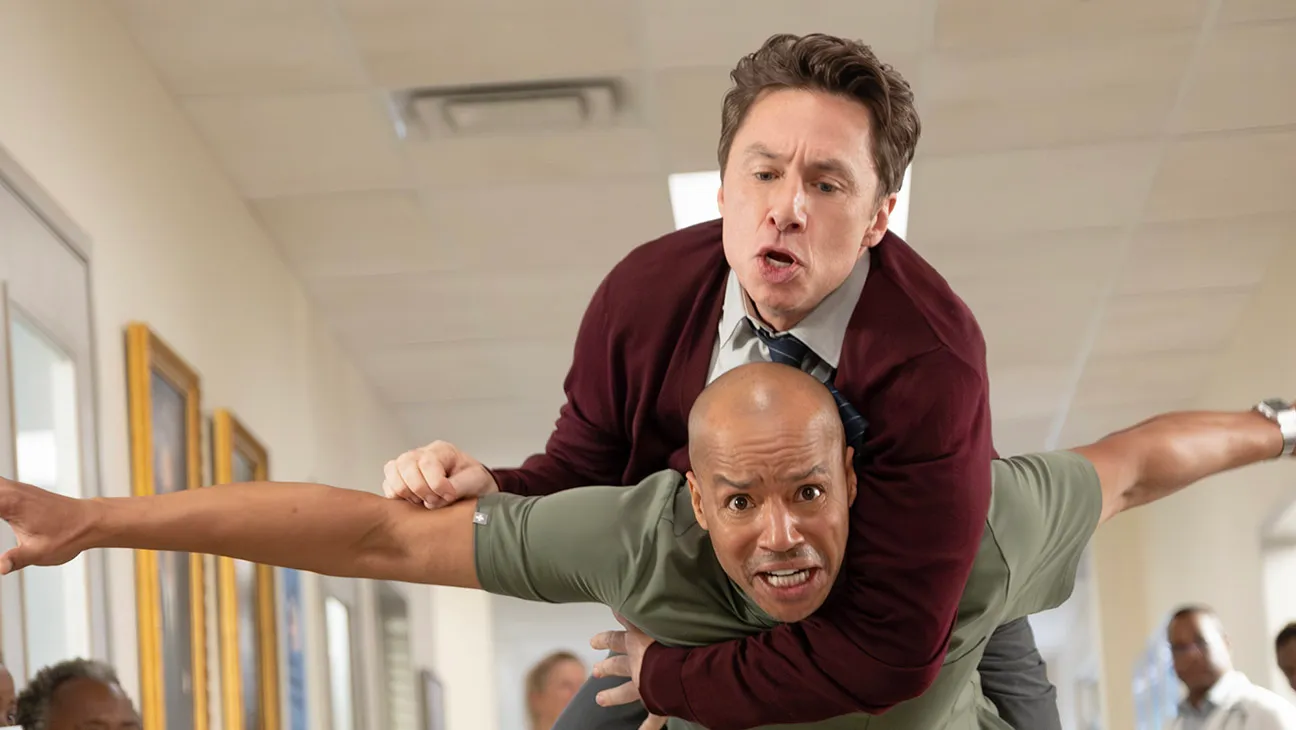
ABC wants critics to treat some silly plot points as secretive, which hardly matters in the long run. The only thing that matters is that through some set of circumstances, J.D. (Braff), Turk (Donald Faison), Elliot (Sarah Chalke) and Carla (Judy Reyes) are reunited at Sacred Heart; that Dr. Cox (John C. McGinley) is in the first of four episodes sent to critics; that Hooch (Phill Lewis) and The Todd (Robert Maschio) pop up occasionally; and that nobody acknowledges anything related to the ninth season.
We find out very early on the status of J.D. and Elliot’s marriage, as well as the state of Turk and Carla’s relationship. Some things have changed. Other things haven’t. I’m not going to pretend that the specifics matter.
There are some absent faces from the past, but plenty of new faces to give the impression that the practice of medicine goes on at Sacred Heart. Vanessa Bayer plays Sibby, who is in HR or mental health or some amalgamation of elements that let her be a general wet blanket, restricting some of the same old behaviors — Todd’s sexism, Cox’s abuse, J.D.’s everything — as if to suggest that society hasn’t changed, but one smiling administrator has.
Joel Kim Booster plays Dr. Eric Park, a surgeon who immediately becomes J.D.’s adversary, even though Dr. Park is correct about absolutely everything and J.D. is wrong about absolutely everything. That’s kinda the way Scrubs has always worked, and there’s no evidence that the show is aware that Park is right about everything and J.D. is wrong about everything.
Then there are a bunch of fresh-faced young doctors, including Asher (Jacob Dudman), who is so thoroughly a sitcom version of Whitaker from The Pitt that my notes just call him “Huckleberry” throughout. Then we’ve got Dr. Tosh (Ava Bunn), whom everybody makes fun of because she uses social media a lot; Blake (David Gridley), who’s very attractive; and surgical interns Dashana (Amanda Morrow) and Amara (Layla Mohammadi).
The first episode hinges primarily on machinations to bring J.D. back into the fold at the hospital, a process that’s bafflingly ill-considered. Scrubs is a show that needed barely any contrivances at all, and yet they’ve chosen to lean into details that are frustratingly dumb and not in a “I can let it go because it’s a sitcom so there’s no requirement that the medical stuff make sense” kind of way. It’s dumb in a “This makes no sense and everything that follows makes no sense, and I’m now rooting for all the adversarial characters because they’re clearly right (even if they aren’t written well enough to be rooted for)” kind of way. It isn’t just Dr. Park who gets swiftly annoyed at J.D. for reasons that he’s right about. Elliot, Turk and several other characters spend the four episodes I’ve seen being exasperated at J.D.; they, like Dr. Park, are completely correct, and the show doesn’t understand why.
And if you’re saying, “So nu? Isn’t that what the show has always been?” Yes! But in giving the voiceover narration to Bishé’s Lucy, the ninth season — whether you liked it or not — endeavored to explore what was universal about breaking into the medical profession, presenting a version of naïveté that was recognizable, but not recognizably J.D. Restoring the narrative to J.D.’s perspective, only limitedly matured over 25 years, is a bore. If J.D. was a man-child when the show started, back in 2001, what is he now if his privilege has allowed him to skate through live generally unweathered?
Faison, Chalke and McGinley all have truly effective dramatic beats as we see the strain their lives have suffered over these three decades. Nothing impacting them adjusts the stakes in a way that is inappropriately melancholic or melodramatic. They’re just grown-ups. I was so impressed, especially with Faison, that it became vaguely depressing watching the next three episodes and being reminded that, even if you can hope that a half-hour here or there will give the other cast members deserved opportunities, the show is not and never has been an ensemble. It’s Braff’s show. He even directs the pilot. The show’s gravity pulls everything toward him and negates the necessity to follow through with anybody else.
The cutaway fantasy sequences are as amusingly whimsical as they’ve always been, but they again show that J.D.’s version of the fantastical remains exactly what it always was. The substance and execution of the fantasy sequences were both fairly innovative for a broadcast sitcom in 2001, and largely remain so. What has changed is that the rest of the Bill Lawrence sensibility, which he kept in the broadcast space for so long, has moved to Apple and Netflix and across the streaming landscape, capitalizing on expanded running time and loosened tonal restrictions to become the dominant voice of the half-hour (or more) comic format. Shows like Ted Lasso and Shrinking have proven how, with five to 10 extra minutes per episode, zaniness and seriousness can go hand-in-hand. In this new season of Scrubs, the seriousness goes back to being an occasional condiment.
Was the medical material in Scrubs ever good? I would argue that it really was fine at the show’s peak. I don’t require all medical comedies to be somewhat pointed satires, but there’s a newfound toothlessness when Scrubs tries to tackle the high cost of prescription drugs or … actually, nothing else. None of the medical plots stick.
Whatever my complaints or disappointments, I still love Faison, Chalke and the little bit of McGinley we’re treated to. The new stars are all fine, with Morrow, Mohammadi and Dudman the standouts. Bayer is always good at playing characters who are so chipper you assume there’s something wrong with them, and these episodes are beginning to show the cracks in her cheery veneer.
And it isn’t exactly Braff’s fault that I don’t find J.D.’s hijinks as funny at 50 as they were at 25, because Braff is still participating gamely in the silliness.
In the original series, Cox took to calling J.D. “Bambi,” because he seemed so wide-eyed, wobbly and unformed. Sticking with the Disney references, J.D. has become more of a Peter Pan figure, and the show around him, which looked ready to move forward 15 years ago, is back to refusing to grow up.
If that’s what you want from Scrubs, you’ll be pleased.