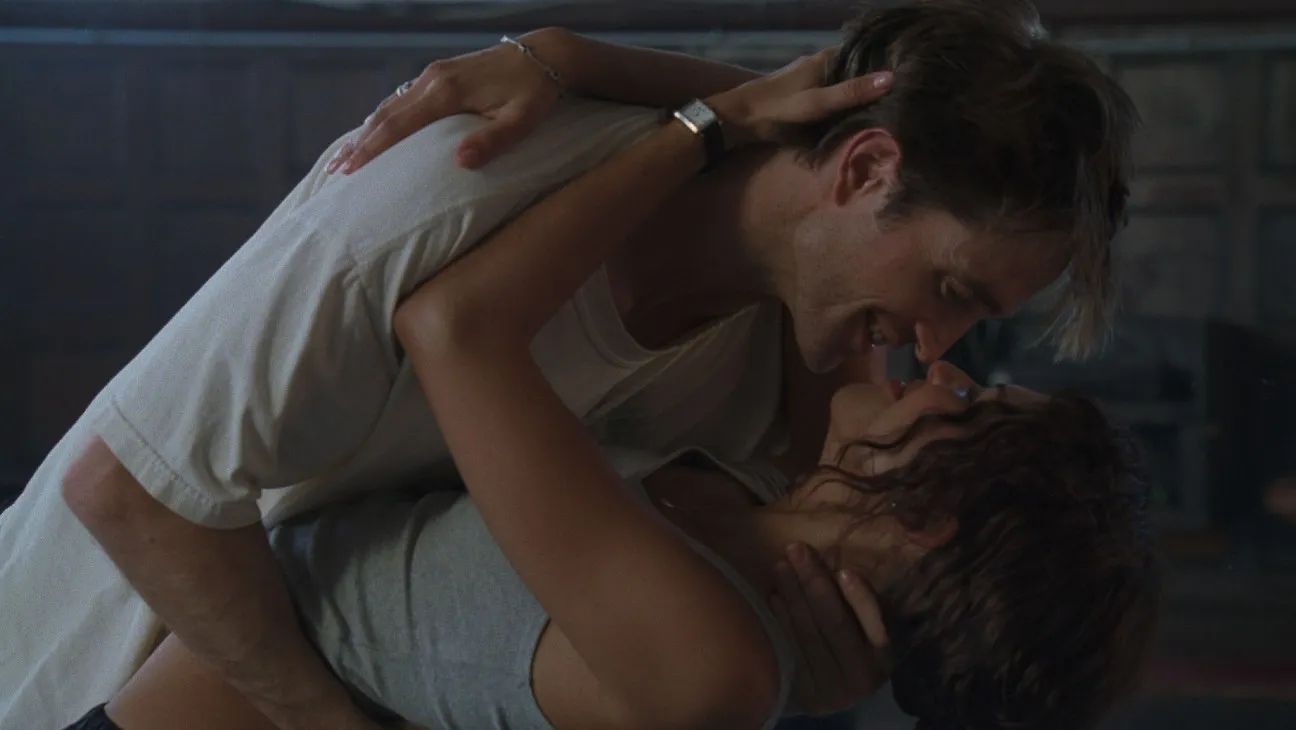
Boston couple Emma (Zendaya) and Charlie (Robert Pattinson) are beautiful and cool (in an upscale bohemian-intellectual way) and madly in love. Though we see the awkward first beginnings of their relationship — Charlie’s early, fumbling attempts at wooing Emma — those are just the cute anecdote parts of a romantic success story. When The Drama opens, Emma and Charlie are about to get married. They’ve a few final hurdles to clear, like locking down the menu for the wedding reception and writing their vows, but they are essentially at the finish line, the end credits about to roll as they stroll off into the rest of their life together.
This being a Kristoffer Borgli (Dream Scenario) film, though, we can guess that wedded bliss will not be easily won — if it’s won at all. Borgli makes uneasy, dark comedies about regular-ish bourgeois lives coming undone. In the case of The Drama, strife arrives during a friendly if charged party game. Emma and Charlie are drunk on their caterer’s wine samples — they’d like to try just one more glass of the skin-contact, please — with their best friends, Rachel (Alana Haim) and her husband Mike (Mamoudou Athie). Rachel goads them all into divulging the worst thing they’ve ever done. It will bond them, clear the air before Emma and Charlie take the plunge. Mike’s worst thing is a failure of chivalry, Rachel’s a bit of cruelty from her childhood, Charlie’s is a relatively anodyne internet misadventure, and Emma’s is…
The Drama
The Bottom Line
Great invite, shame about the party.
Release date: Friday, April 3
Cast: Zendaya, Robert Pattinson, Alana Haim, Mamoudou Athie
Writer and director: Kristoffer Borgli
1 hour 45 minutes
Well, as the trailers for the film suggest, what Emma reveals is shocking. I don’t want to give away exactly what she tells the group, but I will have to allude to it vaguely going forward, so stop here if you are particularly spoiler averse.
What Emma unearths from her past suggests a different person altogether from the woman Charlie knows and loves. It involves a threat of violence born of a troubled mind. Charlie and Mike are flabbergasted, Rachel is horrified. The rest of Borgli’s film exists in the fallout of Emma’s bombshell, tracing Charlie’s mounting insecurity about his impending commitment to someone he suddenly fears is a stranger, one possessed of unfathomable grim secrets.
Or, at least, that’s what the set-up of The Drama promises — an edgy, provocative look at how a relationship might weather the intrusion of a distinctly American pathology. In disappointing reality, though, the film is merely a differently dressed rehash of very familiar material. It’s a deceptively simple dramedy of cold feet, of pre-wedding jitters, only given the stain of higher-minded, more piercing social inquiry. What Emma specifically discloses ultimately doesn’t matter.
Though Zendaya is billed first in the film, the movie really belongs to Pattinson. Charlie is, after all, the one reacting to new information, messily processing things while Emma passively waits for him to come around or bolt. Even in the scenes when the two are together — a comically ill-timed meeting with a wedding photographer, several fraught conversations in their lovely home — Charlie’s perspective is favored. Because, I suppose, he is a stand-in for us in the audience, collectively participating in a what-would-you-do thought experiment.
Pattinson gives a natural, appealing performance, convincingly playing a relatively normal guy (Charlie works in the back office of an art museum in Cambridge, a job that suggests a creative passion that is never expanded upon) who begins to realize that his comfortable life with his quirky dream girl is not nearly as settled, or normal, as he once thought. We don’t know many details about him, but I suppose that is Borgli’s intention. It is easier for viewers to graft themselves onto the character when he’s mostly a blank.
Though we do learn more particular bits about Emma, all of which are delicately sussed out by Zendaya, she too is a cipher. Borgli seems too busy tending to his precious concept to breathe individual life into the world of his film. There is something dismayingly programmatic about The Drama. Strip the film of its elegant finishings and shocking twist (which, again, grows more weightless as the story unfolds) and all you’re really left with is the rough outline of a conventional story about marital doubt. It’s oddly basic for a movie ostensibly concerned with [redacted].
The Drama can be amusing. Its actors have a fluid sense of the film’s comic timing, while Borgli and his editor Joshua Raymond Lee make cuts that deftly punctuate a moment of incongruity or embarrassment. But the movie never really reaches the energy of a full comedy. Nor does it delve into the inherent drama of its premise. It instead hovers in the middle ground — or, maybe more accurately, gets stuck in the mud of no man’s land. A plodding heaviness takes hold of the picture post-reveal, its characters trudging through space that might be better filled with an actual interrogation of what Emma has told Charlie and her friends.
How does such violence sit in the American psyche these days? Borgli, a Norwegian, imagines the answer to that question in frustratingly simplistic, un-nuanced ways. If he was going to be this perfunctory in addressing this particular topic, I wish he’d chosen a totally different worst thing for Emma. The movie would function mostly the same with something else.
As is, The Drama is a handsomely made, sharply performed letdown. It is yet another example of a far too common occurrence: a kicky logline premise having no real structure behind it. Emma and Charlie struggle toward the altar, mistakes are made, and then Borgli throws up his hands as if to say, “Ain’t love a bitch.” Indeed it is. But we’ve kinda known that for a while now, haven’t we?