I distinctly remember the day in 1996 when KROQ DJ Carson Daly first introduced me to Failure. I recall just as clearly the moment the following year when Daly, as MTV’s newest VJ, reported their demise.
It didn’t make sense that an emerging genre-bending rock band could call it quits after tapping into something otherworldly on their third studio record, Fantastic Planet (1996). The Los Angeles-based group consisting primarily of vocalist/multi-instrumentalist Ken Andrews, multi-instrumentalist Greg Edwards and drummer Kellii Scott may have had their champions in the mainstream, but they were still a word-of-mouth band for the most part, so I had no way of knowing in the days of dial-up internet that heroin had wreaked havoc on yet another one of my favorite bands.
I would still be reminded of Failure in the subsequent years. My own musical pursuits led me to a week of sessions at L.A.’s Paramount Recording Studios in 2003. That’s when A Perfect Circle’s cover of Failure’s hypnotic ballad, “The Nurse Who Loved Me,” played in the musician-filled front lobby, kick-starting a whole what-could-have-been conversation in regard to the short-lived, influential band. Two or three years later, a friend insisted that I track down a buzzy new female-led band called Paramore, specifically for their cover of “Stuck on You,” Failure’s most commercial song during Fantastic Planet’s album cycle.
Then, in late 2013, when good news still existed, Failure reunited. Andrews and Edwards had already been testing the waters to see if they could recapture their friendship and unique songwriting alchemy. Once they were convinced, they booked a February 2014 show at the El Rey Theatre. It sold out in less than two minutes, confirming to the band that a whole new generation of fans had discovered their back catalog and were ready for more.
From there, Failure made up for lost time in prolific fashion. They released three self-produced studio albums — 2015’s The Heart Is a Monster, 2018’s In the Future … and 2021’s Wild Type Droid — as well as a 2023 concert film, We Are Hallucinations, and 2025’s Hulu-released documentary, Every Time You Lose Your Mind. They played approximately 220 live shows in between it all, and they are now on the verge of putting out their seventh LP, Location Lost, on April 24. With their newest release, the second phase of the band will officially have more output than their 1990-1997 tenure.
The third single off the ‘80s-infused new record, “The Rising Skyline,” features a rare yet fitting collaboration. Hayley Williams, the frontwoman from the aforementioned Paramore, joins Andrews for the emotional acoustic break-up song that builds to a dramatic finish. Her unwavering support for the band through covers and generous sound bytes is one of the key reasons why Failure was able to grow its audience in absentia.
“She digested [four songs] for a while [before picking the ballad], and she texted me a few times, going, ‘This feels like a different kind of Failure record to me. Good on you guys for doing that,’” Andrews tells The Hollywood Reporter.
The making of Location Lost had its challenges, a trademark of Failure’s entire career. Andrews was still recovering from debilitating back surgery, and Edwards felt adrift for the time since the band’s reunion. His creative North Star had disappeared, hence the album title of Location Lost.
“There was a lot of turmoil and life changes. Going through the process of this record, I wouldn’t say that we were the most cohesive, interpersonally, with each other. It felt like things were ripping apart a bit,” Edwards admits. “I lost the entry point of how to approach it. The documentary had a strange effect on me, and I think I withdrew. If I had been close to the center of Failure for a while, it took me more into the outskirts.”
In the February 2026 press release for Location Lost, Edwards weighed the band’s future by asking a big question: “Is Location Lost the last Failure record, or could it be the transition to yet another new phase? We’ll see where it goes from here.”
When I followed up on behalf of paranoid Failure fans everywhere, Edwards expanded on his current thought process without completely eliminating the less desirable option. “There’s no doubt that we could make another record. We already have enough material to cull another album, easily,” Edwards says. “It’s not that we don’t have the creative force anymore, and it’s not that we don’t have the ability to communicate through it. I just don’t take it for granted that we will continue from here.”
If Location Lost does mark the end of Failure once and for all, it would be a devastating blow considering the band is still writing compelling, forward-thinking music that doesn’t rest on their laurels. Andrews’ voice has also held up remarkably well unlike several of his ‘90s contemporaries. His vocal performance on the newest LP, particularly “Moonlight Understands,” is his finest yet. Moreover, there’s still a healthy market for ‘90s bands like Failure, and it’d be a shame if they didn’t continue to enjoy the fruits of their labor, both past and present.
At the same time, it’s hard to be upset when they’ve already crafted a comeback story for the ages. Hypothetical questions no longer have to be asked about what the band could have done because they’ve now done it. They picked up right where they left off with Fantastic Planet, and the quality of their four LPs since then has set the new bar for any band that attempts a second act.
Below, during a wide-ranging conversation with THR, Failure’s Andrews, Edwards and Scott discuss the ins and outs of Location Lost, as well as the deep cut that has become their most popular tune in the streaming era.
***
Ken, when the four of us spoke for the Failure documentary last June, were you still quietly recovering from your heavy-duty back surgery?
KEN ANDREWS (Frontman, Multi-instrumentalist) Yeah, physically and mentally, it was a long road. It was definitely a long road. The funny thing is, I just met someone who had almost the exact same surgery, and they were fine four weeks later, both physically and mentally. I was like, “There’s no way you had that surgery.” We then showed each other our scars, and they were the same. I was like, “Damn.” But he’s a lot younger than me, so it definitely made me feel my mortality.
How did the injury happen?
ANDREWS I was actually just trying to get in shape. I basically had this incline sit-up device and bench. So I put it at an incline and hooked my feet in to go way back, and that was a mistake. When I started to feel a little bit better, I was so angry at the equipment that I kicked the shit out of it in my backyard. (Laughs.) Then I used a dolly to put it in the back of my car, and I drove it to the dump.

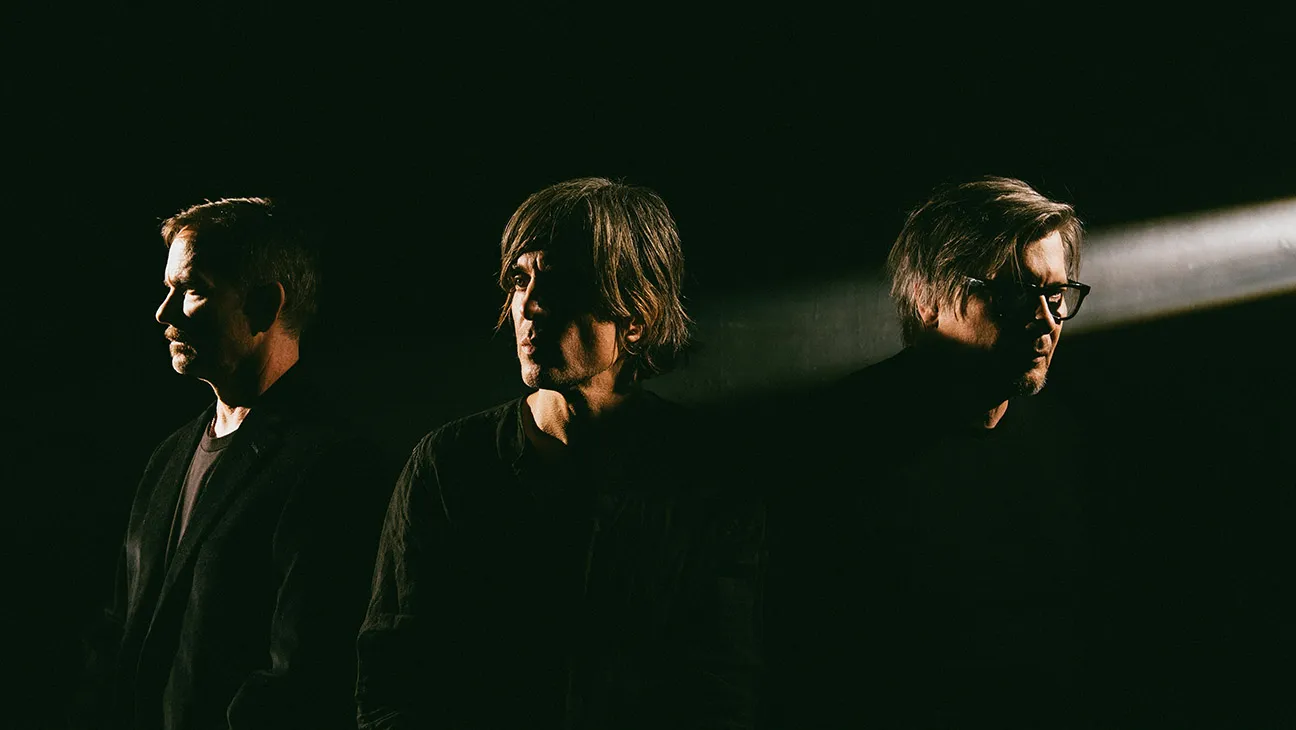
Failure’s Greg Edwards, Kellii Scott and Ken Andrews
Lindsey Byrnes
I desperately want you guys to have a dull moment for a change, but in between every record, there’s always some amount of upheaval that likely sparks the music that I love. Is that collective torture what makes Failure, Failure?
KELLI SCOTT (Drummer) I don’t think we experience more torture than anyone else. I think we’re just willing to talk about it.
Every record has been surrounded by something: breakups, health scares, addiction, label collapse, vendor fraud, a global pandemic, a producer and drummer exit …
ANDREWS Yeah, it’s kind of true. Even the first two records [Comfort, Magnified] had drama.
GREG EDWARDS (Multi-instrumentalist) Well, my perspective on it is that there’s always stuff going on in the exterior. But the interior self-inflicted suffering is ceaseless and constant — and that’s the source of inspiration. Sometimes, the exterior narrative of your life can season that internal suffering, but we’re all just on our way towards death. (Laughs.) I kind of get off on being in touch with that on a pretty constant basis. It actually has the opposite effect of making me depressed, but a lot of the lyrics I’ve written in this band have come right out of that.
Ken, your health informed Failure’s new record, Location Lost, in a lot of ways, as did the 1980s. That decade was a formative time for you guys as teenage musicians, so it’s always there, somewhere. But how intentional or unintentional was the ‘80s vibe?
ANDREWS Well, that’s interesting. You’re the first person to say that about the ’80s vibe. I hear it. I definitely hear it. But it definitely wasn’t intentional. I didn’t say, “Oh, I want to go more into the ’80s sound.” Maybe it was because we let go of trying to make a cohesive album and just focused more on each individual song. Also, my internal editor was less active once we took the music back to my studio. I was just following my bliss more than trying to make the next Failure record. And when I do that, I go back to that late ’80s sound.
I believe Location Lost ties Magnified (1994) with four fade-outs, and that practice reached its peak in the ‘80s. So I assumed, wrongly, that it was meant to be another ‘80s touchstone.
EDWARDS I rarely think fade-outs are an intentional creative decision. It’s just ,”How do we end this fucking thing that goes on forever? How do we get it under 3:30 for radio?” On the Beatles’ White Album, “Helter Skelter” has the great fade out and fade back in. We did something like that on “Small Crimes.” We used it creatively. So it can be nice, but a lot of times, it’s just that there is no actual ending because the end of the song was jammed out for whatever period of time.
ANDREWS I also feel like the outros of certain songs lend themselves to a fade-out. I actually really like fade-outs because they stimulate your imagination. What are they still doing that I’m not hearing?
EDWARDS Yeah, I love fade-outs where some really cool stuff happens almost below where you can hear it. Whether it’s a really great fill or a bass note, you’ll actually wish it would come back up so you can hear what happened from there.
SCOTT And we’ve done that.
EDWARDS Yeah, you don’t want it to end, but it has to end. So it’s just going to subtly fade out, but it still continues somewhere way down in your subconscious. It never really ends.
Instead of self-releasing like the last couple LPs, you’re doing a more formal release for Location Lost. What prompted the change?
ANDREWS We just got tired of doing everything ourselves. I wanted to keep going musically, but I didn’t want to keep handling the business side of it. So we reached out to a manager named Blaze James who was interested in managing us in 2015, but we decided not to go with him back then. And to our surprise, he was still interested in working with us. So I’ve really enjoyed letting him do his thing and sinking back into more of a band member role.
Blaze’s company, The Fellowship, set you up within Virgin Music Group, and while that has the appearance of a major, I believe it’s Universal’s (UMG) imprint for indie artists. Thus, you still have your independence?
ANDREWS I don’t really know. The funny thing is we’ve actually had very little contact with Virgin. Again, it’s nice to just let someone else handle it. So Blaze is our interface to Virgin, and he brought them into the picture around the time the documentary came out.
Failure’s catalog is back on Spotify after four years. Their royalty structure was one of several reasons why you removed your body of work. Did your new manager convince you to give it another go?
ANDREWS Yeah, pretty much. I don’t think it was even a consideration for Virgin. It was something that they basically required. Again, I just let go of that side of things and focused on playing, writing and recording.
Greg, during the release of Wild Type Droid, I heard you mention that you were flirting with the idea of killing off Failure’s mascot, the spaceman, once and for all. If you were going to do it, Droid’s cover art would’ve been the perfect send-off. But he’s back on the cover of Location Lost, so is he just too synonymous with the band at this point?
EDWARDS Apparently, he does okay with head reattachment.
SCOTT He just won’t die. It’s like a recurring comic.
EDWARDS Yeah, [killing him off] was a dream I had at one point, but he’s probably here to stay in one form or another.
The cover art for Failure’s Seventh LP Location Lost
Courtesy
You guys really pride yourself on sequencing. Which tracks were the hardest to find consensus?
EDWARDS There was some debate about the sequence. We released In the Future in batches of four songs before putting them all together. But on all the other past records, I had a fairly strong sense of the narrative of the sequence. We’d go back and forth and discuss it in those terms. But on this record, I didn’t feel that. There were some debates about where a song should go and everything, but it didn’t seem to me like there was some immaculate, perfect sequence just waiting to be uncovered. So I was fairly open to compromise.
Ken has previously described you as his lyrical editor because you’ve done the lion’s share of lyric writing since the reunion. But Ken’s injury inspired him to write a lot more on this record, so did you serve that editorial role in a grander fashion this time?
EDWARDS Not so much. On some of the songs where he wrote almost all the lyrics, there would be a line or two where I would suggest something or change something. There may have been a word that wasn’t quite working, and we would brainstorm together. So we’d sit together in the room and go through each song to make sure that it was all working.
Kellii, Ken also said that he wasn’t processing the music as sharply as he normally does, and that he leaned on both you and Greg to edit and identify good ideas when you were jamming for the record.
SCOTT Well, the beauty of the jams is that there really is no editorial. You just plug in and start playing until you’re left with no more ideas. Then you pack up and come back the next day. We did that for several weeks back to back. The daunting part is editing down that plethora of material, but Ken was left to that, mostly. Even on previous records, if we had 20 hours of material, we would get cut-downs to three hours’ worth of material. Then we would each go through everything and give timecodes for what parts we liked. So Ken went through the whole thing, meticulously, and really narrowed it down to a few concise ideas as a really great starting point.
ANDREWS I wasn’t actually there for probably a third of the jams. It was more like I wasn’t participating as much in the jams, so my time to add my input came later.
“Someday Soon” is my favorite song on the new record.
SCOTT Really!?
Yeah, I was bewildered by it at first, but by the second verse, I became smitten. Would you categorize the verse as funk?
SCOTT I don’t think that drumbeat is funk. There’s something very disjointing about it. It always shakes you back and forth. It never really lets you settle into a hypnotic state. It’s always resetting you at the end of every bar.
EDWARDS But it is a funky thing that we’re doing with the EBow. From when we were jamming it, that may be one of the only songs that was sketched up similar to what it ended up as.
ANDREWS Yeah, when Greg started making that sound with the Ebow across the strings, I was like, “I’ve never heard that. It doesn’t even sound like a guitar.” So that was an exciting moment, actually. I remember being in the studio for that and thinking that this album is going to feel like a step forward.
I know “Distorted Fields” is a beefier song, but is “Someday Soon” in the same neighborhood, rhythmically?
SCOTT No, “Distorted Fields” is probably the most complex rhythm on any of our records. That song is fucking nuts to play.
Both hang on the same note before shifting at the end of each phrase, so that’s where I drew the comparison.
ANDREWS Yeah, the bassline is somewhat similar.
SCOTT The bassline could be similar, but the drums are not even in the same ballpark. “Someday Soon” is actually really simple and repetitive. “Distorted Fields” is, even to this day, challenging to play. It requires a lot of focus. There’s so many counterpoints going on in the drum beat, but it’s ridiculously cool.
Ken, you performed “Daylight” with Hayley Willams at a benefit show following last year’s L.A. wildfires, and Location Lost came up during that time. What songs did you provide her before she selected “The Rising Skyline” for her guest appearance?
ANDREWS I gave her four songs: “Crash Test Delay,” “The Air’s on Fire,” “The Rising Skyline” and “A Way Down.” So she digested those for a while, and then she texted me a few times, going, “This is really cool. This feels like a different kind of Failure record to me. Good on you guys for doing that.” Then I asked her which song she was really gravitating towards, and she picked the ballad out of those four. And I was like, “Oh, interesting,” because I could hear her voice on the song, an octave hire. So she just happened to be winding up her solo record in the studio at the time, and she spent an afternoon recording her vocals with her producer in Nashville.
How much direction did you give her?
ANDREWS I didn’t give her any direction. I just sent her the lyrics and said, “You don’t have to sing the first verse because I think I want that to just be me, but sing everywhere else.” I pretty much knew she was going to sing it an octave higher because it’s pretty low. So I was expecting that, but I didn’t even tell her to do that. It was just naturally in her range to be an octave higher in the second verse.
Did you try to book her for the video?
ANDREWS Yeah, it just didn’t work out with her schedule.
The breath at the beginning of “Crash Test Delay,” did you pull that from a sound library? Or did someone track that?
SCOTT Isn’t it Sammy?
ANDREWS (Laughs.) It could have been your dog. I actually have a library from the Fantastic Planet days, so it’s probably from that. I ripped it onto my hard drive, and I still use it.
Kellii, what’s going on during the verses of “A Way Down”? Is there a shaker of some sort layered on top of your primary drum part?
SCOTT Well, there’s a hi-hat doing the counterpoint from the kick drum. But I think there is a shaker overdub in there. Is that right, Ken? (Andrews and Scott both pull out their phones to play the song and confirm.) Actually, no, that’s just me playing the counterpoint on my hi-hat. There’s no shaker. That’s just the drums.
ANDREWS Yeah, there’s no shaker. It’s a crazy beat.
SCOTT To play it, I literally have to hit the first beat by crossing over. The song is nuts. It sounds super simple, but it’s actually pretty weird.
ANDREWS It doesn’t sound super simple.
SCOTT It doesn’t?
EDWARDS No, it’s immediately a unique beat.
SCOTT I remember when I played it during the jams, and I was like, “What the fuck!?” It’s a really cool beat.
ANDREWS Yeah, as soon as you played that, I was shocked.
SCOTT I liked it so much that I played it for an extremely long time, which I don’t usually do. I usually change beats every couple bars to try and settle into something.
Kellii, once you track your drums, do you bow out for the most part? Or do you provide emotional support while Ken and Greg track everything else?
SCOTT I definitely fade to the background and become more of the peanut gallery. Everything goes through text messages and emails. But when it comes specifically to the drums, I kind of stay out of it. I make sure to do my due diligence before we actually come back [to the studio]. I think we re-recorded six of the songs’ drums, and the rest of them came directly from jams. So I know what it is that I want to play for the most part, and then I have a lot of confidence that Ken is going to turn whatever slop I do into something that sounds super cool.
Greg, we don’t hear much of you on this record. You don’t have a “Mulholland Drive” or a “The Pineal Electorate” or a “Half Moon.” Did you not want to force the issue?
EDWARDS It was just the group of songs that were worked up from the jams. There was one song that may appear later or somewhere. I don’t feel like it’s a necessity that I sing a song on a Failure record. I have such a conflicted relationship with singing anyway, so it’s easy for me to let that go.
SCOTT Is that the “ribcages in the moonlight” song?
EDWARDS No, it’s about going out to look at the night and slipping on the ice. You break through a frozen river and are trapped underneath the ice. Then the river takes you downstream until your body is found in the spring.
SCOTT It made me think of our trip to Montana.
EDWARDS Yeah, it’s actually based on a ‘90s news story in Montana. Someone was on acid when they fell into a freezing river. So maybe that will make its way onto a record at some point.
For clarity, that song was designated for your lead vocals?
EDWARDS Well, I don’t know. It’s possible that Ken would take a swipe at it and sound better — and the song would overall come across better. When I sing on a song, it’s more because it just seems to work. We’ll all feel like the emotion of a song is transmitted adequately with my voice.
“Solid State” will likely receive some “Stuck on You” comparisons due to the wall of sound and music box-type melody over it. Songs like “A.M. Amnesia” and “Headstand” have similar ingredients, but they’re delivered in a more off-kilter way. Sometimes, bands will run away from anything that resembles their most popular song, so did you guys ever consciously avoid interplay that was similar to “Stuck on You”?
EDWARDS Maybe a little bit. Those ingredients do appear in a number of songs; they’re just not as explicitly obvious as they are in “Solid State.” I’ve actually been trying to name a song “Solid State” for decades. So the comparison [to “Stuck on You”] was definitely somewhat conscious. I like when bands are eclectic within their own style, and they keep moving forward without repeating themselves. But I also completely respect and love the Rolling Stones — and bands that are so formulaic that they just keep slightly reinterpreting what they’ve already done. So having that conversation with your older material is okay.
ANDREWS “Stuck on You” is no longer our most popular song. It’s our second most popular song on Spotify by half the amount of plays. We were just looking at the amount of plays, and “Another Space Song” is our most listened-to song on streaming. It’s almost double of what “Stuck on You” is.
EDWARDS I get a lot of gratification from that.
ANDREWS It’s very strange because “Another Space Song” never had a video. It was a deep cut.
EDWARDS Yeah, it was. When we were working on Fantastic Planet, we had an early version with no vocals yet and just the music. I listened to a cassette of it while driving around the neighborhood of Lita Ford’s house in Tujunga. And I just remember having an epiphany about the musical arrangement of that song. I was like, “This is what I want.” I did have a sense that it would be a really cool album cut, but I never thought it’d be a single or anything. So I just love the fact that, after all this time, that’s the song that has resonated with people.
ANDREWS It has so clearly resonated with people.
SCOTT It’s the people’s choice.
ANDREWS Yeah, it’s the people’s choice, and that feels really cool. “Stuck On You,” if it didn’t have the video, I feel like it would be down the ladder a few spots, to be honest. I love it. I’m proud of that song, and we play it all the time. But it’s just interesting to me that the song that was least likely to be picked as a single back in the ’90s when we made Fantastic Planet is now the most played song.
The cream rises to the top. I also can’t believe that Ken Andrews just quoted Spotify data. How things have changed.
FAILURE (Laugh.)
Failure with former guitarist Troy Van Leeuwen in a 1996 press photo
Courtesy of Grandstand Media & Management
Hollywood is having a tough time generating younger movie stars. The loss of the mid-budget studio movie has had a role in it, along with IP overload, social media and streaming. As a result, movie stars from the ‘80s and ‘90s are still ruling the day in their 50s and 60s, and I feel like that’s the case for ‘90s rockstars as well. Bands that were around during the height of rock radio and MTV and a more rock-oriented culture still have an audience today. I can’t even identify who the modern-day rockstars are, unless the definition is broadened. Do you think you have a longer shelf life now due to the lack of an ecosystem that can generate younger rockstars?
EDWARDS Yeah, the curation and gatekeeping of the major record labels — and the things they pushed when radio was king and MTV was king — it was often complained about and cast in a negative light. But if you had a hit or two back then, before all of that died, then it’s very likely you’re still playing shows now. You still have an audience because your music got to so many people. I’m always amazed to see one-hit or two-hit wonders still touring today just based on the fact that they existed in that terrestrial radio era. Now you don’t have anything like that, and the focused curation from the labels doesn’t exist. So you have all these options and choices, which is theoretically wonderful, but it’s just a completely different world.
ANDREWS I have a different outlook on it. I’m going to go back to Spotify because Blaze, our manager, sent us a graph showing the age groups that listen to us the most and the least. And our age group, 45 to 60, is the lowest group that we have. It’s 1 percent. The highest group is 18 to 35. So how did those people find out about Failure? It wasn’t because we were on MTV; they’re too young for that. It’s because of the discovery process that we have now, which is people sharing stuff and going, “Have you heard of this band? They’re from the ’90s.” Maybe the ’90s has a little bit of cachet because of the important bands that came out during that time. But we’ve shifted completely away from the age of our original audience in the ’90s. So it’s a tough one. I obviously don’t like Spotify. I don’t like the fact that they don’t pay artists. But at the same time, we wouldn’t have this new audience that we have now without the current discovery process that exists.
EDWARDS That’s true. For us, it may have been positive. Something has been gained with just the variety and diversity and access to so many acts. But something does get lost when you have less curation and gatekeeping from the top. There’s no longer a focused cultural moment.
ANDREWS The monoculture.
EDWARDS Yeah, that’s been lost, which is strange. You don’t even know what a rockstar is now, which is fine. I guess Taylor Swift and Kendrick Lamar are rockstars now. There are incredibly successful acts that stick out and make shitloads of money. But then there’s this whole middle world.
ANDREWS Yeah, the middle world is bigger now.
EDWARDS It’s totally different. Again, I just find it interesting that bands that had a moment with a song or two somewhere in the ’90s fill venues still. The people that heard those songs on the radio still go to see those bands because the nostalgia is there.
ANDREWS We’re not a nostalgia band anymore.
EDWARDS No, but when you discover music from 13 to 18, the nostalgic valence of those experiences can never be replaced by anything after that. There’s just something about your mental energy as you’re absorbing things at that age. That’s why nostalgia is so strong from your youth. When I used to listen to KROQ or watch MTV, there were just eight or nine songs. You’d hear the same song again and again, and that really ingrained it in you. So the access to a thousand different bands is great, and no one telling you what to listen to is great. But there’s something I miss about the [curation] in the ’80s, the ’90s and maybe the first few years of the 2000s. Right around 2005, it just started to die quickly.
Ken Andrews positions the camera while directing Failure’s 2025 documentary, Every Time You Lose Your Mind.
Grandstand Media & Management
Movies were a big part of Failure in the ‘90s. Fantastic Planet was an homage to the 1973 French film, and the “Stuck on You” video was James Bond-themed. Ken’s original career path was filmmaking. Do you still take inspiration from film?
ANDREWS Big time. The Dune series is a major inspiration for me. I watch it all the time. The sound, the score, the world building aspect of it, I love that side of filmmaking. I’ve always felt that world building is what we’ve tried to do. We’ve tried to create our own little universe of sonics and lyrical references.
EDWARDS There’s some lyrical references to [Michelangelo] Antonioni on this record, specifically Blowup. Anything but other musical acts and music itself is the best place to get inspired. I’ve always loved “Being for the Benefit of Mr. Kite!” from Sgt. Pepper’s. John Lennon basically saw a poster for a circus event with Henry the Horse, so that essentially became the lyrics to that song. It’s always great, especially when you’re stuck, to just pick something from somewhere else that seems completely irrelevant. Then it’ll somehow weave its way into the song or the greater album at large, and it’ll make sense.
Failure performing live in 2019
Courtesy of Grandstand Media & Management
Greg, you said something in the Location Lost press release that has caused me a lot of sleepless nights the last few months. You asked, “Is Location Lost the last Failure record, or could it be the transition to yet another new phase? We’ll see where it goes from here.” What’s behind this ominous question?
EDWARDS I just wanted to artificially pump up record sales and ticket sales for the shows. (Laughs.) No, there was a lot of turmoil and life changes. Going through the process of this record, I wouldn’t say that we were the most cohesive, interpersonally, with each other. It felt like things were ripping apart a bit.
ANDREWS The album title. When you said, “Let’s pull the title from the song ‘Location Lost,’” it all made sense to me.
EDWARDS Yeah, my location was pretty centered through the last bunch of records, but through the process of this record, I definitely felt like I lost the entry point of how to approach it. I felt a little lost in it for a variety of reasons, both personal for myself and also for what Ken was going through at the time. And the documentary, in a way, was cathartic. I suppose it was nice to get the story out there in that way. But I also have a lot of ambivalence about a document like that even existing. It’s just the fact that it’s one way of looking at it. So the documentary had a strange effect on me, and I think I withdrew. If I had been close to the center of Failure for a while, it took me more into the outskirts.
I appreciate your candor, of course, but if it looks like I’m panicking on the inside, I definitely am.
EDWARDS I’m just being honest with how I was feeling as I was going through that process. There’s no doubt that we could make another record. Through jams and things, we already have enough material to cull another album, easily. I also have no doubt that we could start from scratch and make another record. So it’s not that we don’t have the creative force anymore, and it’s not that we don’t have the ability to communicate through it. I just don’t take it for granted that we will continue from here.
***
Location Lost by Failure releases on April 24. Visit their official web site for upcoming tour dates.