Beef creator Lee Sung Jin is revealing some details about the anthology series’ future.
The award-winning writer, director and executive producer says that he’d be content if the show ended with its recently released second season. “I’d be perfectly happy if this were the last season,” Lee tells The Hollywood Reporter in a recent interview. “I think it’s really emotionally taxing, the making of it and the rollout of it.”
Lee says that Jinny Howe, Netflix’s head of scripted series in the U.S. and Canada, has always told him that he should only continue the show if he really has something to say. “I feel like I’ve said it through two seasons of Beef. But I do remain open if the universe shows me something in the future and it feels right for Beef,” he says. “I’m definitely open.”
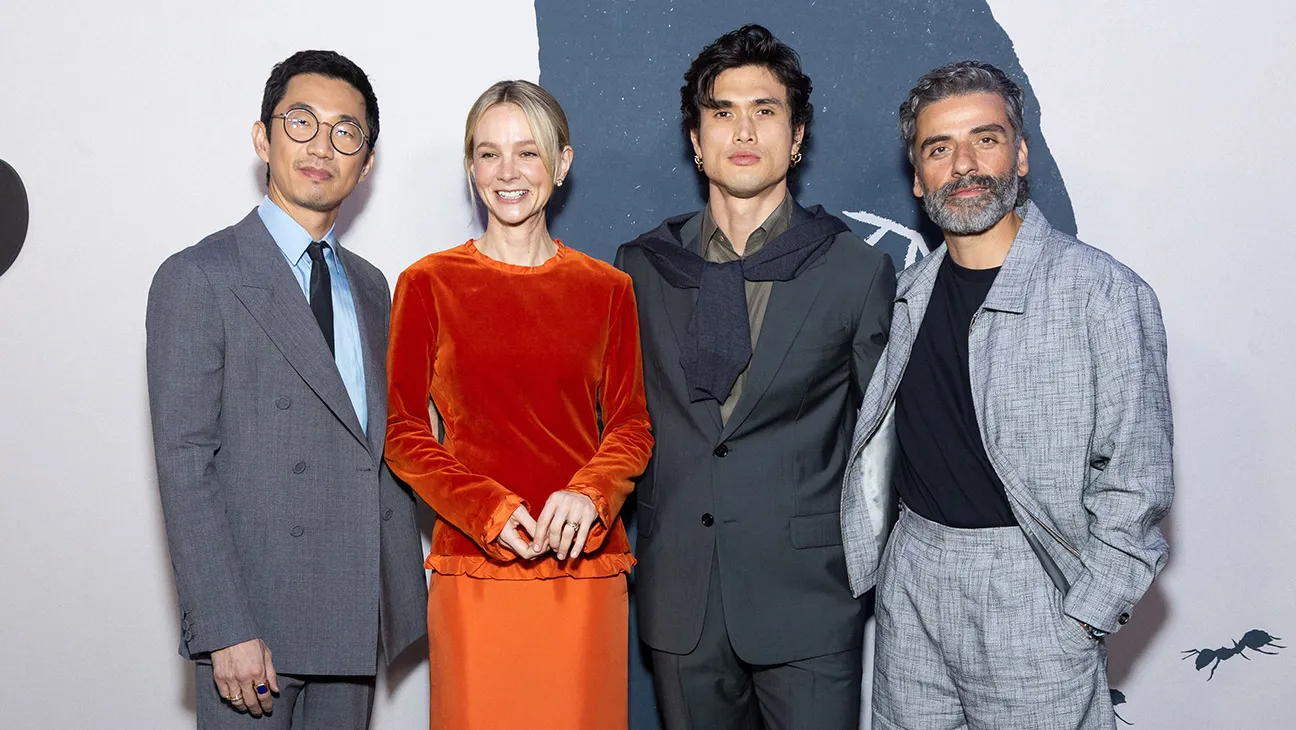
Beef’s second season leaves behind the parking lot feuds of season one, instead focusing on two couples, one millennial (Oscar Isaac and Carey Mulligan) and one Gen Z (Charles Melton and Cailee Spaeny), working at a California country club. It also stars legendary Korean actors Youn Yuh-jung and Song Kang-ho, along with rising actors Seoyeon Jang and Matthew Kim, also known by his K-pop stage name BM.
The second season’s titular beef falls between the Gen Z couple of Melton’s Austin Davis and Spaeny’s Ashley Miller, and their boss, Isaac’s Josh Martin, and his wife, Mulligan’s Lindsay Crane-Martin, after the younger couple witnesses Josh and Lindsay in what appears to be an intense fight.
Much like in season one, Lee took inspiration from his actual life, after he overheard a “heated debate” coming from a couple’s home in his neighborhood, and realized that his younger peers and similarly aged peers responded in very different ways when they heard the story.
A whole host of characters come in, including Youn’s Chairwoman Park, the country club’s new billionaire owner, Jang’s Euince, the chairwoman’s assistant, Song’s Dr. Kim, the chairwoman’s younger husband, and Kim’s Woosh, the chairwoman’s stepson and a tennis coach at the country club.
Below, Lee unpacks the second season’s finale, bridging different aspects of his life and upbringing he didn’t get to in season one, how his work on an X-Men reboot is going and what the deal with all those ants is.
I won’t really ask you the question that I’m sure you’re tired of being asked, but all my colleagues wanted to know what the ants mean. You’ve been pretty clear about leaving that up to interpretation.
I mean, I’m sure you’ve heard my answer. It’s definitely open to interpretation. I’ve been hearing a lot of cool interpretations, though, as we’ve been doing screenings and things.
Oh, really?
I heard one in Philadelphia the other day where someone was like, “Oh, is it because these characters are getting more almost animalistic and then kind of like down to their core, almost lizard brain self?” I hadn’t heard that one, but that’s cool.
Then other people, they’ve picked up on [the fact] ants and bees are hive mind insects and sort of diving into that. Some people are tying the hive mind thing to our theme of capitalism. These are all the right areas. I don’t think that there’s one answer. I think sometimes for me, I start with an intention, and I put it into the show and then I start seeing other interpretations of it.

Cailee Spaeny as Ashley Miller and Charles Melton as Austin Davis in episode 208 of ‘Beef.’
Courtesy of Netflix
It evolves for you too then. That’s the point of art, in a way.
Exactly. I can’t tell you how many times I’ve looked at some of my favorite paintings or even listened to my favorite songs, and then suddenly the meaning’s changed over the years.
I’d love to talk about the ending. With Ashley and Austin [Spaeny and Melton], it felt a bit inevitable we’d see them where Josh and Lindsay [Isaac and Mulligan] started. But why did you feel that was the way you wanted to take it?
Thinking about generations and the passage of time, more often than not, in my own life and from what I observe of others, you end up becoming the thing that you never thought you would be. I remember being in my 20s on staff, and anytime the showrunner would make us stay past 7, I’d be like, “Oh, they probably hate their family. I can’t believe this.” Then here I am, 44 and at work until 11:30 p.m. pretty routinely. It felt very fitting. Whether people interpret that as a tragic ending or not, I think that really depends on where you’re at in your life.
All my favorite pieces of art are fables. [They’re] mirrors to our existence, so that we can see our shadow selves and be like, “Wait, I kind of recognize that person in this story. Is that me? Is that my neighbor? Is that my best friend?” Just to give yourself some pause and think about it. That was very much an ending that we knew we were heading towards from the very beginning, as soon as we wrote the first episode. But Josh and Lindsay, on the flip side, that’s something that we didn’t know. That’s something that we discovered. I can’t tell you how many collaborators begged me to just end their story at the kiss.
Really? Why?
With the Finneas score and everything, it feels so nice to have them reconnect. But for me, I was just, again, thinking about the passage of time. Is that honest? Do we want to keep them together, or do we want to show that summer turns to fall into winter? It felt very fitting for them — for Lindsay to have married older and picked a safe path and have a daughter, and for Josh to suffer the consequences of his actions. But also in doing so, he’s almost become a become a Troy [William Fichtner]. He’s kind of free and loose and he’s himself. It was just trying to think about the God’s eye view, the seasons of life and how to honestly portray what might happen to these characters.
We’re in a strange time in media where it feels, at times, some younger audiences have lost the ability to understand nuance in shows. Making a show in these times, and doing what you’re doing, do you find that to be a bit difficult?
No one’s asked me that, but it’s a question I’ve been thinking about daily. It’s hard, for sure. It’s hard to not fall into the trap of getting older where you sort of have a get-off-my-lawn-mentality. I’ve been doing a lot of self-reflecting this week, and I remember being in my 20s. No Country for Old Men had come out and everyone was like — obviously, now I know it’s an all-time great movie — but in the moment, in my youth, I was just looking around being like, “Did we watch the same movie?” I know I’m supposed to think it’s great, but I was like, “Whoa, so bleak.” I pretended to love it, but in my head, I was like, what am I not getting? It’s just because I hadn’t lived. Now, when I watch that film over and over again, I’m like, “Holy shit, what a masterpiece” — not just in terms of its bleakness, but in its reflection of what reality and life and nature can be. It’s unrelenting. I try to keep that in mind.
Oscar Isaac as Josh Martin and Carey Mulligan as Lindsay Crane-Martin in episode 208 of ‘Beef.’
Courtesy of Netflix
I understand that.
I hope people come back to this show time and time again. I hope the younger crowd watches it in 10 years, and if some feel the same, great, but hopefully some people feel differently because they’ve gone through different experiences. Our aim with the show is how we can leave something that, throughout the test of time, will reflect different things to different people depending on where they’re at. I just have to constantly remind myself, as a creator, that it’s OK for different swaths of the audience to feel differently. I’m just thankful that there’s even a discourse. We live in an age where so much stuff doesn’t cut through, and I love that people are comparing season one and season two. I’d rather that than them compare us to another show. I feel a certain way about the seasons right now, but that may change for me too. The fact that this is touching a nerve enough that people want to talk about it and debate it and have really, really strong opinions online on both sides, I welcome all of it. For me, it’s just about trying to fight the traps of getting older and getting stubborn.
To go back to Lindsay, there’s been discussion about if her ending was deserved. You’re writing flawed people because real people are flawed, so the idea that a character can deserve something is a strange thing to wrap our heads around. But narratively speaking, people have things they think characters should or should not get. How are you working around the traps of this idea?
That’s what’s fun as a writer’s room. A lot of us, we’ve been doing this for a while. I’ve been writing for 20 years. I know what chord people want me to play. It’d be foolish of me not to acknowledge. Yes, it’s very satisfying when a certain character does something, and then they either get the consequence from it or they get the reward from it. I know what chords are supposed to be there, but as someone who plays a lot of music, it’s like my favorite stuff, it’s when you think the chords should be this and then they do something else.
I know where we want Lindsay to be, but it just felt true to me. Also, I think it spawns that discussion of life’s not fair. That’s just not how it works, and if you want a narrative that kind of gives you the fairytale ending or the expected ending, there’s plenty of other shows that do that. I watch those shows as well, but Beef has never presented itself as that. We’re going to keep pushing things, we’re going to keep doing left turns, and it may make people angry at the time, but I’m hoping with some space and some processing, they’ll return to these moments.
With Josh, in particular, where in creating this narrative did you pinpoint his ending?
It was actually a conversation with Oscar in the pre-time jump, because there were different ways that prisoner’s dilemma between the two couples unfolded in early drafts and nothing was quite feeling true. Then Oscar said he wished his character did something selfless finally. He asked me, “Do you remember Last of the Mohicans?” I knew exactly [what he was] talking about. It’s the [moment where] you sacrifice yourself, unbeknownst to the person you’re saving. It felt like it was very true for someone who was so focused on himself that he finally does this act of sacrifice. Even though he has to suffer the consequences of prison, all the pressures that he was under for the whole season, they finally kind of lifted. He gets to be fully himself in prison. He’s just the guy. He’s getting people gushers and nail clippers, but he’s free. He’s looser. We were rewriting that finale up to the 25th hour.
For me, watching Josh’s arc is satisfying. Oscar’s performance on that final push onto his face, where he has to accept that he has to let go. It’s sad, but then it’s also very zen. Josh is finally in this zen space. And who knows? He’s in the chapter that Troy and Ava were in. I’m curious where Josh is going to end up in his winter stage. We don’t know. I’m really thankful for collaborators like Oscar, [where] it’s just a constant conversation, and it’s never about ego. It’s never about anything other than what’s the best idea here. Carrie, Oscar, Cailee, Charles — they have really finely tuned radars for bullshit. I’m very, very happy with how that prison moment played out. Jake [Schreier] obviously shot it so beautifully as well.
Song Kang-ho as Dr. Kim in episode 203 of ‘Beef.’
Courtesy of Netflix
I’ve been thinking about something Seoyeon said to me. She had this moment on set in L.A., sitting with YJ, where she realized she’d never imagined this for her or other Korean actors. This season is definitely a blending of actors from different places and in different points of their career. Do you have any more thoughts on it?
For me, this season is so much about bridging aspects of my life and my background that I didn’t get to explore in season one. Again, having done this for 20 years, I know everything I could have done to replicate the success of season one in terms of leaning into the same narrative beats and covering the same ground. I just find that for me as a writer, there’s so many aspects to the Asian experience and the Asian American experience, and an endless infinite amount of dimensions. That with the limited time here on earth that I get to do this job, I’ll run out of time to even get to explore a tenth of those things.
Naturally, in season two, I wanted to tap into what I was going through in my real life. It was the bridging of the east and west. I was going over to Korea more so than I had ever done before. I was getting exposed to high society in Korea in a way that I had never done before. In this constant quest of being as meta as possible, I then went for the king and queen of Korean cinema.
Absolutely.
I was getting to flex muscles that I hadn’t been able to flex ever in my career. There are more scenes written in full Korean by far relative to season one. That particular scene in episode three with Song Kang-ho and YJ at the breakfast table, that’s probably one of the scenes that I’m most proud of. It’s a long scene.
It is.
It’s one of the longest scenes of that episode. It’s just unapologetically full Korean, not holding back at all. Just all the cultural specific ways that Song Kang-ho speaks. YJ saying, “I love you,” in English at the end. There’s all these little touches that I know that I may never get to do something like that again. I’m just very thankful that I got to stretch myself and try things that I’ve never gotten to try before. I’m also really proud of the fact that we found even more newcomers this season. Seoyeon is so talented. I think she’s going to have a very long career. Matthew Kim, the first time he’s ever acted. He’s incredible. I’m excited for Matthew to continually evolve as an actor. Even chief counsel, Jason [Her]. It’s so hard to find an actor that speaks that fluent Korean and English, who has that Korean cinematic look, with his hair that felt like chaebol society. Just to still be able to, even as we tried new things, constantly discover new talent while getting to work with the greats, what creator wouldn’t want that?
Why do you think you’re able to do that?
I do feel very, very privileged and blessed that Netflix was so supportive of all these decisions. I’m very aware that at other places, with other executives, I don’t know that I would’ve gotten to do this. I think there might’ve been pushback or [asking to] cut one of the Korean scenes [or for them] to start talking in English at some point. That was never the case. Netflix just wanted more. When I said that we were going to shoot in Korea for the finale, they asked, “What do you need?” I hope I continue to get those opportunities because I’m just going to keep trying to find new slices of the Asian experience that I can cover, but in new ways, in ways that people don’t expect me to, because that’s just who I am.
Lee Sung Jin with Ted Sarandos, Nicole Avant, director Jake Schreir and the cast of Netflix’s ‘Beef.’
Stefanie Keenan/Getty Images for Netflix
We’ve spoken before about how you realized it was better for the ideas for the seasons of this show to come to you instead of trying to manufacture them. You just resigned your Netflix deal. What’re you looking at doing next?
For the series of Beef, I’d be perfectly happy if this were the last season. I think it’s really emotionally taxing, the making of it and the rollout of it. Jinny [Howell] always told me, “You should only do it if you really have something to say,” and I feel like I’ve said it through two seasons of Beef. But I do remain open — if the universe shows me something in the future and it feels right for Beef, I’m definitely open.
In the meantime, I do have a lot of other projects that I want to pursue. I’ve been in the lab every day with Kevin Feige, Jake Schreier and Joanna Calo. We’re working on X-Men tirelessly. That is a privilege of a lifetime, to handle the best IP in the business in X-Men, so I’m looking forward. I’m definitely just continually trying to tell interesting stories that hopefully will reach a lot of people. Maybe I’ll return to Beef in the future, but if not, I’m very proud of the work that we’ve done over two seasons.