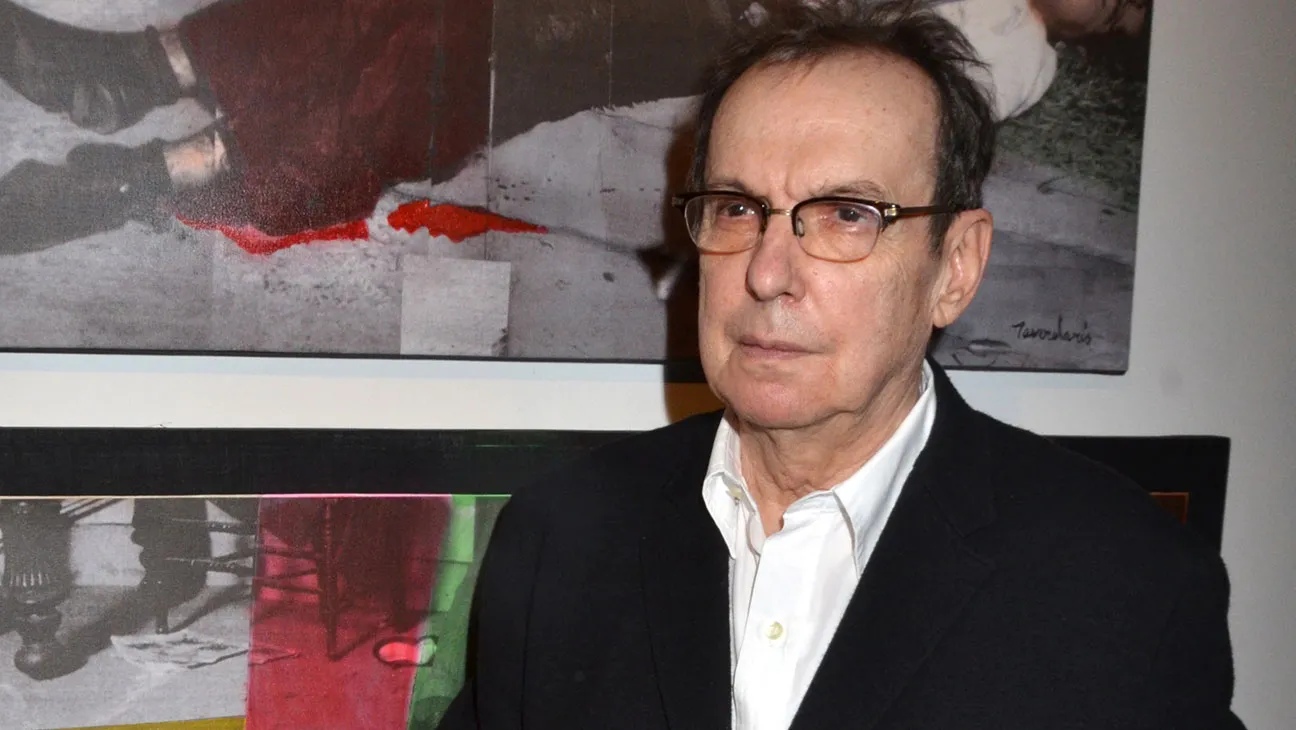
Dean Tavoularis, the revered Oscar-winning production designer who collaborated with Francis Ford Coppola on 13 films, including all three Godfather movies, Apocalypse Now and One From the Heart, has died. He was 93.
He died Wednesday night in Paris from natural causes, THR writer and film critic Jordan Mintzer reported. The two teamed on the 2022 book Conversations With Dean Tavoularis.
Tavoularis received his Academy Award in the best art direction-set decoration category for The Godfather: Part II (1974) and also was nominated for his work on three other Coppola-directed films — Apocalypse Now (1979), Tucker: The Man and His Dream (1988) and The Godfather: Part III (1990) — plus William Friedkin‘s The Brink’s Job (1978).
In his first movie as art director, Tavoularis came up with the bleak Dust Bowl look for Arthur Penn’s fabled Bonnie and Clyde (1967), the first of six best picture nominees on which he worked. Two of those — the first two Godfather films — took home the ultimate prize.
Tavoularis also teamed with director Coppola on The Conversation (1974), The Outsiders (1983), Rumble Fish (1983), Peggy Sue Got Married (1986), Gardens of Stone (1987), New York Stories (1989) and Jack (1996).
Talking about Coppola, “There are many partnerships in all different kinds of businesses that can always turn out badly, but sometimes it can turn out to be a collaboration. You see eye to eye; you feel supportive,” Tavoularis said in a 2018 interview. “When you’re doing a film, no matter how tough you are, no matter how strong you are, you need a feeling of support. And I always had that with Francis.”
“Like all great collaborations,” Coppola said in 1997, “I began to depend on Dean. This grew into a natural and wordless collaboration, which provided so much comfort to me and added to the style of the films we worked on together.”
He received the Lifetime Achievement Award from the Art Directors Guild in 2007.
For The Godfather: Part II, Tavoularis transformed East Sixth Street between Avenues A and B in Lower Manhattan into Little Italy in 1918, complete with a dirt road and quaint, old-fashioned storefronts.
There was nothing quaint about the making of Apocalypse Now, for which Tavoularis created a nightmarish jungle kingdom with a decaying temple — inspired by the ancient Angkor Wat in Cambodia — as its centerpiece. His scheduled 14-week stay in the Philippines wound up lasting two years. (In all, the movie took four years to finish.)
“You never had the feeling at the end of the day that it is one day less and you were one day closer to completion,” he told the Los Angeles Times in 2012.
And for the nostalgic (and pricey) love story One From the Heart (1981), who needed to trek to Las Vegas when you could have Tavoularis construct a multimillion-dollar, high-tech version of Sin City at Coppola’s American Zoetrope in San Francisco?
Covering nine soundstages, his set included replicas of casinos and Fremont Street with loads of neon lights and a paved intersection, a residential neighborhood, a desert motel and a faux runway at McCarran International Airport.
“I’ve bought a movie studio, which is like getting a theater. What the hell am I going to Las Vegas for?” Coppola told Rolling Stone in 1982. “Let’s build it inside the studio and totally control it and have the sets be on one stage, as on Saturday Night Live, and have the actors literally perform it like a play — ‘Ready, begin!’ — and do the whole movie as a performance and then go back and put the cameras in different places with the transitions, music, everything. There’d be nothin’ like it!”
He continued, “Dean, in his mind, couldn’t get with the idea of creating the illusions of the movie with matte shots and trickery on that level. He wanted to build the fantasy — that’s what cost the extra 10 or so million dollars.”

‘One From the Heart’
Columbia Pictures/courtesy Everett Collection
Constantine Tavoularis was born on May 18, 1932, in Lowell, Massachusetts. When he was a kid, the family moved to Los Angeles, where his dad was in the coffee business.
“We are Greek Americans, and one of [his father’s] clients was Fox studio, which was owned by [Greece native] Spyros Skouras,” Tavoularis said. “In the summer sometimes I would go with my dad and spend a day going around on his deliveries. We would drive back to the commissary, and you saw stage pieces and ladies dressed in their period gowns. It was a mysterious, magical paradise.”
He studied architecture and painting at Otis College of Art and Design and joined Disney as an in-betweener in its animation department, where one of the first films he worked on was Lady and the Tramp (1955).
He served under art director Robert Clatworthy on the live action Disney films Pollyanna (1960) and The Parent Trap (1961), then was Clatworthy’s assistant at Warner Bros. on Robert Mulligan’s Inside Daisy Clover (1965), set in Santa Monica in 1936.
Despite Tavoularis’ lack of experience, Penn gave him a great opportunity on Bonnie and Clyde, and he delivered.
“We made Bonnie and Clyde on a minuscule budget. It was barely more than a couple of million dollars,” Penn said. “But Dean Tavoularis and Theadora Van Runkle, who designed the costumes, created a whole era.”
After working on Michelangelo Antonioni’s Death Valley-set Zabriskie Point (1970), he reteamed with Penn on Little Big Man (1970), a Western filmed in Montana and Calgary.
Tavoularis first met Coppola while he was an assistant art director on the Marlon Brando-starring Candy (1968).
He said that Paramount execs pushed for the director to make The Godfather (1972) in St. Louis. “Why St. Louis? I went over there and looked around; it was ridiculous. It wouldn’t have made the picture better; they only wanted to escape the New York unions,” he said. “Everything that Paramount wanted would have made this movie a flop. Everything that Francis fought against and fought for made The Godfather a screen classic.”
‘Apocalypse Now’
United Artists/ Courtesy: Everett Collection
For Apocalypse Now, Tavoularis went in search for helicopters and a river.
“We went to the Pentagon, this huge mythical Pentagon building, but the Department of Army read the script and they said, ‘No.’ No helicopters from the United States,” he recalled. “So we started looking for helicopters elsewhere — and we needed a river. … I went to Thailand, Borneo, Jakarta, Malaysia — it was educational, and I still remember the weirdness of these trips. I ended up in the Philippines, and like a lot of war films finally did, the government co-operated and gave us helicopters, and they had the rivers. So we shot the film in the Philippines.”
He once described the shoot as “living in the house of death that I was making.”
Tavoularis’ other credits included Farewell, My Lovely (1975), Caleb Deschanel’s The Escape Artist (1982), Wim Wenders’ Hammett (1982), Shelf Life (1993), Philip Kaufman’s Rising Sun (1993), Warren Beatty’s Bulworth (1998), Nancy Meyers’ The Parent Trap (1998), Roman Polanski’s The Ninth Gate (1999) and Roman Coppola’s CQ (2001).
After a decade away to paint, he returned to work for Polanski again on Carnage (2011), his final feature.
In The Offer, Paramount+’s 2022 limited series about the making of The Godfather, Tavoularis was portrayed by Eric Balfour.
Survivors include his second wife, French actress Aurore Clément, whom he met on the set of Apocalypse Now and then married in 1986 at Coppola’s home, and his daughters, Alison and Gina.
(His wife’s scenes in the mesmerizing French plantation sequence of Apocalypse Now were cut from the original release but restored for the expanded redux version.)
In an introduction to a 2007 exhibit that showcased Tavoularis’ career as a film designer and painter, writer Jean-Paul Scarpitta said the designer “attained a higher reality, that of poetry.”
“In his art, he doesn’t dwell on magic, visual deception, optical illusion or unreality … His penetrating eyes allow him to watch and feel things deeply, which leads him to capture what others are not privy to see: the gimmicks, the artifices, the tricks, the element of life upon which the veil of illusion is cast,” Scarpitta wrote. “In his mind, there is a clear parallel between painting and cinema, in that he considers one and the other as different yet compatible means to create an illusory world that only exists in a dimension of its own.”