Hirokazu Kore-eda brings his customary warmth and generosity of spirit to the seemingly cold presence of GenAI in our lives in Sheep in the Box (Hako no naka no hitsuji), in which grieving parents hope to ease their pain by embracing a humanoid built in their dead son’s image. The Japanese director has no shortage of ideas — chief among them the potential for advanced robotics to bring closure to the bereaved. But too few of those ideas yield satisfying conclusions, resulting in a drama that becomes treacly and insubstantial, reaching for a profundity that remains elusive.
Family dynamics have frequently been at the heart of Kore-eda’s films, invariably distinguished by his exceptional direction of children. Something of a motif in his work is the resilience and resourcefulness of kids, which continues here with a robot that outgrows the need for his adoptive parents, just as flesh-and-blood children do when it’s time to seek independence. But these and other thematic threads lack both definition and emotional heft, making the movie feel flimsy, especially considering its two-hours-plus run time.
Sheep in the Box
The Bottom Line
Beautifully made but thematically woolly.
Venue: Cannes Film Festival (Competition)
Cast: Haruka Ayase, Daigo, Rimu Kuwaki
Director-screenwriter: Hirokazu Kore-eda
2 hours 6 minutes
Despite occasional detours into fantasy like 1998’s sublime After Life, Kore-eda is fundamentally a naturalistic filmmaker with a marked humanist vein that has often tagged him as an Ozu descendant. Which makes the prospect of him tackling a near-future sci-fi scenario sound of interest. The droll futuristic touches of the opening scenes — a delivery drone that could pass for a mini-UFO carrying parcels high above a city coastline; a robot crossing guard trailed by a string of children — hold the promise of low-key humor.
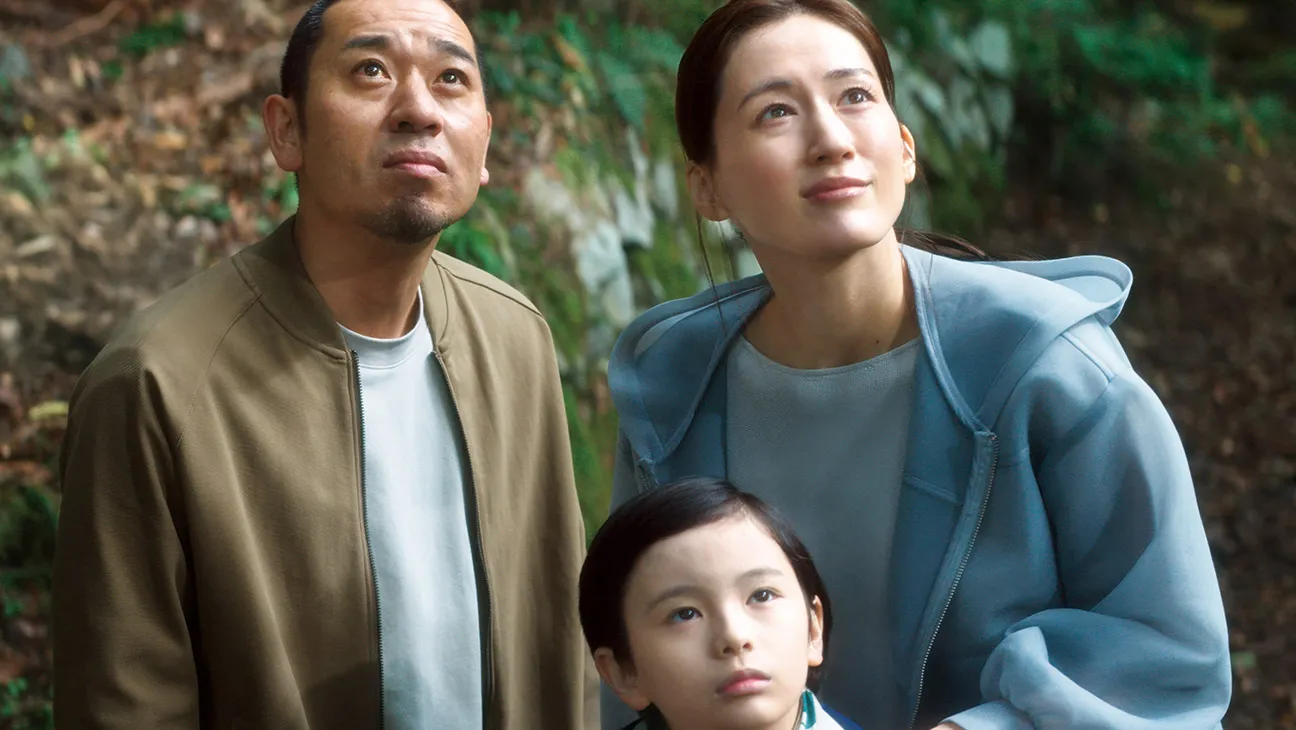
That drone touches down at the address of architect Otone Komoto (Haruka Ayase), who designed her family’s modernist home, an arrangement of overlapping boxes stacked around a garden courtyard. It was built by her carpentry and construction tradesman husband Kensuke (Japanese TV comic Daigo). When the camera pans to a framed photo of their 7-year-old boy Kakeru (Rimu Kuwaki), composer Yuta Bandoh’s melancholy score provides an unsubtle hint that the boy is no longer with them.
One of the parcels delivered contains a heart-shaped package that opens to release a hologram of a luna moth, the logo of a company called REbirth that specializes in generative AI humanoid replicas of deceased loved ones. It turns out the Komotos were first approached by a rep two years earlier at their son’s funeral and are eligible for a free promotional trial.
Otone is somewhat curious, given how acutely she still feels Kakeru’s absence, but Kensuke is more skeptical. They make an appointment at the REbirth offices and listen to the sales pitch but remain uncertain until a young boy around their son’s age when he died approaches them in the cafeteria. Astonished by how lifelike the robot child is, they sign up for the program, submitting photos, videos and other info on Kakeru to be fed into his design.
When the new model Kakeru is delivered, Otone is overjoyed, even if the boy’s communication skills are basic, at first limited to “Mama, I’m home.” But “papa” is tougher to convince, dismissing the new arrival with cracks about Tamagotchis and Roombas before heading out to play baseball for the day.
Most directors would look for conflict in the inevitable incompatibilities between grieving parents with human feelings and a humanoid with no emotions and no needs beyond his overnight charging station. But Kore-eda dawdles over all that without ever finding much dramatic nuance, making for a dullish midsection.
Things come briefly to life when Otone’s judgy mother shows up uninvited, faints at the sight of her dead grandson and then scoffs at the folly of replacing the boy with a machine, reminding Otone that she’s still young enough to have another child. But even that fails to generate tangible drama, as do ongoing tensions about the circumstances of the real Kakeru’s death.
More intriguing is the appearance of a youth in black, followed by a handful of other children with whom Kakeru finds kinship as they spend time each day in an abandoned warehouse making mysterious plans.
While Kore-eda’s take on the existential threat of AI is refreshingly free of violence, rebellion and gloom, it’s also a bit predictable in its conclusion that the humanoids’ accelerated learning capabilities will soon make their human families superfluous. And the writer-director tips his hand by having Kakeru collect the offcuts from Otone’s architectural models and start building his own model in secret.
The film’s most original idea is the instinctual connection of robots to aspects of nature like the networks of trees nourished and protected by a “mother tree” that functions like a central computer hub. Sure, there are dystopian shadings in the inference that robots will form their own communities, leaving people behind. But Kore-eda is more interested in a smiley-happy outcome of mutual accord, which is pushed into sentimental overdrive by increasingly cloying slatherings of Bandoh’s score.
Shot by Ryuto Kondo, who also served as cinematographer on Kore-eda’s wonderful Palme d’Or-winning Shoplifters and the more recent Monster, the film looks sharp, with lots of striking aerial shots and gorgeous natural light in the many outdoors scenes. It’s also well-acted, notably by Ayase, the lead in Kore-eda’s Our Little Sister, whose gentle disposition and unforced sweetness are an ideal match for the director’s sensibility.
But Sheep in the Box (the title comes from The Little Prince, another motif) is unquestionably a minor entry in the Kore-eda canon. If you want to see a stimulating meditation on humanoid-human interaction that’s genuinely moving, seek out Kogonada’s criminally under-appreciated After Yang, from 2021.