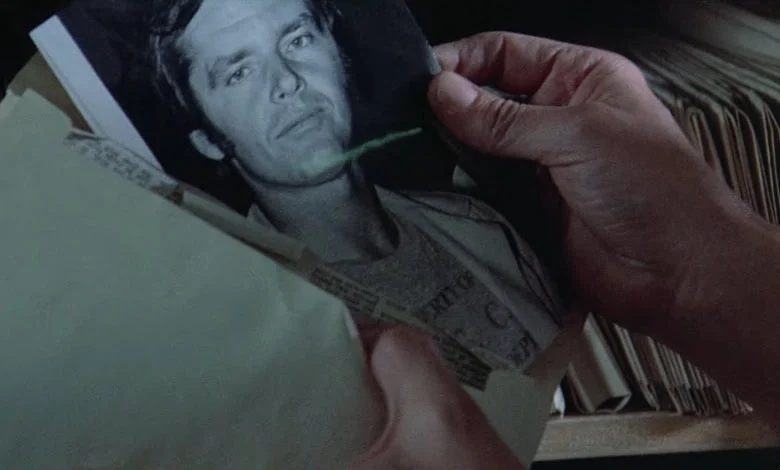
Michelangelo Antonioni’s “The Passenger” (1975) marked a special collaboration between the director and his star, Jack Nicholson.
Their daring, highly unusual film, now 50 years old, is a challenging work and deserves to be rediscovered.
When we meet Locke, played by Nicholson, he’s a reporter on assignment in the Sahara Desert, finding himself alone and unhappy. His vehicle stuck in the sand, Locke defeatedly returns to his rundown room for rent and discovers that his neighbor has died.
Rather than report it, Locke is suddenly hit with an idea and runs with it: Locke steals the dead man’s identity and flees the country.
Locke was originally on the search for truth, but his journey became about creating and maintaining his own, original existence. When Locke meets a character identified as Girl (Maria Schneider), he only entangles her in the danger his new life has brought him.
A subplot emerges where figures from Locke’s past are trying to locate him. Yet, since Locke’s existence is no longer tied to his former identity and his path coincides with a newfound danger, who exactly is he at that point?
The initial luxury Locke experiences in wandering the world a free, anonymous figure becomes yet another form of existential dread.
Patient in its scene-to-scene movement, which isn’t the same as being slow or boring, “The Passenger” has this spellbinding ability to make the viewer feel like you’re seeing the story occur in a real, organic manner and not ensnared to convention or mainstream narrative expectations.
Locke’s strange journey, both a soul search and an escape from the past he escaped and the present he’s failing to control, could be taken as a metaphor for counter culturists. Or, it could be an allegory for what Nicholson and other actors experience whenever they take on a new character.
Jack Nicholson, Maria Schneider ‘The Passenger’ (1975) Michelangelo Antonioni. pic.twitter.com/MM6mKrJUws
— The projectionist woman (@projectionistw) March 4, 2023
Perhaps some will be bored by this (as some were with Antonioni’s prior films) but what the filmmaker succeeds at evoking is a story unfolding in real time. The unpredictable quality of the story and the transformative nature of Nicholson’s character mark it distinctly as a film of the 1970s.
Yet, even in the midst of gritty, uncommercial, anti-mainstream 70’s works like, for example, “Dog Day Afternoon” (1975) or “The Conversation” (1974), Michelangelo’s film maintains an experimental approach that defies easy categorization. Like a David Lynch film (minus the overt surrealism) without a scholarly or any explanation, there’s still so much here to unpack.
Rather than come across as aloof or cold, “The Passenger” is intensely fascinating, a movie that rewards multiple viewings and offers a deep cut for fans of Nicholson’s work.
Michelangelo’s most well-known films will always be “Blow-Up” (1966), “L’Avventura” (1960), “Zabriskie Point” (1970) and “Red Desert” (1964). Yet another crucial Antonioni deep cut is his final film, “Beyond the Clouds” (1995), which the filmmaker co-directed with Wim Wenders.
That film has ravishing dream-like moments that have never left me. I remain hopeful that The Criterion Collection will rescue “Beyond the Clouds” from obscurity.
The most famous scenes in “The Passenger” are the single-take shots where so much is happening in the frame, while a great deal of choreography and careful timing is occurring off camera. Digital filming would allow so many acrobatic shots to be achieved more easily today but Antonioni was doing in-camera shots that are amazing for how seamless they look.
Nicholson has called the making of “The Passenger” as “the biggest adventure in filming of my life.”
The Passenger (1975, Antonioni)
“Michelangelo Antonioni reduced all this reducing of the actor’s use to me in one simple statement, ‘Jack, nothing’s wrong, but for me, the actor is a moving space’.”
— Jack Nicholson pic.twitter.com/Ilz2wn9Smh
— DepressedBergman (@DannyDrinksWine) June 15, 2024
Nicholson plays all this very real and straightforward, without the knowing stylishness of his more flamboyant portrayals. As in his best work, you can never catch him acting.
Part travelogue, part thriller, “The Passenger” is a loving expression of the possibilities of cinema. “The Passenger” arrived in 1975, a landmark year for Nicholson- the same year as his odd cameo in the Ken Russell musical “Tommy,” his ill-fated comic turn in Mike Nichols’ flop “The Fortune” and, most crucially, his starring role in the Best Picture Oscar winner, “One Flew Over the Cuckoo’s Nest.”
“The Passenger” was the third of Antonioni’s trilogy of English-language films (“Blow-Up” and “Zabriskie Point” were the others).
After being released in the 1980s in a clamshell videocassette, Nicholson took the film out of circulation and made it a hard to find, sought after work. The film resurfaced in 2005-2006, with Sony Pictures distributing a re-release and Nicholson providing a solo commentary track on the DVD that acts as a master class for actors and fans of the film in general.
Now more than 50 years old and mostly forgotten, “The Passenger” is a gift for lovers of cinema and an underseen masterpiece from both Antonioni and Nicholson.