While the theatrical poster for Adam McKay’s Step Brothers focused on a studio portrait of the characters played by Will Ferrell and John C. Reilly, each boasting an unnaturally dazed smile, the DVD cover accentuated the movie’s less domesticated side: Dale (Reilly) is pulling Brennan’s (Ferrell) hair in a tableau that’s half posed and half unconfined violence, with each stepbrother baring teeth, one in pain and the other with a rictus grin of either effort or triumph.
I can’t say for sure if Richard Gadd and the HBO marketing department are intentionally emulating Step Brothers with the primary poster image for Gadd’s new limited series, Half Man. In the poster, Gadd’s Ruben has Jamie Bell‘s Niall in a headlock. It’s a position at once intimate and competitive; the stepbrothers could, at first glance, be wrestling for fun, but one look into the eyes of either man makes it clear that no fun is being had. At least the series delivers on that promise.
Half Man
The Bottom Line
A deeply felt but monotonous exercise in trauma.
Airdate: 9 p.m. Thursday, April 23 (HBO)
Cast: Richard Gadd, Jamie Bell, Stuart Campbell, Mitchell Robertson, Neve McIntosh, Marianne McIvor, Charlie De Melo, Bilal Hasna
Creator: Richard Gadd
I wouldn’t put it past Gadd to make his follow-up to Netflix awards juggernaut Baby Reindeer as a nightmarish counterpoint to Step Brothers — one a zany comedy with a disturbing melodrama just below the surface, the other a disturbing melodrama in which odd notes of comedy (not all that zany) come through at the least expected of moments.
It’s my sense that Gadd wants his work to sneak up on viewers, though following one of the most successful word-of-mouth sensations of the recent streaming era — one that transformed Gadd from a largely unknown alt comic into the winner of many Emmys — the chances of a second stealth maneuver are low. It doesn’t help that while Half Man has almost nothing narratively in common with Baby Reindeer, its thematic concerns are similar and the weight it presses upon the viewer is similar. The result is a six-episode series that boasts several great performances and some gripping perspective on toxic masculinity, trauma and sexual violence — yup, it’s another one of those shows — but feels emotionally unrelenting for six consecutive hours.
From a distance of a few days, I can see Half Man as a melange of elements that mark the intriguing and off-putting intersection of Judd Apatow and Sam Shepard, but if you’d asked me how the series was as I was watching it, my only answer would have been, “It’s…a lot.” It’s a show with much to recommend it, but it’s an emotionally draining show that, in its ultimate revelations, left me with little enthusiasm for recommendation.
The series opens with Niall’s jovial Scottish wedding. In a barn, Ruben is confronting Niall about…something. Their conversation is evasive and threatening and pregnant with decades of secrets, some shared and some to be revealed over the next six hours. The threat of violence — sexualized violence — is in the air, and within less than five minutes, several forms of assault will be perpetrated, leading into a flashback.
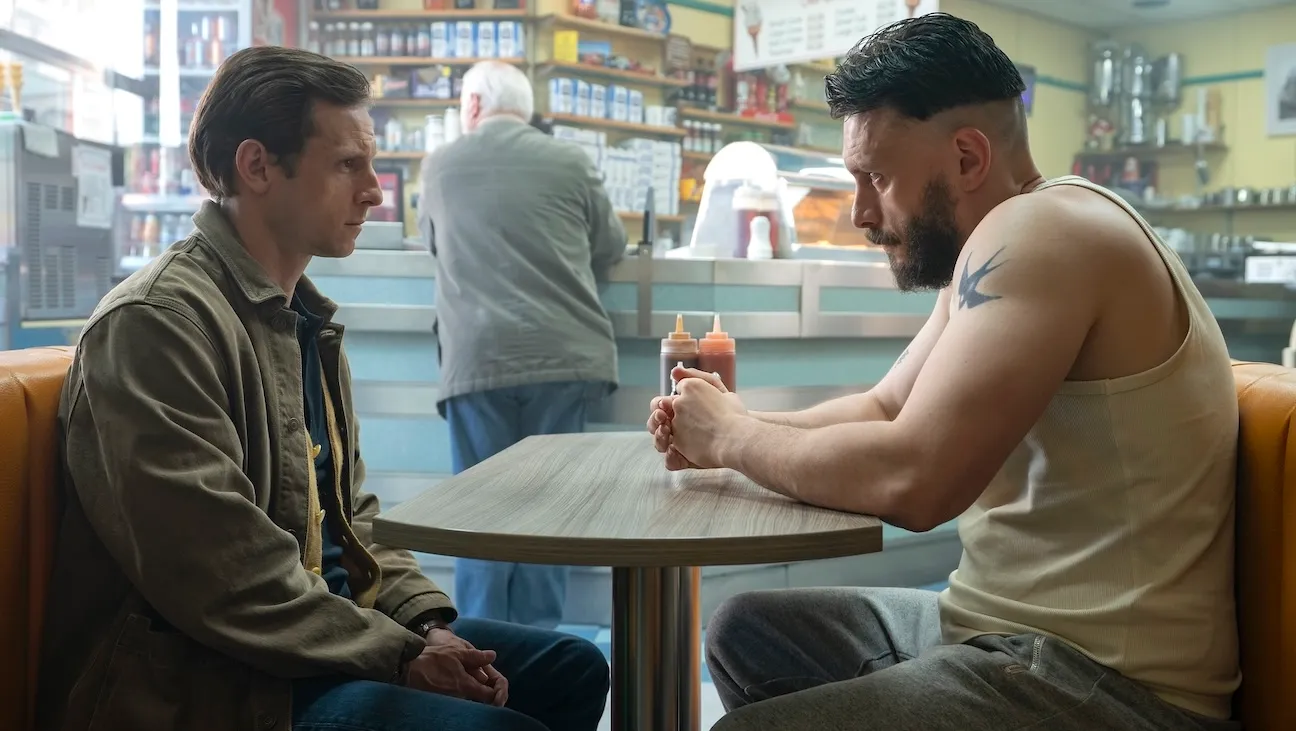
Decades earlier — signaled more in sountrack choices than anything else — Niall (Mitchell Robertson) is a socially awkward, oft-bullied teen, whose eyes grow wide with terror when he hears that Ruben (Stuart Campbell) is about to join his high school class. Ruben has spent two years at a juvenile detention facility, and Niall doesn’t want him as a classmate. He definitely doesn’t want to share a room with him, but it turns out that Ruben is moving in with Niall, because Niall’s mother (Neve McIntosh, excellent) and Ruben’s mother (Marianne McIvor) are close friends, locally rumored to be lovers (because they are).
Ruben is everything that Niall is not. He’s tall, assertive and wildly charismatic. He’s also dangerously out of control in ways that scare the meek Niall — who dreams of becoming a writer and is clearly coming to terms with his nascent homosexuality — but simultaneously intrigue him. Ruben takes action, whereas Niall prefers to be passive. Ruben comes with his own gravity, whereas Niall naturally recedes into the wallpaper. Will Ruben be the death of Niall, or will his outsized confidence turn out to be exactly what Niall needs to self-actualize? Will Niall help Ruben get his life in order or will he somehow destroy him?
It’d be easy to look at the characters and at the show’s title and think that Niall is an embodiment of ego, Ruben an embodiment of id, and that together, these two half-men might help each other become a full man. But that’s not exactly what the show’s title refers to and that’s not in any way what happens here.
Subsequent episodes follow a similar structure, bookended with the events at Niall’s wedding and filling in the gaps in their respective journeys, which don’t go exactly the way you expect them to. Except that…man, they go a lot of exactly the way you expect them to. The show almost immediately settles into a rhythm where you know that any time Ruben shows up, it’s going to lead to shouting — SO much shouting — threats and violence, even when circumstances initially suggest otherwise.
A show like this really needs to keep the viewer off-balance, never quite correctly anticipating the degree to which Niall’s life is positively or negatively impacted by his “brother from another lover.” In lieu of that, the story’s mystery needs to be enough to keep you curious or guessing. Neither traditional narrative draw emerges here.
Even when expectations are reversed, as happens occasionally in the middle of the season, it’s only to amplify the next emerging threat.
Even when the shuffled chronology renders cause-and-effect confusingly jumbled, Gadd’s tendency to come back to traumatic sexual violence as a precursor for adult personal and sexual development, while dramatically satisfying, is psychologically unconvincing. I also found that to be the case with Baby Reindeer, where Gadd’s need to give answers required that he impose a cause-and-effect in circumstances that aren’t always so thoroughly connected.
Though Gadd obviously wants to upend the initial good brother/bad brother, victim/ perpetrator, hero/villain binaries, only the dominant narrative, rather than the attempted subversion, sticks. The bones of the story, which go back to Cain and Abel (or Jacob and Esau), are so familiar, as are the reversals, that it’s hard to find anything Gadd’s doing to be genuinely fresh. The best he can accomplish is execute familiar beats with earnest, heightened theatricality. There are one or two scenes in which Niall and Ruben monologue at each other that made me think of Shepard’s True West or Willy Russell’s Blood Brothers, and I can respect how Gadd worked with those influences, but there were very rarely moments that felt genuinely original or out of the blue in the way that so much of Baby Reindeer did. You’re in a vice for six hours, with an author who lever lets you forget that he’s in charge of tightening and adding pressure.
Gadd is terrifying, a fierce force of nature and a perpetual misadventure waiting to happen. His voice rumbles up from some place deep inside, tinged with menace and pain, and you can’t stop watching or listening to him. He and Campbell, who plays the part for much of the series, convey a similar sense of uncontrollable danger, though even when the script says otherwise, Ruben never becomes anything other than feral. It’s easier in Campbell’s interpretation to see how Ruben could be both dangerous and appealing, harder in Gadd’s interpretation to see him as anything other than a wounded animal.
Robertson grounds both versions of Niall in a sad-eyed misery, with Bell stepping in and giving the character grace notes of humor that don’t always seem to fit the story. I laughed out loud several times at acting choices Bell made, the rare release valve within a show that could badly use more. Baby Reindeer was hardly a laugh riot, but mortifying humor is still humor and, with episodic running times in the 30-minute range, the show had a charging, unpredictable momentum. Baby Reindeer series directors Weronika Tofilska and Josephine Bornebusch also added visual variation, while Half Man directors Alexandra Brodski and Eshref Reybrouck dig deeper and deeper into pervasive glumness that isn’t allayed by two or three seconds of people in kilts festively dancing as a framing device. Half Man is largely dour and colorless, doomed from beginning to end.
More than anything, Baby Reindeer had a dose of warmth courtesy of Nava Mau’s Teri, while the central love story in Half Man, which I won’t spoil, is too flimsy to be sweet. The love story exists here to offer hope, but not much and not for long. And maybe that’s the point — to chart a descent of two inextricably linked characters, bound together for better or worse long before the opening wedding. I can respect the lines Gadd is drawing between nature and nurture, destiny and self-determination, trauma and healing. I just can’t say I found the unveiling of those truths to be especially enjoyable or revelatory.