[ad_1]
[This story contains major spoilers from the season nine finale of 9-1-1, “Hearts and Flowers.”]
Ryan Guzman has learned to roll with the punches on 9-1-1. Back in 2021, when his firefighter-paramedic character, Eddie Diaz, was shot by a sniper, the actor genuinely feared for his job security. But when he recently learned that Eddie was going to face another near-death experience, Guzman’s reaction was surprisingly blasé, despite the fact that the ABC first-responder procedural had just killed off its first main character last year.
“We get these production packets [from showrunner Tim Minear], so we never get a full script, really. It always keeps us on the edge of our seat,” Guzman tells The Hollywood Reporter with a wry smile. “The show always throws curveballs at us, and we’ve become used to it after nine seasons of adjusting to it.”
In Thursday’s season finale, Eddie is caught in the crosshairs of Anatoly Caster (Alan Starzinski), the scion of a corrupt businessman who was the target of a police raid, led by protagonist Athena Grant (Angela Bassett), for facilitating a human trafficking ring involving migrants in Los Angeles. After becoming dissatisfied with the crooked Major Crimes detective Ben Hooks (Josh Stamberg), who shot Athena at the end of the penultimate episode in a desperate attempt to cover up his involvement in the scheme, Anatoly decides to avenge his late father by showing up to the hospital where Athena is being treated with a gun.
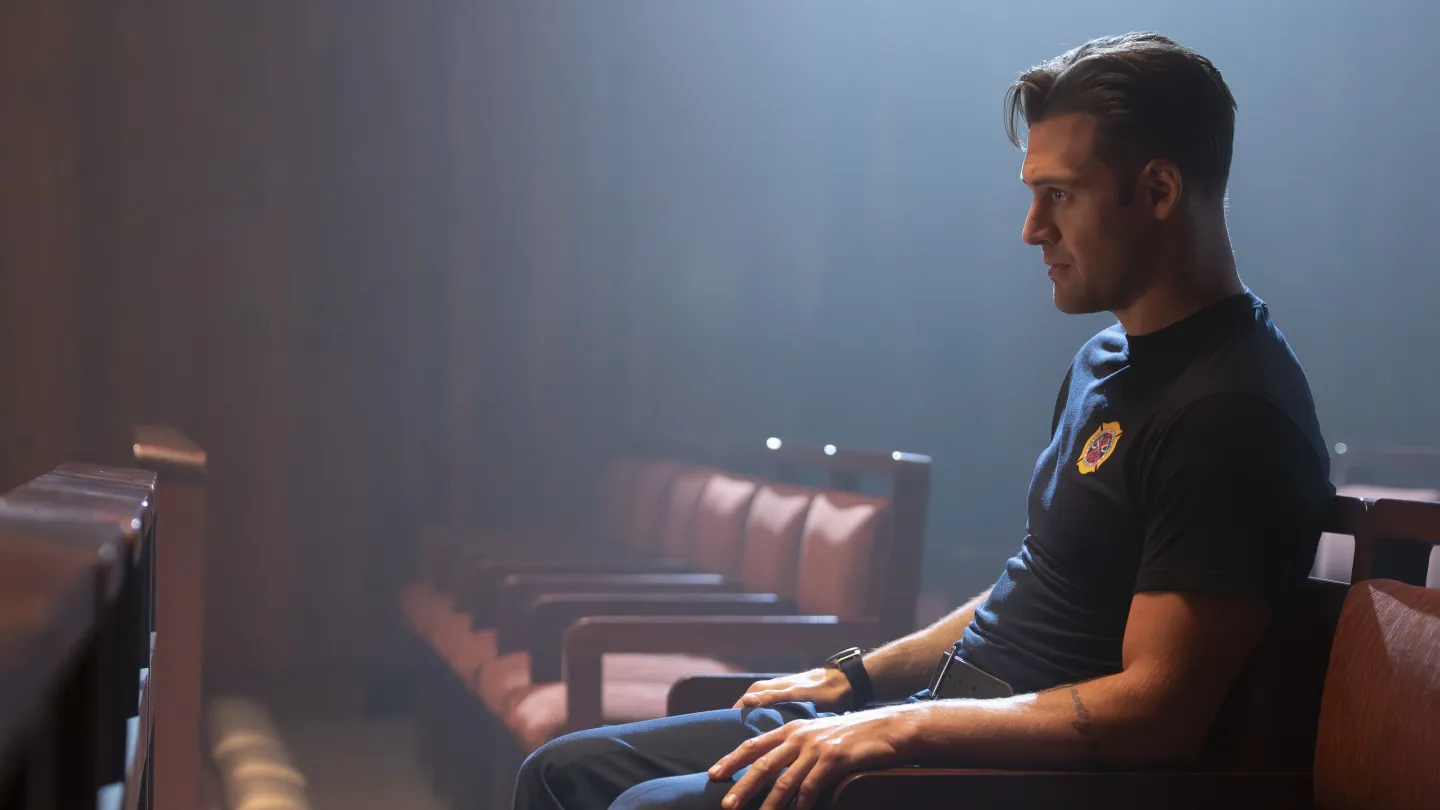
After he overhears Eddie make a snide comment to Chimney (Kenneth Choi) about how the one silver lining is that “the bastard that did this is already dead,” Anatoly follows Eddie into the hospital chapel. Upon learning that Athena made it out of surgery alive, he then stabs Eddie in the abdomen and steals his phone. A woozy Eddie manages to claw his way to the elevator, but he ends up getting stuck after a nurse initiates a hospital-wide lockdown. It isn’t until Anatoly is apprehended that the rest of the 118 is able to come to Eddie’s rescue — and, of course, it was Eddie’s best friend, Buck (Oliver Stark), who was the first to notice he was MIA.
In a wide-ranging chat with THR, Guzman opens up below about why he fought for Eddie to be included in the show’s ICE raid storyline, how playing this character has helped him come to terms with his own identity — and how he thinks Eddie’s “naivety” factors into his fan-favorite relationship with Buck.
***
Eddie has fought his way back from death’s door multiple times on 9-1-1, but he really could have bled out in that hospital elevator if the police didn’t get there any sooner to end the lockdown. How did you approach playing Eddie in the aftermath of that stabbing? Was there anything in particular that you think was going through his mind in what could have been his final moments?
Eddie’s seen battle before, so he’s gotten shot at countless times now. Stabbing is nothing. (Laughs.) So [executive producer Bradley Buecker, who also directed the finale, said] we can make a meal out of it, but at the end of the day, we’re going to play this suspension of disbelief and build that tension into the character’s story going into the elevator. But when we get into the elevator, it’s going to be very quick before the 118 comes and helps. So let’s not play it too crazy because Eddie will be fine. This [finale] is the big “aha” moment for Athena [to become a detective], not Eddie.
I believe [Eddie thought about his son] Christopher [played by Gavin McHugh] — the one true love that he’s had in his life — and that he’s got to stay alive for that kid. So going through the obstacles of trying to go from the church to find help, and then going to the elevator, and then within the elevator shutting down, he’s like, “Okay, we’re here for the long haul. What’s the best-case scenario in this worst-case scenario? Let me try and find some way I can pack this wound, stop the bleeding as much as I can, and give some timeframe to others to help.” At the end of the day, it wasn’t looking too good for him. (Laughs.) So he was going a lot on faith.
Eddie looked real pale in that elevator!
Real pale and bloody. (Laughs.)
While Eddie lays in a hospital bed, he tells his son Christopher that he doesn’t want him to be sitting there all night by his bedside. Chris responds, “Why not? You did it for me.” There’s another flicker of realization in Eddie’s eyes that Chris is not a little kid anymore. How is Eddie grappling with the idea of becoming an empty nester sooner rather than later?
I don’t know if Eddie’s ready for that. He’s put so much time and effort into becoming the dad of Christopher. A majority of his identity is around that. So if there’s no kid to take care of now, and the kid has grown up to a certain point — actually, Gavin just had his 16th birthday yesterday, it’s so crazy. But it’s like, “What do I do with my life now? Where’s my purpose? My purpose was my child, and now my child is trying to take care of me.” It’s flipping the script. So, in a sense, it’s actually inviting a lot of opportunity to Eddie. I have hopes for [Eddie] once he starts to understand the new dynamic between Christopher and himself. I feel it invites a lot of gray area [within himself] to be searched out and understood a little bit better.

Ryan Guzman, here with Gavin Mchugh, in the season finale.
Disney/Christopher Willard)
While 9-1-1 has never been shy about drawing inspiration from real-life emergencies, the writers have never leaned into topical events, apart from the COVID-19 pandemic, quite like they did in last week’s episode with ICE agents raiding a hospital where migrants were being treated. Is it true that you had to ask Tim to revisit that migrant storyline to include Eddie?
Whoa, who told you that?
I believe you said it in another interview.
(Laughs.) I did?
You mentioned that you had a conversation with Tim after reading the end of the season, and he ultimately rewrote a “topical” storyline to include Eddie.
Yeah, we had a conversation — me, Tim and Brad as well. We all were of the same mind that Eddie was pivotal in this. With 9-1-1, we rarely go after topical events this big, because there’s a lot of people that feel differently about this, but this one had to be told. The Pitt had done it before, and now it’s 9-1-1’s version. We got to humanize the experience for the audience, to let the audience understand what the migrant story really is and that they’re people just like any of us. It allows for people to really feel the whole story. Getting pulled from the worst conditions in some basement, and then going into this recovery process, all just to get taken away and deported again and thrown into these encampments is a horrible idea to wrap your head around. So I’m grateful that Tim wrote that in, and Brad and I wanted to do it justice.
When did you guys have that conversation?
It was the same day that we had gotten some semblance of the script for the last episode. After reading it, I was just curious why Eddie was more involved in one storyline than the other, and then it brought upon the conversation between Tim and I. Tim made the ultimate decision to put Eddie into it.
What did you actually make of Eddie’s involvement in these final episodes?
From the moment that Eddie is leading the 118 to go find the room [where the migrants were being held], I felt tied to the storyline, being as topical as it is. And representing Mexican-American culture, I felt like it was a disservice if I didn’t speak up and allow Eddie to attach himself to this storyline a little bit more than was presented, especially when he’s holding the child and bringing him to the ambulance. I’m like, “You’re getting twofold [representation] there.” One, you’re getting a representation of, “Whoa, this could have been Christopher. They’re the same age.” And then second, “This is my people. This is my heritage.” It brings up the question: “What am I doing about it?” So when the opportunity presents itself, I just felt that it was befitting of Eddie to put his foot forward and showcase that we got to do everything we possibly can to help these people out.
What has it been like for you to watch that kind of aggressive enforcement of immigration play out from afar on the news and now in this fictional context? Did it feel viscerally different from other storylines you’ve played out on 9-1-1?
Absolutely. I have many, many family members that have been affected — that could be affected — and it’s very, very real. In a time and age where anything and everything can be used against you and you’re [considered] guilty first before being proven innocent, I’m in awe a lot of the times when I look at the news. I can’t believe a nation founded on immigrants is treating immigrants in the worst ways.
So I’m, again, very proud that 9-1-1 was able to showcase this in a way of, “How can we help migrants? How can we help people? What are we willing to do to get around these obstacles?” In truth, a lot of people that I’m watching on the news don’t have the resources in their day-to-day lives, and it takes money to get people out of certain encampments. These videos that I’ve seen, man, they’re horrible. Watching kids being taken away from their mothers; people being taken from the hospital, their jobs. It’s a bad situation.
On the flip side, you had an opportunity to showcase a different — and more celebratory — side of Mexican culture in the “Día de Los Muertos” episode, in which Eddie loses his abuela abruptly but reconnects with his faith. After eight seasons of playing him, what did that episode reveal to you about Eddie as a character, and what did that storyline mean to you personally?
From a character perspective, Eddie found that he was more spiritual, and his faith was stronger than he’d believed. Eddie was able to understand that everything that he had gone through the past 7-8 years led him to that moment, because he handled the passing of his abuela much differently than any other death. He was able to essentially mature in that episode and showcase that maturity and vulnerability, yet not losing himself through the vulnerability because now he has [developed] emotional intelligence. He was able to pull from all these profound messages that he got from his abuela and Bobby [the late fire captain played by Peter Krause] — the two most influential figures to him in the past years — and go full circle in that storyline, which was beautiful to me.
That specific episode made me so profoundly proud of my culture. I was looking around at plenty of the Latin people that work with us. Many of them happened to be Mexican, and I was asking them, “Have you ever experienced something like this?” And they said, “No.” Plenty of times, we would stop and watch everybody come down that street dressed up and celebrating the passing of their loved ones, and you get emotional. It’s this out-of-body experience. I was just thanking God and so grateful that I happened to be born Mexican-American. This is the culture that I pull from.
Guzman (second from right) with Elijah M. Cooper, Anirudh Pisharody and Aisha Hinds.
Disney/Christopher Willard
As a mixed-race person, how has your relationship with your cultural identity changed over time? Do you feel like your increased visibility has come with any added pressure or responsibility?
Absolutely. Earlier on in my career, people didn’t really know what nationality I was, so I would rep Mexican pretty hard because a lot of people would think I was just strictly white, and then they’d start saying certain things about Mexicans in front of me. So I wanted it to be known that, “No, no, no, you can’t say that. You’re not getting the pass around me. If you’re going to say it around me, then be aware.” Since the show though, I have seen a lot more representation being thrust upon me and my involvement meaning a lot more.
I struggled with identity for the longest time, but my understanding now is that I represent a specific group of Mexican-Americans. I’m biracial, first and foremost. I can be white-passing plenty of times. I was raised a “no sabo” kid. So there’s plenty of Mexican-Americans that look like me, sound like me, walk like me. I think everybody’s so used to the stereotypical Mexican. They have that ingrained in their mind from years and years of being pushed this narrative. I’ve now seen an opportunity again to showcase to not only just the U.S., but to the world, that we come in different flavors, sizes, shapes — and here I am.
You have drawn a number of uncanny parallels between you and Eddie over the years — to the point that you’ve been able to play out some moments on TV before they happened to you in real life. Do you ever feel like Tim is pulling inspiration directly from your own life? How would you characterize your working relationship with him?
(Laughs.) Oh yeah, it’s crazy. You know that whole conspiracy about The Simpsons writing the future? Tim tapped into a little bit of that, so I don’t know what he’s doing on his personal time. (Laughs.) But it’s eerie, to be honest, when that happens. Maybe it’s synchronicity, maybe it’s fortune-telling, but I’m glad that I get an opportunity with the character to work out all these different things so that when it happens in real life, I feel like I’ve already done the work.
As far as my relationship with Tim, I’m so grateful for him. He’s helped me so much throughout the entirety of this show. Our communication has never been better, and our relationship has never been better. He’s one of those rare showrunners that is so open to collaboration if you have something of worth to add to the character, or if something’s not feeling right with the character. I’ve worked with other showrunners, and it’s hard to get in contact with them — or they’re not open to hearing anything from you. Tim is quite the opposite. His whole schtick is that he’ll get the script to you 10 days late, but outside of that, it’s because he’s reworking everything he possibly can to make your character shine.
Did you two discuss Eddie having a love interest this season? You said months ago that something was “cooking” in Eddie’s romantic life, but that ultimately never materialized.
Yeah, we did. There was an opportunity with something happening in Eddie’s storyline. It didn’t pan out the way we saw it. We had hopes, but at the end of the day, if something’s not working, you have to adjust and you have to make something [new] to fill that space. So it became less about Eddie’s love story — that’s been pretty prevalent in the past couple seasons — and it became more about the involvement of Eddie in his 118 family and his overall growth as a human being.
Buck and Eddie’s road trip from hell right after the 9-1-1: Nashville crossover was a particular highlight this season. After they are separated in a car accident, Eddie breaks himself out of the hospital to find Buck, Buck even tries to sacrifice himself to protect Eddie, and then they ultimately save each other. It felt like a testament to just how close these two guys have grown over the years.
I feel like we found the secret sauce with that relationship — the back and forth [between] Buck and Eddie — and the fans spoke for themselves for that episode. I believe it did really, really good [ratings-wise]. So I like the fact that we dive into more of the humorous parts between those two characters, because there’s a lot of humor to play off of. God, when you really look at it, they do oppose each other a lot in different attributes. It’s a perfect balance of positive/negative, negative/positive. One’s super hopeful about a drive home; the other one’s trying to be realistic/pessimistic about everything. That relationship continues to evolve, and what it’s evolved to already is more than Oliver and I even had intended for, let alone understood, in the beginning.
Eddie and Buck have this really great verbal argument at a diner in New Mexico, and a homophobic patron remarks that he’s never seen their “type” before. Do you think Eddie was aware of how he and Buck came across as a bickering married couple to these locals?
No, I think Eddie lives in such naivety, and he’s oblivious to so much that that’s kind of the texture of the character. I think if he knew what that looked like or played into that, it wouldn’t read as well, to be honest. So him having that spat with Buck, not knowing that he looks like the exact married couple that you see on TV, amplifies that scene. When the guy starts talking, “I’ve never seen your type over here,” Eddie has no clue where that’s coming from, and he’s just so irate at that point that he’s looking to throw his anger at somebody. So he goes after that guy, and he just leans into it, and it’s still not clicking to him like, “What the hell’s happening?” He just wants to hurt somebody. But yeah, I think, again, his naivety is what’s allowing all the tension to build.
Eddie doesn’t know that Buck’s sister Maddie (Jennifer Love Hewitt) and ex Tommy (Lou Ferrigno Jr.) both questioned Buck about whether he was in love with Eddie last season. But I guess you think Eddie has never even asked himself if Buck might be interested in him.
Yeah. (Laughs.) You don’t know what you don’t know, at the end of the day.
Fans have very strong opinions about whether Buck and Eddie’s relationship is platonic or romantic. Is there a reason that you think the writers have been reluctant to commit one way or another to defining their dynamic?
That would be more of a question for Tim, to be honest, and I wouldn’t want to speculate on their own answers. But, again, the true nature of why I feel we’ve lasted for so long and [why] we’re going into our 10th season is because each person that plays each character coexists with the other person in such a nice way, and we pull from each other so well. So when the camera calls cut and we go back into our regular lives, we’re having so much fun and we’re diving deep into each other’s lives, helping each other with certain things. It builds this textured life that reads so well on camera. And to commit to any sides of the characters themselves, I don’t know. I think from a writing standpoint, maybe that limits the tension, or the opportunities for possibilities. There’s so much to say that I wouldn’t be able to give you a full answer.
That’s a fair answer. Tim recently said that, ultimately, “the possibility of [Buddie]” is what makes that dynamic “exciting.”
Exactly.
Have you ever leaned one way or the other when it came to how you see or choose to play that dynamic?
No, if anything, I’ve leaned more into just playing the truth of where Eddie is. That’s his best friend, and he cares about him in a very, very deep way. I pull from my own experiences [and] my best friends. I’d do anything and everything I possibly could for them, especially their families. So I think the truth of Eddie at this point in time is leading into that naivety. And if Buck were to present anything else [to him other than friendship], I haven’t even wrapped my head around how Eddie would understand how to move forward with that — other than being caught off guard, I guess. It’s almost like when something’s so close, you can’t see [the bigger picture]. It’s right under your nose, but you can’t see it. I think that’s how it’s meant to be played. So, yeah, I have no clue what the future holds. Again, Tim is the Almighty, and we’ll see what happens.
Buck has always acted as a kind of co-parent to Christopher, but Buck now has a child of his own because he becomes the foster parent of Theo — the son that his late friends conceived with Buck as the sperm donor — at the end of the finale. Do you think Eddie and Buck will start having more conversations about parenting going forward? How could the addition of another child change their dynamic?
It could change things a lot. We just talked about Christopher not needing Eddie so much, and maybe now he’s found another kid that needs him. But then again, the dynamic between Theo and Buck is perfect because, as said in a previous episode, [Theo’s] almost the embodiment of Buck. This crazy, chaotic kid is probably going to break every bone in his body as he goes along in life — he’s almost payback for how Buck was as he grew up. (Laughs.)
So there’s so many learning experiences that are crucial to Buck’s character that happen only for Buck, but there will be a lot of leaning on Eddie in trying to understand how this all works — being a single dad and time management, and even understanding the psyche of a child and their sleep schedules, and all the things that come with a child. But that also offers so much humor. So we can play the funny moments of that — not just the crazy and sad moments. There’s so much that we can play. And let me just say that the two kids that play Theo are incredible, because [when they’re] that young, it’s so hard to keep somebody on track. Every single time they called action, they knew exactly what they were doing, when they were doing it, and how to say certain words or lines. So I’m excited to see what evolves with those characters.
***
All nine seasons of 9-1-1 are now streaming on Hulu.