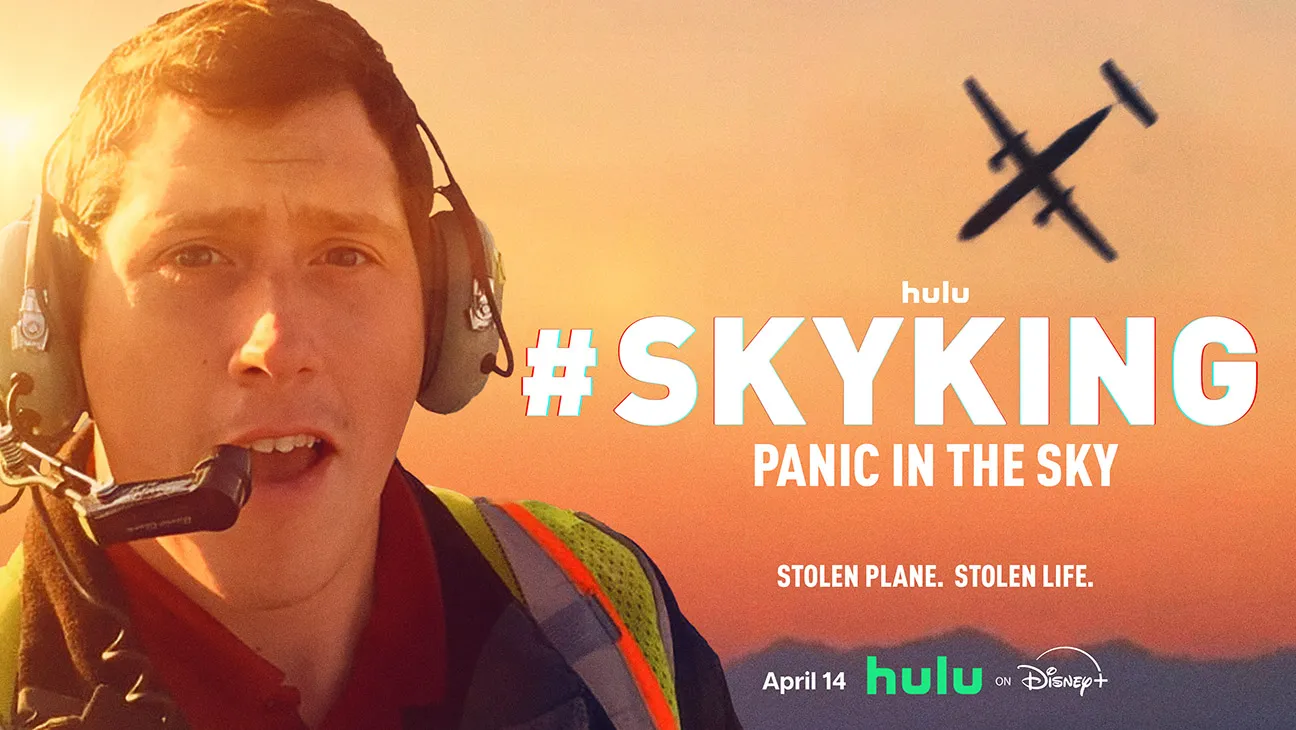
Richard Russell is a folk hero to some folks — including more than a few of the wrong ones — but he’s just “Beebo” to the loved ones he left behind.
In 2018, the 28-year-old Horizon Air (a subsidiary of Alaska Air) ground service agent clocked into work wearing a shirt that said “The sky’s no limit,” stole a $33 million plane (a Bombardier Q400), and took off into the skies of the Pacific Northwest. There was just one problem (OK, so there were numerous problems, but starting with) … Russell did not know how to fly an airplane. Or at least how to land one.
After a few-hour joyride (as joyous as one can be on a suicide flight) around the mountains and over the water, Russell crashed into the side of a sparsely populated island. He did not attempt to land — Russell chose death over prison, and as a way to escape his personal prison of depression.
Along the way, Russell made a few statements to air traffic control that have lived on. One in particular has completely clouded reality, #SkyKing director Patricia E. Gillespie tells The Hollywood Reporter, turning a mental health issue into a race issue.
Read our Q&A below.
***
I either never heard this story or it went in one ear and out there other — what does that say about me? Or perhaps about society if it’s not just me?
You know what’s interesting? My friends back home — I grew up working class — and my friends back home all knew it. My friends from, you know, the city and the industry and college — I was really lucky, I got to go to NYU and do all that — they did not know it. And so I think it actually says something about the echo chambers we all live in, where the stories gain traction and where they’re discussed, and what some of us that are higher up on the economic ladder don’t hear versus those of us who are in the trenches hear.
Is that simply because Beebo is something of a blue-collar folk hero?
Well, he’s a lot of different things to a lot of people. This film really tries to emphasize that he was a human man, and though you can use him in all these different contexts — some of them true and fair, some of them untrue, some of them productive, some of them quite dangerous — at the end of the day, none of those things really encompass his humanity. Our documentary tries to do that.
I’ve seen some criticism online like, “So he steals an airplane, commits suicide … and gets a documentary?!?” What is your response to that take?
I hope they take a moment to watch the film because the film works very hard to address the fact that suicide — it’s not the end of your pain. It passes the pain on to people who love you the most.
The film also — I hope on some level, for people who are willing to engage with it — highlights the fact that when we do have these hot takes, a lot of the time we miss the deeper story. In this case, people were so quick to sensationalize and politicize and quick to take a stand before they have facts. As a result, you missed a really important story about class and its intersection with mental health. The media approaches these stories in kind of an uncurious way. When we approach these things with curiosity instead of judgment, a lot more story narrative — and frankly, facts — emerge.
You mentioned the politics. For readers, during his conversation with the tower, Beebo says he was passed up for a promotion at work because he’s “just a white guy,” so that’s a DEI dig that has inspired some unsavory speech online. Also, one of Beebo’s brothers wears a Trump cap throughout your interview with him. But neither of them seem racist or hateful.
I think the fam— what I hope people take away is that there are people with very diverse political opinions and life experiences in this film. The sort of mainstream narrative that’s going around on social media and in some mainstream media says these people shouldn’t be able to get along on anything, but they actually have a lot of things in common when it comes to the realities of the American economy. When it comes to the reality of a working life in this country and its intersection with mental health, we have a lot more in common. There’s this phrase that comes from my childhood where it’s like, “Anybody who knows what a bread sandwich tastes like is my friend,” right? If you’re down there on that level, scrapping, people that the world will tell you you have nothing in common with, you actually have a lot more in common with them than you think.

Richard “Beebo” Russell’s car lives on via an annual road trip, now eight years removed from his death by suicide in 2018.
ABC News Studio
In terms of mental health, and I’m probably not correct here, but my understanding is there are two ways somebody can “snap.” One is instantaneous, the brain just flips into unrecognizable thoughts, and the other is a deterioration over time. Which do you believe led Beebo to make his fatal choices?
You know, I could not diagnose him. And the tragedy is, because he ended his life and because he didn’t feel he had the space to discuss what he was feeling, no one will ever be able to. Of course, we all have our opinions or what-ifs or maybe-because — but I don’t think it’s fair to guess. I think the only person who had that answer was him, and it’s a real tragedy that Beebo and guys like him, you know, shuffle off this mortal coil without ever being able to tell anyone exactly what was going on. I do think that if he understood how much his death was going to hurt the people who loved him, who he loved very much, he wouldn’t have done it. I think depression is a monster that hides that truth from you.
Is it fair to say his suicide was premeditated, since Beebo says he researched how to take off but not land?
I think he had never taken flying lessons and he knew how to get the plane to take off. I think people can infer what they want from that, but again, I’ll never be able to live inside his head. As a filmmaker, I try to be just really open to the information that comes to me and not draw any conclusions that don’t have a factual basis or can’t be corroborated. And sadly, the inside of his mind is not a place I was ever able to go.
Beebo was firm that he was not trying to hurt anyone, but then when he finally crashed it wasn’t into a mountain he circled or the water he spent so much time over — he hit an island, albeit not a very populated one. Is the belief that he was trying to land at the last second?
If you look at the— I believe it’s the FBI report, might be the FAA report, I can’t remember. But it does say “controlled descent.” He worked at the airport, he lived in the area. He knew the terrain, and he knew where people lived and where they didn’t. I’m inferring, but I would imagine if you hit the edge of a sparsely populated island where people do not live, you would imagine you were going to die and die quickly. He also said on the flight he didn’t want to drown.
I don’t think you die from drowning if you crash an airplane into water.
But if you don’t know how to fly the airplane, who knows? He was running out of gas, he says that on the call. Again, I can’t speculate on what’s in his mind, but imagine if you run out of gas and you’re not choosing where to crash the airplane? Something really bad could have happened. So again, can’t live in his mind, but I think [crashing into the side of a sparsely populated island] would be what you would do to try to ensure you didn’t harm anyone.
Beebo’s mom Karen visits the beach in ABC News documentary ‘#SkyKing’
ABC News Studio
There is a card at the end of the doc that states Beebo’s wife declined to participate. Totally understandable of course, but did you get a specific explanation from her as to why?
I didn’t, and I don’t think she owes me one. My heart really goes out to her. I think this had to be devastating, and I respect that she didn’t want to comment on it, and I hope the audience respects that. I do want to say there was nothing in our years of copious research that suggested anything other than these were two people who loved each other very much [and existed in] an incredibly difficult, broader cultural context.
You interviewed his boss, Colleen, but did you speak with the FAA tower guy, Andrew?
I did speak to Andrew a great deal. And similarly, it just wasn’t— I think everybody who was involved with this story went through a lot, and it was not the right thing for him to revisit this, to participate, but he’s a lovely, lovely guy. And, again, I support his decision to not want to comment.
Colleen was great.
Colleen is incredible. She is incredible. If you’re ever in a bad situation in the sky, Colleen is the lady you want running the room.
Those you interviewed said or suggested that Beebo’s motive here was to draw attention to the airline paying its workers less than minimum wage. In your research, was that true? And if so, how could they get away with that?
They were factually paying less than Seattle minimum wage, and it was legal that they were doing that. I really encourage people who have those questions, which I’m thrilled to hear raised, to read about the long legal battle over this in Seattle and wherever you live. Be a little more curious about the lives of people working at your airport or, working in service positions around you. There are a lot of rules you’d be surprised to learn.
Is this specific to the airline industry?
I think it’s specific to all working people. And that’s sort of why, at the beginning of our conversation, I was talking about how, even though there are a lot of things we might rightfully disagree on — like firmly, truly disagree on — we have to kind of come together and address this stuff. The more there’s infighting that prevents working people from talking, the more that disadvantageous legislation or court rulings can happen that do pay people less, that do create difficult work environments, that do disentitle us from, you know, the sort of basics of reasonably comfortable American life.
Grizzly Man, Timothy Treadwell, 2005
Lionsgate/Courtesy Everett Collection
You had your interview subjects listen to the full conversation between Beebo and air-traffic control — or as much as they could stand — and comment along the way. It’s a very effective device that takes viewers through the story. Was that always the plan?
Thank you so much for asking that, That was baked in very early on. I thought that was the most responsible way to tell a story about suicide, because I never wanted the audience to lose track of how much this incident affected these people. How much it hurt, much it was painful to listen to for some of these people even eight years later. Karen (Beebo’s mom) didn’t, at the time, want to listen to it, and I respected that decision. I can’t imagine listening to the last 70 minutes of your son’s life. When we premiered at SXSW she decided to listen to it, and she sat between me and my husband and watched the film. It obviously was very tragic to see her watch this, but it was also— I was so happy that she could see herself and this sacrifice she made of opening up her pain to share with so many people, to see it take shape and see people respond to it.
The device itself is borrowed, or inspired, I guess I should say, from the movie Grizzly Man. I’m a Werner Herzog super fan, and the film is a masterpiece. It’s about this guy who’s a naturalist, and he’s filming himself interacting with bears, and it ends badly for him. There’s this tape with audio of the incident where the bear kills him and his partner, and you see in the film Werner Herzog listen to it, but you don’t hear the audio. And he says, “No one should ever listen to this.” I remember that being so affecting. And I said, “OK, well, what about if we use these people, and we are hearing the audio? And we are seeing the context of what is making that tear fall down the cheek, or what is making that gasp in her lungs?” What they say in those those moments is powerful indeed, but what’s most powerful to me is that look on their faces, yeah. I hope people who are struggling, who are thinking, “Maybe it’s time to end it,” or whatever, see that and think, “I don’t want my mom to look that way, or my sister.”
More from our Zoom conversation with Gillespie will be in our June 11 magazine.