It wasn’t so long ago that conversations about what “sustainable” meant in fine jewelry were murky at best, and downright convoluted and frustrating at worst. If you asked three different jewelry brands to define their sustainability policies, chances were you would get three different answers — none of them fully satisfying.
Using recycled gold, for example, might not always be sustainable, and while lab-grown diamonds tell a feel-good story by avoiding the human exploitation frequently associated with mining, what’s often not discussed is the energy consumption required to create those stones. Too often, claims of sustainability in jewelry have more to do with marketing than fact, and don’t hold up to scrutiny. There’s a word for such dubious claims of environmental virtue: greenwashing, coined in 1986 by American environmentalist Jay Westerveld to describe the deliberate misrepresentation of a practice’s true ecological cost.
Fortunately, consumers have gotten wise over the past 40 years, and more curious about truly sustainable jewels. They’re increasingly unafraid to ask tough questions before making a substantial purchase. Indeed, the answers demanded by those consumers from diamond and jewelry houses have gone from “nice to have to need to have,” says Sally Morrison, the U.S. lead for natural diamonds (as opposed to lab-grown diamonds) for De Beers Group.
Rebecca Selva, chief creative officer at vintage jewelry house Fred Leighton, agrees. “I’ve been here for 33 years, and the questions by informed consumers aren’t only more numerous than ever, they’re also incredibly specific,” she says. “They want to engage in detailed conversations about old mine cuts or antique diamonds, but also where those stones came from at that time and whether that manufacturer was considered ethical during that period. I also get questions about whether we have pieces by certain designers, like [early and mid 20th century jewelers ] Georges Lenfant or André Vassort. I find it quite something that consumers are doing such extensive research in a quest for vintage jewels that aren’t only beautiful, they’re timeless and enjoying a new life with owners who love their backstories.”

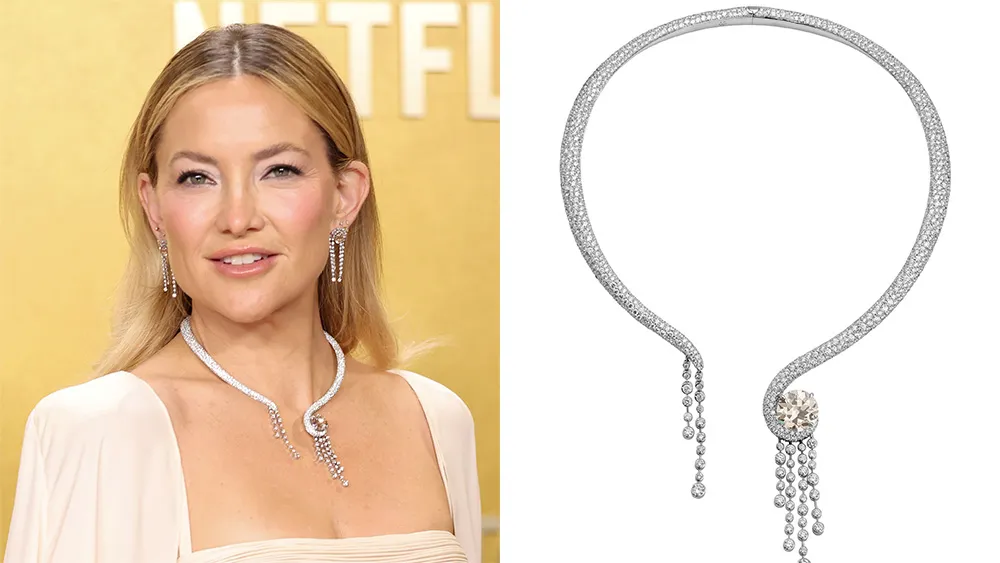
Kate Hudson
Getty Images; Courtesy of De Beers London
Where are knowledgeable consumers also garnering inspiration? The red carpet, of course. Indeed, just as eco-conscious stars have been turning to vintage fashion to lower the carbon footprint of looking glamorous, many of today’s stars are turning to the past for their awards season jewelry. From Kirsten Dunst and Carey Mulligan at the Oscars to Kate Hudson at the Actor Awards, sustainable jewels dominated red carpet choices. Sterling K. Brown and Paul Tazewell likewise made sustainable choices of vintage Fred Leighton brooches that adorned their tuxes during recent awards events: Brown’s floral brooch at the March 15 Academy Awards was a 19th century design featuring old mine-cut diamonds, while Tazewell, the 2025 Oscar winner for best costume design for Wicked, made style headlines that night for his own sartorial splendor, which included a 1950s diamond and platinum brooch that featured more than 45 carats of round and baguette-cut diamonds. “Men and women alike reached out after [Tazewell] wore that brooch,” Selva says. “But as far as brooches in particular are concerned, it really has been the men who are driving that trend and interest in vintage.”
Carey Mulligan
Getty Images: Courtesy of De Beers London
In jewelry, new doesn’t always mean unsustainable. It’s common these days for diamond houses to position their sustainable policies front and center on their websites — but only after ensuring they are well-vetted and can withstand scrutiny. After all, stars wearing new pieces want to make sure their choice won’t ignite a backlash on social media. “It’s not enough to select something beautiful; you also must, must ensure it was created responsibly,” notes one Hollywood publicist. “Choose the wrong piece from the wrong company, and you could be called out on Instagram very quickly.”
Paul Tazewell
Getty Images; Courtesy of De Beers London
San Francisco-based Brilliant Earth is a digital-first jewelry retailer that sells both lab-grown and natural diamonds and puts an emphasis on its sustainable and ethical practices. Its starry clientele has recently included Ciara Miller at February’s Grammy Awards, Olivia Munn at November’s Baby2Baby Gala, and Kristen Bell, who wore the brand while hosting the March 1 Actor Awards. In February, the brand announced it was named the most sustainable jewelry brand in 2025’s Sustainable Jewelry Rankings by the Association of Intelligent Diamond International, an independent global organization focused on advancing standards in lab-grown diamonds and responsible jewelry.
Ciara Miller
Getty Images; Courtesy of De Beers London
“For more than 20 years, we have worked to redefine what sustainability, responsible sourcing and transparency look like in our industry,” Beth Gerstein, co-founder and CEO of Brilliant Earth, said in a statement. “This recognition reflects meaningful progress, from validated net-zero targets and improved traceability to stronger health and safety standards and public reporting on our goals. It is a testament to our team and partners who advance this work every day. We believe sustainability must be embedded in how we design, source and serve our customers, and we remain focused on advancing these practices across our industry.”
While conservation efforts by London-based De Beers Group extend as far back as 1900, it was in 2009 that the world’s largest diamond producer created a “new normal,” as the company put it, following an extensive review of its strategies. Six years later, De Beers partnered with the United Nations Sustainable Development Goals to employ a multipronged approach to its practices, announcing climate initiatives, a net-positive impact on nature, community investments that include jobs and education, and ensuring ethical sourcing through the use of blockchain technology and chain of custody, the documented path that traces a diamond from its origins as a rough stone from an ethical mine until the moment it is presented, cut and polished, to a consumer.
In 2018, Wanetsha Mosinyi joined De Beers as the social impact and sustainability lead at De Beers Group; he is based in Gaborone, Botswana, where he was born and grew up in a farming community. Today he is among the most respected members of the country’s diamond industry, precisely due to his focus on sustainability, ethical practices and a focus on creating new opportunities for his fellow Botswanans. De Beers choosing to partner directly with his country’s government has been a key reason both the group’s mining practices and the surrounding community have enjoyed success. His current goal is likewise ambitious: “We aim to reduce our carbon emissions by 42 percent in Scope 1 and Scope 2 by 25 percent by 2030,” he tells The Hollywood Reporter.
In October 2025, De Beers — which is facing financial difficulties as the cost of lab-grown diamonds keeps going down, eating into the company’s core business — introduced Desert diamonds, an initiative rooted in showcasing the wide spectrum of colors available in natural stones, from the brightest white to brilliant yellows, champagne hues, deep ambers and other Sahara-inspired hues. While Desert diamonds might be viewed as a program created to highlight the benefits of natural diamonds versus lab-grown stones, Morrison also points out that natural stones offer an additional benefit. “We love that with these, you can secure a diamond that, for example, beautifully matches your skin tone,” she says. “If you’ve ever looked at the diamond you’re wearing and thought it’s not the shade that suits you best, Desert diamonds can correct that.” Since launching last fall, Desert diamonds have been seen on several red carpets, from Rose Byrne at the 2025 Oscars to Jessie Buckley and Kate Hudson at the 2025 Actor Awards.
Consumers — whether red carpet fixtures or civilians — who worry about the environmental or human cost of their jewelry must ask tough questions. You might love the design, but do you know how it was created? Understanding the choices — vintage, ethical sourcing or lab-grown stones, among them — has become a necessary step. For Selva, that information only enhances the enjoyment of a purchase.
“I don’t think it’s ever just one thing,” she says. “It should speak aesthetically to someone, but it also should be a fit for their lifestyle, and that includes their commitment to sustainability. For us, vintage pieces have no age. You might respond to it because it celebrates your personal style; once it’s chosen, it’s meant to last forever.”
This story appears in The Hollywood Reporter’s 2026 Sustainability Issue. Click here to read more.