Netflix has renewed the Duffer Brothers’ animated spinoff Stranger Things: Tales From ‘85 for a second season.
The Hollywood Reporter can exclusively reveal that the series, from animation veteran and showrunner Eric Robles, will return to Hawkins and the Upside Down sometime this fall. The show’s renewal comes just four days after season one’s debut, which saw Tales From ‘85 take the No. 7 spot on the streamer’s global top 10 list with 2.8 million views.
The 10-episode first season has also officially landed in Netflix’s top 15 animated series debuts of all time. The spinoff’s renewal and season one success comes just four months after Stranger Things proper — the Duffer Brothers’ original live-action series — concluded its decade-long, five-season run at the end of 2025. Following the release of that massive final season, the Stranger Things franchise has continued to perform across social media and with audiences.
Collectively, all five seasons of the Duffers and Shawn Levy-produced series starring Millie Bobby Brown, Finn Wolfhard, David Harbour and Winona Ryder have accumulated 1.5 billion combined views through March 2025 since their premieres. Interest in season five has also propelled the show’s previous four seasons back into the global top 10 for eight weeks — another record-breaker for the series and streamer. As part of the Stranger Things 2025 campaign, the fifth season also garnered 5.75 billion owned social impressions. Together, the show has amassed nearly 10 billion owned social impressions.
This also follows the season five soundtrack impact, including Prince’s “Purple Rain” seeing a surge in Gen Z streams, and Diana Ross’ “Upside Down” garnering a spike in global searches. The Stranger Things season five launch also produced the largest consumer products program in Netflix’s history and bump in ticket sales (to the highest levels since the initial launch) of the Tony-award-winning Stranger Things: The First Shadow, which was recently filmed with the original Broadway cast.
The Stranger Things universe is alive and well on the screen, stage, in stores and at Netflix House, with Tales From ‘85 being the latest investment by Netflix to see success among audiences. In wake of the animated spinoff’s renewal and its live-action predecessor’s ongoing impact, Nobles spoke with The Hollywood Reporter exclusively below and teased what fans can expect from season two when they will continue to expand the Stranger Things universe.
***
When you were discussing extending the Stranger Things universe, what material was in your “content bible”? What did you have room to play around with, and what couldn’t you do?
The assignment was, “Hey, Eric, do you want to build this fun frozen-in-time moment with these kids, where you think back to shows that we grew up watching in the ’80s?” For myself, that was The Real Ghostbusters. Back then, just to be given an animated version of more adventures with the team was a dream come true. But if you’re familiar with The Real Ghostbusters, you know Ghostbusters II came out, and it wasn’t like, “How come they don’t talk about the Boogeyman?” — because the Boogeyman was a big part of the animated series. There were so many adventures within the animated series that were never discussed in the movies. So [Matt and Ross Duffer] said, “We want you to have these great adventures with these lovable kids at a time when they weren’t worrying about saving the world. It’s just about saving Hawkins. Could we have fun opening up this sandbox between seasons two and three, and tell these fun adventures with these kids being kids, riding bikes, solving mysteries?”
But we also have to respect certain rules and parameters. The Duffer Brothers didn’t want us to go down their specific lore. Because once we open that gate and have the Mind Flayer or Vecna come out, it would have destroyed what they’d already built. If you’re a hardcore fan, you can easily plop us on and enjoy. When we talk about what is canon, I’ll tell you: it’s the personalities of these characters. We had to make sure stayed true. If we learn a little bit more about them, it technically still fits into their timeline. It’s character growth, as opposed to world-building.
If we did animated seasons two and three, then it would probably be more of these mundane situations, and then what can kids look forward to? Especially a younger audience that is going to be introduced to the world of Stranger Things through this show. Is it perfectly aligned with the timeline? No. But it started becoming this organic, fun adventure, and that’s what our entire crew has been doing for decades best. We tell stories that entertain and make characters grow.
So you’re saying this is more soft canon than hard canon?
Exactly. There’s no possible way pumpkins were in those fields. But the science makes sense — at Eugene’s farm, you had all those vines and dead Demodogs, and Hawkins Lab had to do the big cleanup in that area. We built this scientist who created this serum and brought dead plant matter back to life, so when those spores trigger and land on any organic matter, it would technically be infected and would create something like that.
That was actually the most difficult part of the assignment. In the early days of development, when Netflix approached me about this, the problem was — and many had tried prior to me — that the Duffer Brothers wanted [the story] to take place inside [seasons] two and three — but you can’t open up gates. How do you create creatures if the gates are closed? So I went back to my library of ‘80s films that I used to watch, that my dad used to make me watch with him, and there was Re-Animator. This classic ‘80s film gave me the idea. If we can have Hawkins lab science meet Upside Down matter as they did in Re-Animator, then we can open up this whole new kind of adventure.

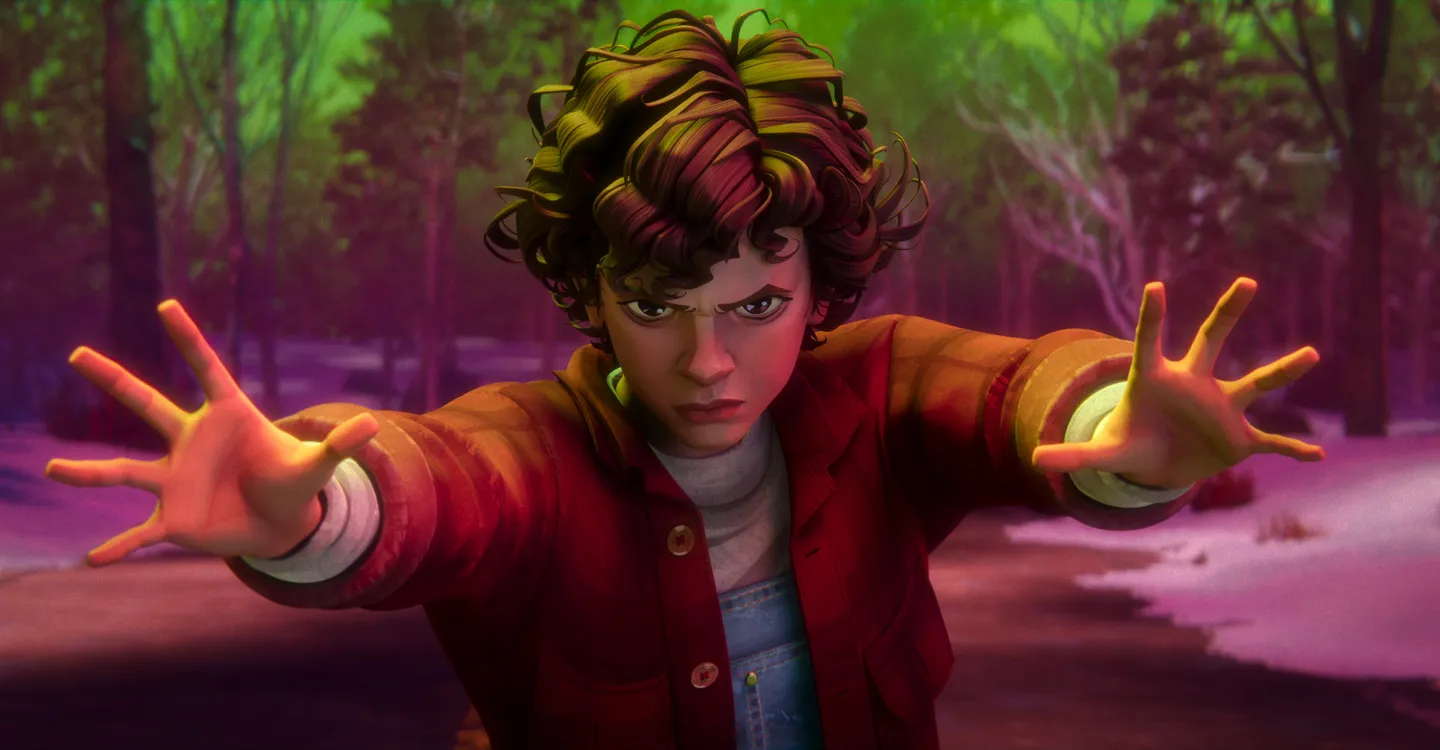
Braxton Quinney as Dustin, Benjamin Plessala as Will, Brooklyn Davey Norstedt as Eleven and Luca Diaz as Mike in Stranger Things: Tales From ’85.
Netflix
There’s so much about the animation industry and how the practical process has changed between now and 20 years ago. Some of that comes through in the series. What are some of the bigger advances that impacted your work on this action-filled YA horror franchise show?
My first show was Fanboy and Chum on Nickelodeon. That was a squash and stretch show. Back then, CG was not able to do squash and stretch, and my goal was to do a very old school Looney Tunes-type squash and stretch show with CG. They kept telling me, “Robles, you can’t do that. You’re gonna break the rings.” And I’m like, “No, we can do this. We can figure this out.” To see the evolution, how we figured that out, even in those early days of CG, and what you can do with CG now, is amazing. Especially with a show like Stranger Things. The lighting, colors and textures — all these amazing things you’re seeing up on that screen. When the kids have the flashlights, the lens flares? There’s all these little details. In every shot, you’ll see what we call motes, and it’s all those dust particles.
You’ve been given a second season, but how much farther do you see this series going beyond two?
I have a number in my head. This is going to be a really fun ride for the story that I want to tell. But I don’t plan to overstay my welcome. I’m giving you a very vague answer, but I have an idea of what feels right for me, creatively, in terms of the story introducing Nikki Baxter — her not being around anymore and what that means. Technically, she doesn’t fit into the timeline. It’s not in the cards, in the sense that this was developed when the Duffers were in season four post[-production]. What I can say is that I understand the responsibility of ending this story for this series correctly — what the kids process, how they move forward after that, how it connects perfectly to season three and why they don’t talk about her.
Is it going to be perfect? I don’t know. But I’m going to do my best with my team. It’s not going to satisfy everybody. That is the most impossible task ever. But I can tell you that we will satisfy this story, Tales From ‘85.
In the season finale, you tease Nikki as a LEGO character when she joins the Hawkins Investigators Club to play D&D. Netflix has done LEGO versions, and you’ve gotten to take a few liberties with Stranger Things style through its “neon” animation aesthetic. Would you play with your styling in any way, even in a one-off episode?
We take ourselves a little bit more seriously in the storytelling, so we wouldn’t do a LEGO side story. In the early development days, when we talked about The Real Ghostbusters, we talked about how Slimer was the character who became their sidekick. And we were like, is that what we’re doing? That extent of cartooning where you have Dart come back and become Dustin’s little buddy? I think the audience would really dislike us for being too childish and disrespecting the IP that much.
I think that goes into this conversation, where once you start breaking those rules that way, it really pulls you out, and the stakes are less real. In the finale, Nikki’s fighting for her life. Those kids and the fact that they’re holding on to the rope, every single one of them, and trying their best? They had no chance to stop that queen on their own, but it was the willpower of friendship. The reality of them trying everything, getting hit and coming back for more — that is what’s real. So yes, it’s animation, but the stakes are real for us when we’re writing and boarding and animating. We absolutely take ourselves seriously as storytellers, and do our best to sell that kind of show.
What can fans expect around new characters and new locations for season two and beyond?
You can imagine being a writer where you have to give arcs for every single character. But you have 22-23 minutes an episode, and you have to fulfil every single arc while telling the big episode story and fulfilling the entire season arc. You’re trying to do all of that as fast as you can. It becomes so difficult to do that with so many characters. If Stranger Things were about Mike, El and Dustin, I’d be like, “We can introduce as many characters as we want!” But because the cast is already so big, it gets too difficult to keep introducing new ones.
Something we get resistance to is introducing more characters as opposed to reusing existing characters. [Audiences] wonder why we don’t just use the characters we have. So with Nikki, it’s just enough; and we’ve introduced bully characters with Jeff and Charlie. You’re going to probably see them come back since they’ve been introduced now into this world. But we are going to go to new locations. For season two, we’re going to discover a little bit more about the history of Hawkins and what that history means to these kids. There’s a little bit more lore into the founding of Hawkins as a whole, and a lot of that has to do with how all the pieces come together with that last flower you see bloom.
The Broadway show, Stranger Things: The First Shadow, ventures into historical territory. Should viewers anticipate any connections between it and your story?
The Broadway show gets into its own territory. We stayed away from that. Anything past season two wasn’t game for us because the kids wouldn’t know any of that stuff. They’re still discovering and learning. So we took what we knew from seasons one and two and built our own bridge. What I’m hoping for is very much what happened with [Dave Filoni’s Star Wars:] The Clone Wars. Right out the gate, everybody was like, “The Clone Wars?” Then all of a sudden, people started watching it and were like, “Wait a second.” They gave it a chance, and then got into the Star Wars of it all, understanding that these were their own unique adventures.
Stranger Things: Tales From ’85 cast: Luca Diaz as Mike, Braxton Quinney as Dustin, Jolie Hoang-Rappaport as Max, Benjamin Plessala as Will, Brooklyn Davey Norstedt as Eleven, and Elisha “EJ” Williams as Lucas.
Your voice cast is different from the original live-action cast, with character additions voiced by Odessa A’zion, Lou Diamond Phillips and Robert Englund. There are also original characters like Joyce Byers who don’t appear. What was the decision-making around who would and wouldn’t show up?
The truth of production is you’re only given so many toys to play with, budget-wise. There are only so many assets built within the budget you have, so there’s only so many characters you can build for a show within that. When it comes to CG animation, you’re given a lot more freedom to play, but you also have to build every character. You have to design, model, texture, rig, light — everything for each character. That takes a lot of money and time. So when we do bring new characters, they have to be integral to the story, as opposed to just cameos.
So going with a fresh cast was about budget.
Budget and then scheduling. Everybody’s off doing other things, and for most, by the time they got to season five, the last thing they wanted to see was more Stranger Things. And it’s not like we have these huge feature budgets to give them money to come back and do these roles. But [with the voice cast], we weren’t going for exact matches. We were trying to get as close as we could.
We got really lucky with some of these kids, like Braxton [Quinney], who plays Dustin. When I heard him the first time, I was like, “That sounds like Dustin!” Gaten [Matarazzo] wanted to come by the studio, so we gave him a full tour, and we played him this animatic with Braxton in it. He looked at us and goes, “Is that me?” We were like, “No, that’s Braxton!” It was so awesome to get that live reaction from him because that means we’re doing something right. So we tried to get semi-close, but not one-to-one. That would have been, I think, nearly impossible.
You can’t say, “We’re searching for voice actors for an animated series for Stranger Things.” We did an audition and people submitted. I am listening to hundreds of thousands of auditions to see who I can find. Also, these kids recorded this stuff like three and a half years ago. People have said, why didn’t they just get the original actors because these kids look older now? Well, they’ve gotten older in the last three years. When we initially cast them, they were still very young, and that’s a huge part of it. That personality they bring, when they start owning the characters in such a different way — without losing the spirit of the original characters we’ve grown up loving. They bring this pure energy and joy to reading these lines. These kids are embracing them in a way that I’m not sure you would get in terms of excitement from the [live-action] actors.
One of the ways you leave a unique mark on the Stranger Things universe is with the show’s title theme. Can you talk about making that musical divergence?
We could have easily said, “Let’s do the main title from Stranger Things.” But the Duffer Brothers said, “Robles, you have to make this your thing. It needs to become your own voice.” So the pitch I gave the composers who tested for this – until Jason Nesbitt knocked it out of the park – is that I’ve been a huge fan from day one of this series. As a fan, I don’t want you to right out the gate give me something I’m not familiar with. What we have to do is think of this like we’re on a plane. On the tarmac, we’re going to take off, and I want to hear Stranger Things because that’s what I love, and that’s what I’m familiar with. But as that plane starts launching, I want you to start changing it into your voice, slowly, gradually.
Now you’re up in the air, and when you’re in the air, that belongs to you. This is Tales From ’85. Now I need it brought right back home, so when we land this plane, the last thing I hear is the thing I love, which is the Stranger Things theme song again. We bookend it, and you’re going on that ride when you’re listening to it.
You have some great needle drops. Dare I say, a little better than the live-action? I don’t want to call yours deep cuts because there’s a lot of popular music in there. But there are some songs that if you know, you know. What song was your personal favorite, and what was most challenging to clear?
The personal one I wanted was The Cure, “A Forest.” It’s episode two when Lucas and Max are getting the news from Dustin and they all have to rush to the fair, and Rosario is chasing Dustin in the forest. I’ve been such a Cure and Robert Smith fan. My first concert at 15 was a Cure concert at the Rose Bowl. So it meant so muc to have the opportunity to put that needle drop in the right place. The lyrics are perfect for that scene.
The badass one that was a challenge was Black Sabbath’s “Children of the Grave.” To get the rights to Black Sabbath was like half the budget. It’s the Ozzy [Osbourne] of it all. I remember having a lot of back and forth — maybe we might have to get some alts or other ones, just in case.
But Allison Wood, who is our music supervisor, was a champion on that. I also want to give a lot of credit to my co-executive producer, Ian Graham, because he’s the first one who dropped that one in there and said, “You’ve got to listen to how this sounds for this sequence” with all of the zombie pumpkins. We were so excited when we heard that together. Then it was a matter of saying to Netflix, “We think it’s gonna be difficult to get Black Sabbath, but listen and see what you think.” And everybody fell in love. So it was up to Allison to really bring it home and make that happen.
Stranger Things: Tales From ’85.
Netflix
You were able to debut in a theatrical setting. What was that like?
We did a 12 o’clock screening at Century City AMC with the cast and fans, and the chills I got! My dad took me to movies since I could remember. He worked two jobs, and his only day off was on Monday, so that was my day with my dad. Specifically, in the late ‘80s and ‘90s, he’d take me to the AMC theater. So to have been a part of something that is now going to be in the theater was emotionally special for me. And being surrounded by fans. These experiences are so awesome because you’re around people there because they’re excited. Nobody showed up to judge. It’s like going to a concert. You’re all in. That energy was phenomenal.
Then I bought tickets, with my wife and son, for the three o’clock screening because I now wanted to be a fan. We got seats in the back row so I could feel the energy that way. Nobody was prompted to be at that screening. That was just fans showing up like anybody wanting to be there. So the fact that that theater got filled up — nobody got special-treatment tickets — and to see everybody’s reaction and joy while wearing their own Stranger Things merch? It was a two-parter, so when the second main title came on, everybody cheered. I was gonna cry because that love and excitement is something you cannot pay people for.
The anime industry has already embraced the TV-to-theatrical release pipeline. Streaming now has expanded TV budgets, while lengthening movie run times and shortening season orders, blurring some of the lines that separated the mediums. The Tales From ‘85 screening was not designed to generate revenue, but this is a moment where theaters are desperate for audiences and animated TV production is declining despite steady consumer interest. What do you think Tales From ‘85’s theatrical experience says about the potential of this moment?
K-Pop Demon Hunters went on Netflix, people went nuts over it, and they said, “Let’s try it in the theater.” An explosion happened. Stranger Things season five was at the theaters; it did its own thing. I think that’s why I was so adamant in telling people they should go to the [Tales From ‘85] screening. It’s bigger than just this show. This is among the first times an animated show was going to premiere in a theater, and the importance of that for the community is huge. If everybody goes to these things, then the next time we all might have opportunities to premiere in theaters. And not just animated shows, but anything that exists on TV. It can open doors in so many ways.
A lot of the stuff that we’re streaming isn’t just basic television. It’s theatrical. We made our finale feel like a theatrical experience with that creature trying to get through that gate and everybody fighting it — all the epicness that happens there. It wasn’t your typical Saturday morning cartoon. We wanted you to feel that cinematic experience.
We will continue to do that in season two and beyond, if given the opportunity. I also think the maturity level of the audience can expect that. It’s our responsibility to deliver that, and it’s for the health of the industry. Like 80 percent of the animation industry right now is hurting. So many of my friends — I can only give so many jobs to people out there — are out of work. This community needs a lot of love and support. So the importance of what just happened was huge.
***
Stranger Things: Tales From ‘85 is now streaming season one on Netflix.