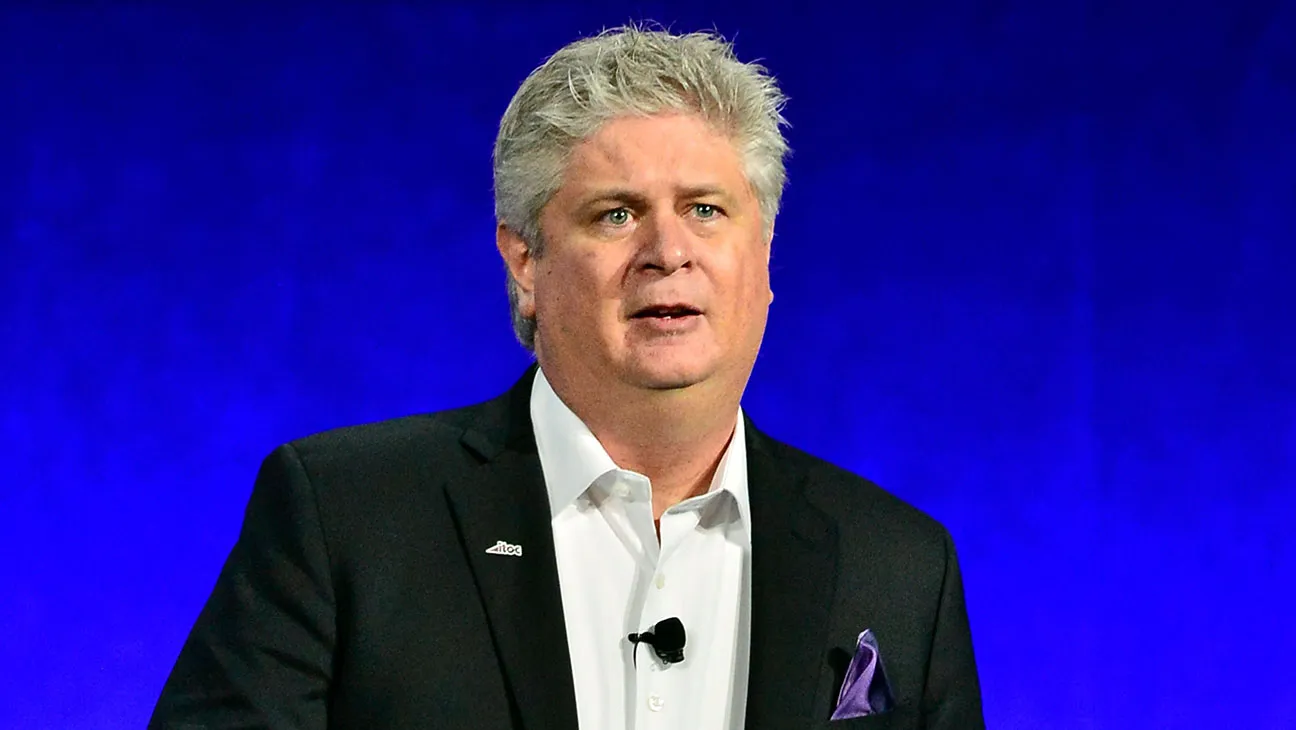
Cinema United chair Michael O’Leary was not afraid to take strong positions when delivering his annual state of the union address in Las Vegas, saying theater owners will continue to oppose David Ellison‘s bid for Paramount-Skydance to merge with Warner Bros. He also said is association will continue to press for longer theatrical windows.
“We believe this transaction will be harmful to exhibition, consumers and the entire entertainment eco-system,” O’Leary said. “Further concentrating marketplace power in the hands of a smaller group of distributors that dictate the terms, windows, scheduling, screen-placement of movies and access to historic film catalogs will have a real and lasting impact on Main Street and millions of movie fans around the world.”
He appeared on stage inside the Colosseum Theater at Caesars Palace hours before Warner Bros. was scheduled to showcase its upcoming slate of films to the thousands of exhibitors attending this year’s edition of CinemaCon. Cinema United, the world’s largest trade association of exhibitors, hosts the show. The new regime at Paramount Skydance will present Thursday morning.
Continuing, O’Leary said Cinema United will continue to press these issues at the national level, as well as assist his counterparts overseas. “Unfortunately, history shows us that consolidation results in fewer films being produced for movie theaters,” he added.
His remarks came one day after the release of a letter signed by more than 1,000 Hollywood bold-faced names expressing “unequivocal opposition” to Paramount‘s megadeal to acquire Warner Bros. Discovery.
The letter, which was released by a consortium of groups, including Norm Eisen’s Democracy Defenders Fund and Jane Fonda’s Committee for the First Amendment, counts a who’s who of signers, including talent with projects at CinemaCon this year, including J.J. Abrams and Denis Villeneuve.
O’Learly also said he will continue to press for longer theatrical window. Last year, he drew fire from studios when calling for a return to an exclusive window of at least 45 days.
“I took some heat for those comments, but I believe in them even more firmly today,” he said. “After six-plus years of theories and experiments devoted to proving that theatrical’s days have passed, there is a growing recognition of something we have always known — theatrical exhibition is the foundation upon which the entire entertainment industry rests, and that will never change.”
O’Leary pointed out that in 2025, the average theatrical window for the top 100 films was 37 days, representing a three-day increase over the previous year. He added that if those releases last year benefited from a minimum 45-day window, the overall average would have been a full two weeks longer at 49 days, emphasizing the critical nature of exclusive windows for theaters.
Continuing he said “Look no further than our friends at Disney. Last year, for the 12th time in the past 15 years, they led the industry in total box office. In 2025, they were the only studio to have a movie gross over $1 billion. Disney’s average theatrical window last year – 62 days.”
He also cited Sony movie chief Tom Rothman for recently writing in the New York Times that “too many people now think they can see any film at home, and it is killing the adult audience for movie theatres.”
O’Leary also said goes without saying that “we welcome and applaud” the recent announcement from NBCUniversal’s Donna Langley and her team, that as of Jan. 1, all Universal Pictures films will have a 45-day theatrical window.
“Taken together, these events reflect the fact that yes, windows do matter – theatrical exclusivity does matters. There is work to be done,” he said. “Broad adoption of a window of at least 45 days, and ideally more in the Disney 60 plus day range, will energize audiences, the industry and the box office.”
More to come.