Amazon Studios has to be at least a little thankful that J.R.R. Tolkien is no longer around.
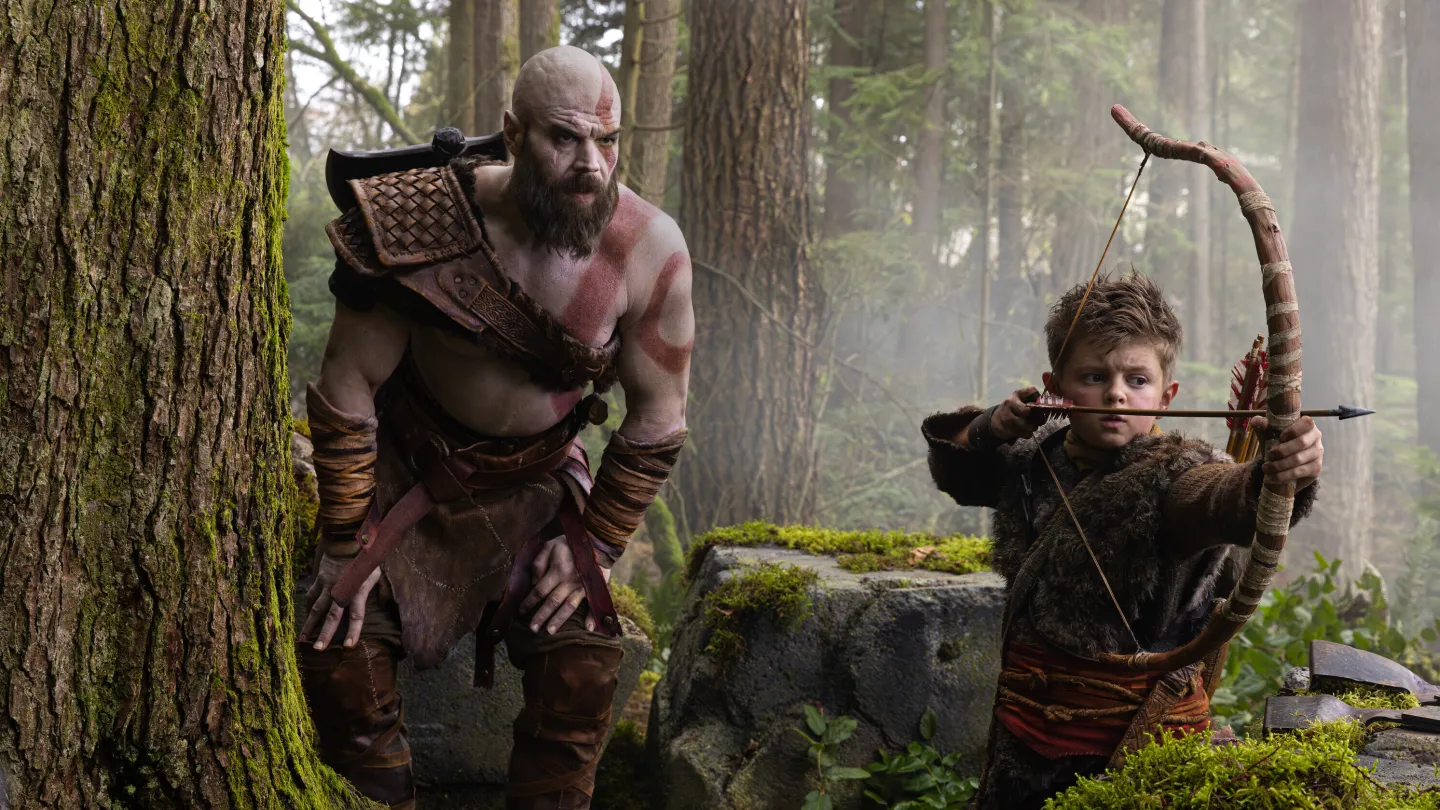
First, the studio came under fire by bestselling fantasy author Brandon Sanderson for its Wheel of Time adaptation (“I had my problems with the show,” Sanderson said last year. “I won’t miss being largely ignored; they wanted my name on it for legitimacy … it had a fanbase that deserved better”). Then last month, the creator of the God of War video game, David Jaffe, savaged a first-look photo (above) from Prime Video’s upcoming big-budget adaptation (“It is so bad in so many ways,” Jaffe said in a YouTube rant. “Neither of these characters look very interesting or appealing. If this was God of War: Dumb and Dumber edition, this is what you would expect”).
To be fair, Jaffe has been a critic of other God of War spinoff efforts since his involvement with the game ended nearly two decades ago, and he added that he trusts the Prime Video show’s producer Ronald D. Moore to deliver. But given all the fandom debate that surrounded Amazon’s first two seasons of its The Lord of the Rings prequel series, The Rings of Power, not having Tolkien rage-tweeting about the show’s Harfoots has to be a blessing.
Prime Video is not alone in having a fantasy creator target its adaptation. The Witcher author Andrzej Sapkowski has repeatedly thrown passive barbs at Netflix’s troubled series, saying things like the streamer “never listened to me” and “I cannot praise the show, it wouldn’t be decent” (The Witcher also famously lost its star Henry Cavill amid still-murky circumstances, with the actor having hinted that fidelity to the source material was a core issue for him).
George R.R. Martin — after years of dutifully holding his tongue over some things about Game of Thrones he wasn’t thrilled about — unleashed a dracarys on prequel House of the Dragon for its deviations from his book, Fire & Blood, amid a falling out with showrunner Ryan Condal. (“We got into season two, and [Condal] basically stopped listening to me,” Martin said. “I would give notes, and nothing would happen.” Yet Martin has sung the praises of new series A Knight of the Seven Kingdoms, saying the show is “as faithful as an adaptation as a reasonable man could hope for” and playfully quipped, “and you all know how incredibly reasonable I am on that particular subject”).
HBO recently had a slightly similar issue with an acclaimed Green Lantern comic-book writer Grant Morrison, who aligned with outraged fans taking issue with the showrunner of the upcoming Lanterns series joking “green is stupid.” Morrison wrote, “What is this jockish dismissal of superhero conventions intended to prove anyway?” The showrunner, Damon Lindelof (who surely had to be amused at being called a “jock”) drafted a sincere apology.
Another HBO fantasy project, The Last of Us, had a split when the game’s developer, Neil Druckmann, left as co-showrunner after season two. Druckmann hasn’t said anything negative about the show but noted after he left, “[The way] I can best contribute to it, is to make sure [season three] as deeply faithful as season one was. Because I feel like that is the gold standard for this kind of adaptation.” There’s that word again: Faithful.
Ironically, the biggest fantasy author in the world, J.K. Rowling — who is perhaps one of the most controversial names in media due to her trans views — has nothing but nice things to say about HBO’s upcoming adaptation of her Harry Potter books. “I’m so happy with it,” she has enthused. (Rowling is an executive producer on the project).
The common threads are authors being riled at adaptations that do not — in their view — closely honor the source material, or feel like their views are not being taken into account.
Authors having such a sentiment about their adapted works is, of course, nothing new, and is not necessarily an indication an adaptation has done anything wrong (Stephen King famously hated Stanley Kubrick’s adaptation of The Shining, which is nonetheless considered one of the best horror films of all time). But authors feeling empowered to speak out about their concerns while their show is currently being released — or even before it’s released, even if they’re attached to the project — does feel new.
Two factors have emboldened authors to push back, suggests Professor Amanda D. Lotz, a media and digital trends scholar at the Queensland University of Technology and author of After Mass Media: Storytelling for Microaudiences in the Twenty-First Century.
First there’s a reason which is perhaps obvious: Authors have a closer relationship with their fans — and a massive megaphone — thanks to social media. “Just the norms around how one performs being an author — especially with a strong fan base — that relationship has evolved a lot over the last two decades along with the way in which they can communicate and experience people reading their works,” she says.
But also, filmic storytelling itself has dramatically changed just in the last several years. The combination of audience fragmentation (where studios no longer need to draw the largest possible viewership on every show) and streaming services collectively serving up hundreds of long-form titles a year now allows these stories to be adapted with a level of specificity and loyalty to the source material that wasn’t realistic before.
“Audience fragmentation has made it possible to keep the interesting bits of novels rather than trying to smooth out the challenging bits for a broad audience,” Lotz says. “Netflix is trying to compel lots of different people with different tastes to continue to pay for it — that’s a very different mandate than trying to come up with a miniseries [adaptation of a novel] that you’re going to try and compel many people to watch at the same time in a way that will get lots of attention that you can sell to advertisers [like in the past].”
The rare exception in the non-streaming space was something like Peter Jackson’s big-screen The Lord of the Rings trilogy — which was nearly 10 hours long and considered a massive gamble at the time. Rings is considered perhaps the best example of delivering a hugely faithful fantasy adaptation that wasn’t afraid to make smart and significant changes that improved the story.
But streamers are trying to balance making wide-appeal content and pleasing a vocal hardcore fandom that can often have an almost religious view of “canon” — and now have authors potentially breaking ranks to join fans in their criticisms as well.
One benefit of the old way of doing things was that because adaptations had to change so drastically to fit a two-hour movie or broadcast TV miniseries format, there was greater acceptance that changes would be significant. No movie-length version of The Shining could have ever captured Jack Torrance’s very gradual slide into madness as well as King’s novel. But an eight-hour version on streaming perhaps could — and, if it did, there would be little excuse to leave out other fan-favorite bits from the novel too. Faithfulness would suddenly be possible and then, therefore, expected.
Says Lotz: “I don’t envy the studios trying to negotiate these things.”